




Understanding Plant Nutrition: Low Media-EC

 June 4, 2009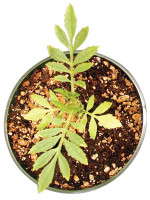
When growers talk about “lack of feed” or “hungry plants” (Figure 1), the issue is usually insufficient supply of fertilizer nutrients. The easiest way to measure fertilizer level in the root media is with an electrical conductivity, or “EC,” meter.
What is Media-EC?
What Causes Low Media-EC?
The initial concentration of nutrients in a container media is provided by the pre-plant nutrient charge, which may include lime (providing calcium and magnesium), and other fertilizers such as superphosphate, gypsum or urea-formaldehyde. Part of the initial nutrient source is immediately soluble and therefore affects the initial media-EC. Other nutrient sources are bound to the soil particles or are in a slow-release form (e.g. limestone, resin-coated fertilizers), and only affect EC as nutrients dissolve into the soil solution.
Most media components, such as peat, bark or perlite supply a small amount of nutrients, whereas compost can supply significant nutrients as it decomposes and releases nutrients.
Because of differences between batches of growing media, even from commercially blended products, it is important to not only know what your starting nutrient intensity is (as measured by EC), but also the composition and balance of the nutrients making up the EC (as measured with a complete soil test at a laboratory).
After planting, the goal is to balance deposits and withdrawals, in order to supply nutrients to the plant within an optimal level so they don’t get too high or too low. This is measured during the season by regular on-site EC testing.
You can picture the nutrients available for plant uptake in a pot using the analogy of a bank account (Figure 2).
We can increase the account balance by making deposits through salts contained in the irrigation water, with water-soluble fertilizer, or by surface-applying nutrients. Certain nutrients (carbon, nitrogen, oxygen and hydrogen) can be fixed from the air and water, but they do not contribute to soil EC unless they are dissolved ions in the soil solution.
The account balance is decreased by several types of withdrawal. These include nutrients taken up by roots for plant growth. The faster the crop is growing, the more nutrients are withdrawn from the crop and the more fertilizer needs to be deposited. Plants often require greater amounts of nutrients as growth rate increases during the middle of the crop, and less nutrients both when plants are very small or are mature and flowering. Some growers may increase the fertilizer concentration during this rapid growth phase, but keep the fertilizer concentration lower during the early and later stages of the crop.
Leaching is a very important type of withdrawal, because nutrients leaving the container can enter the environment and it is the one type of withdrawal that is completely controlled by the grower.
Many growers routinely leach, but this is not needed if irrigation water contains few impurities such as sodium and chloride. Leaching washes nutrients from the pot, and leaching with clear water is therefore one way to reduce EC when the nutrient concentration is too high. However, the more a crop is leached on a routine basis, the higher the applied fertilizer concentration that is needed to maintain adequate nutrient levels in the root media. In other words, lower fertilizer concentration with low leaching can have the same effect on the EC account balance, with less cost, compared to a high leach/high concentration approach.
An excessively low EC means the nutrient balance can become “bankrupt” (i.e. there is inadequate nutrient level for healthy growth and plant stress occurs). You then need to deposit additional fertilizer. Figure 3 shows a low EC may occur if the starting balance is low, or if the withdrawals are occurring more rapidly than deposits.
Summary



1
1
5
Understanding Plant Nutrition: Low Media-EC
Subscribe to eNewsletter