


Follow us: RSS Feeds Twitter Facebook
Search

Insect & Disease ID And Diagnosis Guide: Stem Lesions

Diagnose pest and disease issues that manifest as stem lesions.

January 21, 2009

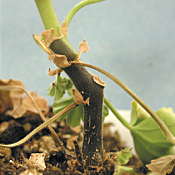
  •  A blackened stem base ("black leg") on plants such as geranium is often caused by Pythium.  © 2009
    A blackened stem base ("black leg") on plants such as geranium is often caused by Pythium.
  •  Black or brown discoloration at the base of poinsettia stems may indicate Phytophthora drechsleri infection.  © 2009
    Black or brown discoloration at the base of poinsettia stems may indicate Phytophthora drechsleri infection.

  •  New Guinea impatiens show thin black streaks extending up from the root crown when they are infected by Pythium irregulare.  © 2009
    New Guinea impatiens show thin black streaks extending up from the root crown when they are infected by Pythium irregulare.
  •  New Guinea impatiens sometimes show extensive black bands or rings in the stem when infected by INSV or TSWV.  © 2009
    New Guinea impatiens sometimes show extensive black bands or rings in the stem when infected by INSV or TSWV.
  •  Impatiens may also show black stem sections when infected with INSV or TSWV.  © 2009
    Impatiens may also show black stem sections when infected with INSV or TSWV.
  •  Stem lesions, in conjunction with white spots on petioles and leaves, are strong indicators for a diagnosis of poinsettia scab.  © 2009
    Stem lesions, in conjunction with white spots on petioles and leaves, are strong indicators for a diagnosis of poinsettia scab.
  •  Stem lesions such as these on poinsettia are characteristic of Rhizoctonia stem canker.  © 2009
    Stem lesions such as these on poinsettia are characteristic of Rhizoctonia stem canker.
  •  A brown canker at the stem base is the first symptom of Rhizopus stem rot on vinca.  © 2009
    A brown canker at the stem base is the first symptom of Rhizopus stem rot on vinca.
  •  Poinsettias may develop black lines along the stem in response to root uptake of dilute chlorine bleach.  © 2009
    Poinsettias may develop black lines along the stem in response to root uptake of dilute chlorine bleach.

Seeing stem lesions on your crops? Take a look at these pictures to see common diseases that can lead to stem lesions.

Scouting tip: Ship several plants with attached root systems by overnight or two-day service to the diagnostic lab, and avoid shipping at the week's end. Package plants carefully, enclosing pots or root balls in plastic bags separately from foliage.

A blackened stem base ("black leg") on plants such as geranium is often caused by Pythium.

Black or brown discoloration at the base of poinsettia stems may indicate Phytophthora drechsleri infection.


New Guinea impatiens show thin black streaks extending up from the root crown when they are infected by Pythium irregulare.

New Guinea impatiens sometimes show extensive black bands or rings in the stem when infected by INSV or TSWV.

Impatiens may also show black stem sections when infected with INSV or TSWV.

Stem lesions, in conjunction with white spots on petioles and leaves, are strong indicators for a diagnosis of poinsettia scab.

A brown canker at the stem base is the first symptom of Rhizopus stem rot on vinca.

Poinsettias may develop black lines along the stem in response to root uptake of dilute chlorine bleach.

Leave a comment: (All fields are required)
Name:  E-Mail: 
Type only the numbers from the code into the textbox:
[ CAPTCHA ERROR ] (DO NOT enter the brackets [ ] )
Comments (0)