




Understanding Plant Nutrition: Managing Multiple Species

 January 23, 2010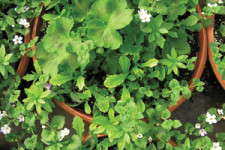
Often, these species have different acceptable pH ranges and iron requirements (Table 1), which can lead to growing difficulties that affect plant quality. In this final article, we give tips on managing multiple crops in the same greenhouse.
Management Tips
Organize greenhouse zones so plants are grouped by similar nutritional requirements. One of the most useful groupings is based on the plant’s ability to absorb iron from the soil solution (Table 1). For example, grouping all iron-inefficient species together and away from all iron-efficient species will simplify your nutrition program because all the plants in a specific group should be able to be treated the same.
Other factors to consider when grouping plants include acceptable EC levels and fertilizer requirements, light requirements (both intensity and day length) and moisture requirements.
If you want to use one fertilizer solution to grow all crops, it can be easier to manage the different iron groups by using several root media with different starting pH levels. For example, having a media with a pH of about 5.5 for the iron-inefficient crops (petunias) and general crops, and a second media with a higher pH of about 6.2 for the iron-efficient crops (geraniums). This method works best for obtaining different pH ranges during the first few weeks of the crop, when the plants are small.
The easiest way to make a high-pH (geranium) media is to add additional limestone to the media prior to planting. This additional limestone can be added right on the mixing line, or blended into the prepared media prior to planting. The exact amount of limestone needed to raise the pH of a particular media above 6.0 will depend on the components used to produce the media. Often, trial and error is the best method for determining lime rates.
An alternative way of making a high pH media after planting is to drench the pots with flowable limestone. Use a rate of 2 quarts of flowable limestone per 100 gallons and thoroughly drench the pots with the solution. You may need to reapply the flowable limestone if the media pH is less than 6.0.
Using One Root Media
If you want to use one root media to grow all crops, it can be easier to manage the different iron groups using several fertilizer solutions. For example, you can use a basic reaction (high nitrate-N) fertilizer to keep the media pH up for the iron-efficient crops, and an acidic reaction (high ammoniacal-N) fertilizer to lower the media pH for the iron-inefficient crops. This method for raising or lowering media pH works best once the plants are thoroughly rooted and actively growing (about three to four weeks after planting).
If your irrigation water has high concentrations of alkalinity (greater than 200 ppm), you can change the pH reaction of a single fertilizer by adjusting the acidification. For example, use acidified water for the iron-inefficient (petunia) group but turn the acid off when watering the iron-efficient (geranium) group.
Managing medium-EC and medium-pH go hand in hand. Not only will high medium-EC suppress medium-pH, but a high media EC is also an indication high concentrations of fertilizer salts (including micronutrients) are present, increasing the risk of micronutrient toxicity, particularly in the iron-efficient group at low media pH.
In contrast, a low media EC indicates the concentration of nutrients (including micronutrients) is low, increasing the risk of micronutrient deficiency, particularly in the iron-inefficient crops.
Basing fertilizer decisions on regular soil tests of medium-pH, medium-EC, and the EC of the fertilizer solution will often prevent many nutritional problems by alerting growers to problem trends before plants are stressed. A soil test pH is also an easy way to confirm a suspected medium-pH problem. Monitoring other factors (i.e. root diseases, greenhouse temperatures, pest problems, high or low medium-EC) help rule out these problems, because many factors other than medium-pH cause chlorosis.
To interpret results from a test of medium-pH:
– Low pH problem: Medium-pH is below 6.0 for an iron-efficient crop, or below 5.4 for most other species.
– High pH problem: Medium-pH is above 6.2 for the iron-inefficient group, or above 6.6 for most other species.
Specific Tips For Combos
Before planting combination pots or baskets, consider the species you are placing in the same pot. It may not be the best idea to mix certain species together. For example, a combination of red seed geraniums (very susceptible to iron toxicity) and white petunias (very susceptible to iron deficiency) is a bad idea (Figure 1).
Ask yourself: “Must I have a geranium and petunia, or do I really need a red upright plant and a white trailing plant?”
From a pH management standpoint, it is best to make combinations from plants in the iron-inefficient group and general group (acceptable pH range of 5.8 to 6.2), or the iron-efficient group and general group (acceptable pH range of 6.0 to 6.4), because the acceptable pH range for these type of combinations are relatively wide, making them easier to manage.
Growing combination baskets or pots that contain both iron-inefficient and iron-efficient plants can prove difficult to manage because the acceptable pH range necessary to prevent both high-pH induced iron deficiency and low-pH induced iron toxicity is small (6.0 to 6.2).
If you are growing iron-efficient and iron-inefficient species in the same pot and cannot maintain the medium pH within the acceptable range, it is better to have the medium pH too high rather than too low. If the medium pH is too low, you will induce iron/manganese toxicity in the iron-efficient crop, which will damage the leaf tissue beyond repair, affecting quality.
In comparison, if the media pH is too high, you will induce iron deficiency on the iron-inefficient species. The early stages of iron deficiency does not damage the leaf tissue, so the deficiency can be corrected by applying additional iron in a form that is available to these plants at high pH. When supplementing iron under these conditions, add no more than 1-2 ppm iron in addition to what is in the fertilizer solution.
If you must have specific combinations that do not grow well together, consider ways to reduce the cropping time, or at least the time plants must spend together in the same pot. Options include growing plants separately (for example, in 4-inch pots or 10-count liner trays), and combine in the final container two to four weeks before sale (Figure 2).

1
1
5
Understanding Plant Nutrition: Managing Multiple Species
Subscribe to eNewsletter