



How to Harness Digital Twins in Greenhouse Growing
 August 9, 2025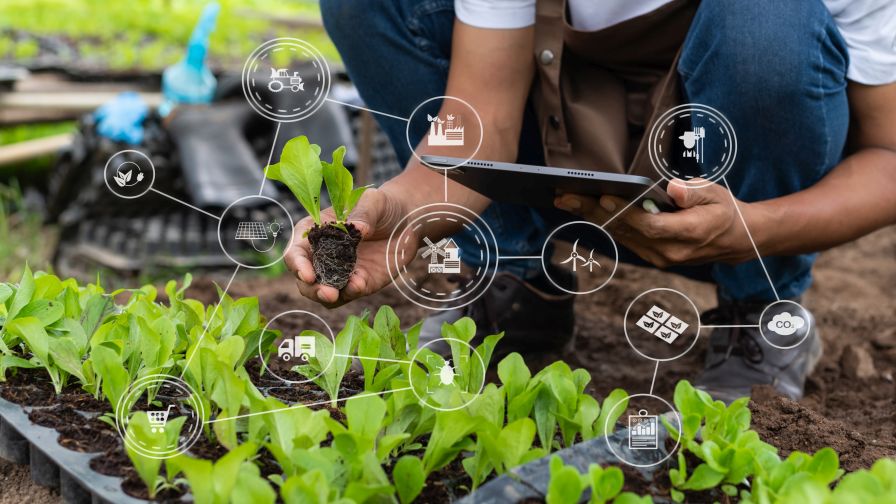
A woman hand gardening crop plugs with digital visualization icons. | Nuttapong Punna via Adobe Stock
The concept of a digital twin — a virtual representation that mirrors the state, behavior, and evolution of a physical object — did not emerge from farming. Its roots lie in product management and project planning. In the early 2000s, product lifecycle management needed a central repository of product information accessible throughout the lifecycle. The idea soon merged with the Internet of Things (IoT), where every physical item could have a digital counterpart that holds history, sensor context, and provenance. Modern definitions describe a digital twin as “a virtual representation of real-world entities and processes, synchronized at a specified frequency and fidelity, representing the past, present, and simulated predicted futures.” Digital twins use simulation, integration, and monitoring to allow decision makers to test scenarios and optimize operations.
This concept has direct relevance to agriculture and greenhouse operations. Precision agriculture, which uses sensors and data to deliver exactly the right inputs, is being reshaped by digital twin technologies. A virtual replica of a crop can model irrigation, fertilization, and pest management to support sustainability and resource efficiency. Digital twins are thus part of a broader trend toward Agriculture 4.0, blending IoT, artificial intelligence, and big data analytics.
Keep reading for a closer look at how digital twins benefit greenhouse growers and how understanding this technology can enrich project management education.
Why Greenhouse Growers Need Digital Twins
Simulation and Decision Support
Greenhouse horticulture deals with live plants sensitive to temperature, humidity, and nutrient regimes. Controlling these variables becomes challenging as greenhouses scale up and labor shortages reduce the availability of experienced growers. Digital twins address this by simulating the greenhouse environment. They allow growers to test the impacts of temperature or light changes and to simulate corrective treatments using real data. A digital twin can analyze past states and predict future plant growth, enabling rapid responses to deviations.
For example, researchers at Wageningen University & Research (WUR) link greenhouse sensor data to three-dimensional functional structural plant models to create a digital twin. This twin instantly analyses how changes in climate control or cultivation strategies affect the crop. Growers can see forecasts for light distribution, water balance, and temperature, and can adjust the greenhouse environment accordingly.
Remote Monitoring and Autonomous Cultivation
One of the strengths of digital twins is that they remove location and time restrictions. Instead of walking through the greenhouse, growers can monitor conditions remotely and receive alerts when issues arise. They can then test interventions virtually and implement solutions without being on-site. WUR researchers note that visualizing and integrating sensor data allows growers to respond quickly to changes, improving crop health and supporting the next step toward autonomous cultivation. Digital twins are therefore part of a movement that includes robotics and advanced Integrated Pest Management (IPM), reducing reliance on manual labor.
Optimizing Energy and Resource Efficiency
Greenhouses consume significant energy for heating, lighting, and climate control. A 2021 Energy Informatics project in Denmark created a Greenhouse Industry 4.0 digital twin that integrates IoT, artificial intelligence, and cloud computing. By co-optimizing production schedules, energy consumption, and labor costs, the platform predicts how the physical greenhouse will perform under different conditions. It even links to demand response signals from the electricity grid, enabling growers to adjust energy use when prices are favorable. Such models help reduce energy costs without sacrificing yield or quality.
Lessons for Sustainable Agriculture
Digital twins also encourage sustainability. The general agricultural literature notes that a virtual replica allows farmers to examine water use, fertilization strategies, and pest management options, leading to direct savings in water, fertilizer, and pesticide. Another MDPI study emphasizes that digital twins decrease manufacturing time and costs, hide complexity, improve safety, and support environmentally sustainable operations. When applied to greenhouse farming, digital twin technologies significantly increase productivity and sustainability.
Developing a Digital Twin for a Greenhouse: Core Elements
Constructing a digital twin involves combining data from sensors with simulation models. It requires several core components:
- Sensor network and IoT platform – Real-time data from environmental sensors (temperature, humidity, CO₂, light, etc.), energy meters, and imaging systems feed into an IoT platform. A reliable network is critical; delays greater than 1 second may undermine real-time interaction.
- Data processing and artificial intelligence – Sensor data are pre-processed, cleaned, and analyzed. Machine learning algorithms calibrate the digital twin with real data and develop predictive models. In WUR’s 3D plant model, data on light distribution and water consumption calibrate simulation outputs.
- Simulation models – The digital twin uses multi-physics models of plant growth and greenhouse climate. The MDPI case on plant factory transplanting uses a hybrid approach that combines data-driven and physics-based models to monitor machinery and predict optimal operating parameters. Similarly, greenhouse digital twins simulate plant growth to forecast yields and evaluate interventions.
- User interface and decision support – Growers interact with the twin through dashboards that visualize key metrics and propose interventions. The WUR project is testing a dashboard for tomato growers that displays water use, light distribution, and forecasts.
- Feedback loop – The system continuously feeds updates from the physical greenhouse to the digital twin and vice versa, creating an autonomous management cycle.
Digital Twins and Project Management: Why Project Managers Should Care
Origins in Product and Project Management
Because digital twins were conceived in product and project management, their potential for modern project managers is immense. A project manager’s role involves planning, organizing, and controlling resources to achieve defined goals within constraints of time, cost, and quality. Digital twins support exactly these tasks:
- Centralized project data – Digital twins act as a single source of truth, consolidating sensor data, schedules, budgets, and performance metrics. Project managers can track progress in real time and forecast outcomes based on multiple scenarios.
- Risk management through simulation – By simulating interventions in the virtual twin, managers can evaluate risks and impacts before acting. This is particularly valuable when decisions affect yield and energy consumption.
- Stakeholder communication – Visual models enhance communication among growers, engineers, financiers, and regulators. Stakeholders can see the consequences of different strategies rather than relying on abstract reports.
- Lifecycle management – Like product lifecycle management, digital twins maintain historical information that is valuable for maintenance planning, equipment replacement, and training new staff. Project managers can integrate equipment lifecycles with crop cycles and financial planning.
Application to Project Management Curriculum
For project management education, digital twins offer a compelling example of how data, technology, and collaboration can improve outcomes. The following strategies can integrate digital twin thinking into a curriculum:
- Case-based learning – Students can study cases such as WUR’s digital tomato greenhouse or the Danish Greenhouse Industry 4.0 project. They analyze how digital twins optimize resources and how managers make decisions.
- Simulation exercises – Using simplified digital twin software or spreadsheets, students can simulate greenhouse operations, adjusting variables like temperature or energy price and observing the outcomes. This fosters an understanding of system dynamics and trade-offs.
- Cross-disciplinary collaboration – Digital twin projects require collaboration between agronomists, IT specialists, data scientists, and managers. Project management students can work with peers from computer science or agriculture to design a virtual greenhouse, emphasizing communication and integration.
- Ethics and sustainability discussion – The technology raises questions about data privacy, labor displacement, and energy use. Educators can encourage reflection on the ethical implications of autonomous systems and the role of project managers in ensuring responsible innovation.
Considerations and Challenges
While digital twins offer significant advantages, they are not a cure-all. The MDPI review notes that developing digital twins requires significant expertise and investment, and there is limited expertise in creating and using digital twin systems for greenhouse horticulture. Connectivity in rural areas can be inadequate, and a lack of computer literacy can hinder adoption. Real-time data processing is challenging because transferring data to cloud servers can introduce delays. Moreover, building accurate simulation models requires high-quality data and domain knowledge.
Project managers must also consider change management. Introducing digital twins may alter workflows, require training, and raise concerns among staff about job security. Aligning technology adoption with organizational goals and ensuring that stakeholders understand the benefits is crucial. The energy informatics case emphasizes that digital twin integration must not compromise product quality or sustainability. Project managers need to ensure that models are validated and that decision rules account for complexities beyond what the simulation captures.
Moving Forward with Digital Twin Technology
Digital twins represent a convergence of IoT, simulation, and data analytics that can transform greenhouse horticulture. They allow growers to model and monitor their operations, test interventions, optimize energy use, and move toward autonomous cultivation. Research demonstrates that digital twins support rapid decision making, provide deeper insights into plant growth, co-optimize production and energy consumption, and promote sustainability through resource savings. These capabilities are not just technical innovations but also management tools that align closely with project management principles. By incorporating digital twin case studies and simulations into project management curricula, educators can equip future managers to harness data-driven decision support systems in complex projects. As greenhouses continue to adopt Industry 4.0 technologies, understanding digital twins will be essential for both growers and project managers who seek to deliver efficient, sustainable, and resilient agricultural systems.
Subscribe to eNewsletter