



Advice From Other Growers on Coming Back From a Natural Disaster
 October 3, 2025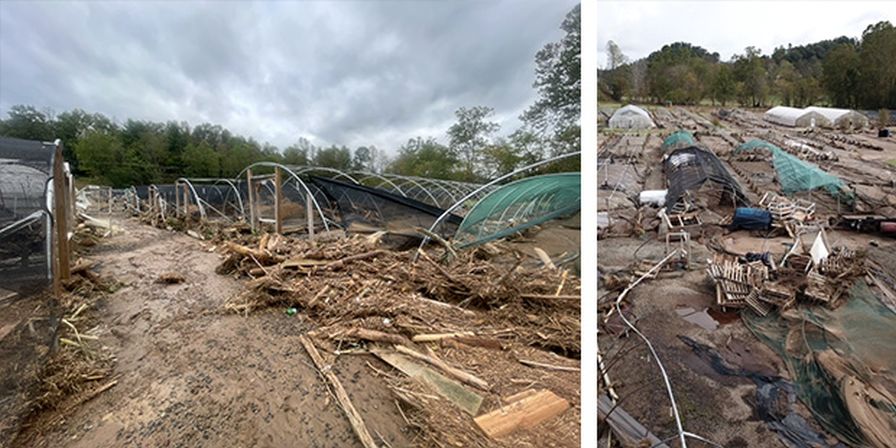
Photo: Carolina Native Nursery Staff
The damage to a greenhouse from a severe storm, tornado, or hurricane can come quickly and without warning. The recovery process, however, is something that can take months if not years to complete. Take, for example, what has happened at Carolina Native Nursery over the last year.
Hurricane Helene dropped 30 inches of rain over western North Carolina in just three days in September 2024. Water tore through the operation, washing away 90% of Carolina Native’s plant inventory, destroying greenhouses, and leaving behind a tangled mess of debris.
Despite running through their hurricane checklist, which includes securing the property and ensuring there aren’t logs in the trout stream or feeder creek, nothing could have prepared the property for what was to come.
“The plants were gone, a lot of the gravel was gone, many of our greenhouses were either damaged or destroyed, and so it left us with just piles of stuff,” says Carolina Native owner Bill Jones. “You can’t stop water like that. There’s just no physical way to do it.”


Not only was their shrub yard and perennial farm destroyed, but the road above the nursery suffered a landslide, damaging the top of the property, and the bottom of the property had been washed away.
Before the rebuild, filing an insurance claim was imperative. “Luckily, we have crop insurance,” Jones says. “Without the crop insurance we had, we never would have been able to afford to bring in all the stock to replant.”
Some plants survived — a few thousand up the hill were out of the flood’s reach. But others had gotten an inch or two of water in the base of the pot.
Even though those plants were salvageable, the Department of Agriculture deems them unsellable once they’ve sat in flood water. For those plants, Jones and his team set up a donation program.
“We ended up donating well over 6,000 plants to nonprofits and volunteer groups trying to replant people’s stream banks and gardens,” Jones says. “That ended up being a beautiful thing.”
A Three-Year Recovery
Jones estimates the nursery suffered about $2 million in damages. Crop insurance — a federally supported program he urges all growers to look into — covered roughly half of that value.
The nursery lost fourth-quarter sales last year and much of the spring season this year. But sales have now rebounded. Staffing has returned. Facilities are nearly rebuilt.
“With our perennials and our shrubs, we’ve recovered tremendously in sales,” Jones said. “With the azaleas, it’s going to be a while. But sales-wise, we’re in really good shape.”
Among the hardest losses to absorb were Carolina Native’s native azaleas — a specialty crop that Jones’ team grows from seed.
“We harvest the seed late in the fall, right after Thanksgiving,” Jones says. “Then we grow the seedlings into liner trays the first year, into 1-gallons the second year, and 3-gallons the third.”
The nursery had tens of thousands of native azaleas on the ground across all stages — and lost nearly all of them.
“All the 1-gallons and 3-gallons were gone. A lot of our liner stock was gone,” Jones said.
Meanwhile, the nursery’s perennials, ferns, grasses, and other native shrubs — sourced from outside growers — have bounced back quickly.
Despite the upheaval, the nursery’s mission hasn’t changed.
“In western North Carolina, the only flat land is near streams and rivers, and that’s where we are. We’re not moving,” he says. “Whether [our clients] are wholesale or retail, garden centers or landscapers, they’ve come roaring back. They were just waiting for us. They didn’t turn and start buying from other nurseries.”
Advice to Other Growers
Having gone through Hurricane Helene, what advice does Bill have for other growers, particularly those in vulnerable regions?
“If you haven’t examined crop insurance and put that as an expense line, it will save your business,” Jones said. “It’s a federal program that is available to everyone who grows a crop.”
“And secondly, if you are met with disaster and people want to volunteer to help, let them. You can do it all yourself. But why? It makes you feel good. It makes them feel good.”
Today, Carolina Native is almost totally renovated. There are just a couple of greenhouses at the corner of the nursery to rebuild that Jones likens to “having one room left to paint before being done with the house.”
But ultimately, he’s incredibly proud to have gotten back to mostly normal operations after such a devastating blow from Hurricane Helene.
“We’re just so happy to be selling plants again,” Jones says. “And that’s what everybody’s working on, either growing or selling. We’re just so grateful to everybody that’s helped us.“
(Note: Content for this story from Carolina Native Nursery first ran on OHP.com).
Other Resources
- In an episode of the Greenhouse Grower to Grower podcast in September 2024, Lauren Kirchner of Spring Creek Growers talked about, among other things, how the company recovered from a tornado that swept through Waller, TX. You can find that episode here.
- Future-Proofing Lessons from Greenhouses That Recovered After Natural Disasters: After recovering from a fire in 2022, Timbuk Farms shows how greenhouses can protect their business by preparing for future disasters.
- How to Better Prepare for Weather Disaster through Local Partnerships: Increased climate uncertainty and extreme weather events make preparation a necessity to protect your greenhouse operation.
- 8 Steps to Prepare Your Greenhouse for Storms and Natural Disasters: With the increasing frequency of extreme annual weather events, here are eight steps to take to protect your greenhouse.
- Hurricane Preparedness Guide: https://www.saveonenergy.com/resources/hurricane-preparedness-guide/
Subscribe to eNewsletter