



How Dutch Heritage Gardens Is Investing in Its Future
 January 16, 2026
Aaron and Rozalia Van Wingerden have led Dutch Heritage Gardens’ recent expansion into young plant production and premium foliage. | Dutch Heritage Gardens
When Dutch Heritage Gardens began operations in Colorado in 2006, owners Aaron and Rozalia Van Wingerden focused on serving the emerging “do-it-for-me” generation of gardeners who wanted finished plants and immediate impact rather than growing from seed. Combo container programs helped meet that demand and establish the operation’s early success.
Nearly 20 years later, Dutch Heritage is once again setting itself up for the future. This time, the focus is on capturing untapped market opportunities through the launch of two new divisions. One centers on young plant production, and the other on digital sales targeting a high-value foliage category.
“We want to show our customers that we can give them a product that we’re proud of, and that they will be satisfied with the quality,” says Van Wingerden.
Dutch Heritage Gardens’ venture into becoming a young plant supplier (branded as Heritage Young Plants), took shape after nearby Welby Gardens announced it would shut down at the end of 2024.


“When the news came out, some of our long-time business partners thought we would be a perfect fit to fill in that market gap,” Van Wingerden says. “We had just lost one of our major buyers, and when one door closes, another opens.”
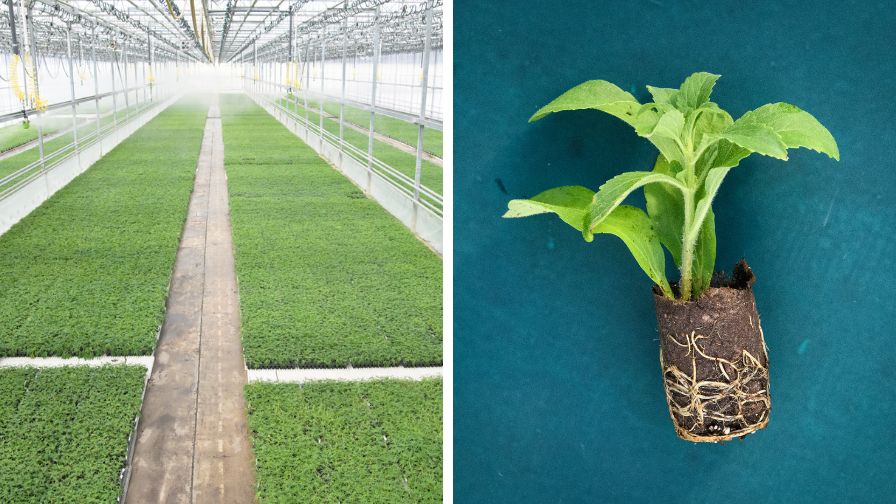
Dutch Heritage’s venture into young plant production is helping fill an important market need. | Dutch Heritage Gardens
What made the decision easier was that Dutch Heritage already had relevant infrastructure in place from its hemp liner program. Up until late 2020, Dutch Heritage had been one of the nation’s largest suppliers of hemp liners.
“That business dried up overnight in 2020 with the challenges the hemp market was facing, so we had a lot of the infrastructure for liner production already in place, including ISO robots, curtain systems, and fogging systems,” Van Wingerden says. “Hemp is much harder to propagate than annuals or perennials, so it was an easy transition for our team.”
There were some challenges during the transition. For one thing, the growing team had to shift from year-round finished production to producing millions of hemp liners for sale in just a nine-week window.
“Our team definitely had to adjust to the logistics, which also included finding trucking companies willing to work with us, and changing our insurance,” Van Wingerden says. “We also learned how to meet the demands of B-to-B customers compared to B-to-C customers. As you know, growers can be hypercritical of product quality, us included, and will find any little thing wrong with the plant.”
That is why having the right technology already in place was critical. Van Wingerden says the lessons Dutch Heritage learned when adding ISO sticking robots and other systems helped smooth the transition to young plants.
“We didn’t have those kinds of challenges because we had already dealt with them,” he says.
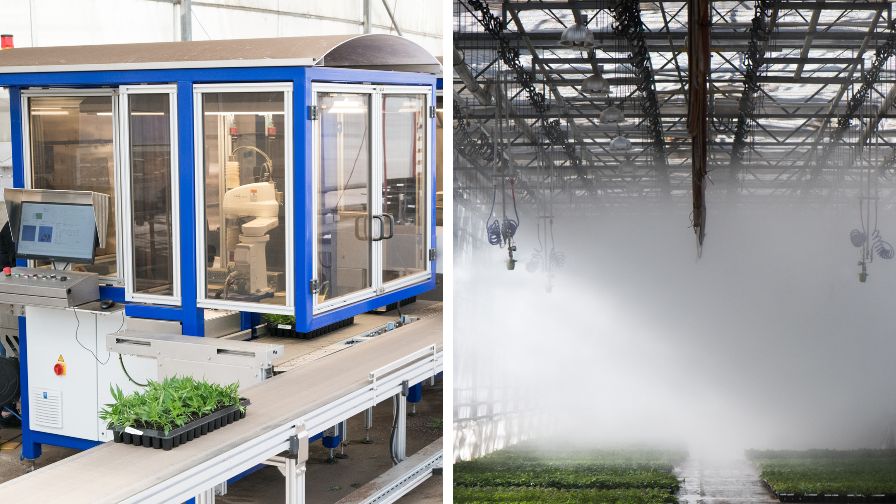
Existing infrastructure, including ISO sticking robots and fogging systems, has helped Dutch Heritage scale both young plants and premium foliage. | Dutch Heritage Gardens
Van Wingerden also credits the support of partners such as McHutchison, which helped build confidence in the move.
“Welby was producing about 5 million liners every year when they closed, and we’re starting a bit slower so we can work out any kinks,” Van Wingerden says. “We want to show our customers we can give them a product we’re proud of.”
Lush + Rare = A Lucrative Opportunity
Dutch Heritage Gardens’ other new venture is not entirely new. It is an effort to lean into existing strengths and turn them into a higher-value channel.
“We’ve been a foliage provider since the early 2010s, and while we may have been ahead of the game compared to the COVID-19 and post-pandemic time frame, we kept waiting for the market to take off with mixed results,” Van Wingerden says.
After a deal with one of their buyers stagnated, Aaron and Rozalia began evaluating other options. Dutch Heritage had also positioned itself to become a West Coast supplier of Proven Winners’ leafjoy products through Van Wingerden’s relationship with his cousin Jason, owner of The Plant Company in Virginia.
“We were growing a mix of some of the standard foliage offerings, such as pothos and sansevieria, along with what might be considered more high-end plants,” Van Wingerden says. “We started selling those in smaller mom-and-pop shops where customers said they were having trouble finding something unique.”
That feedback helped spark a new idea. Rozalia Van Wingerden saw an opportunity to expand into online sales of hard-to-find plants. “I love foliage plants, but the ones I had been buying online would often show up small and sickly,” she says. “We quickly realized we could do better by selling these plants ourselves.”
With the launch of Heritage Young Plants, existing infrastructure made the shift easier.
“Fogging and misting technology we had incorporated into our hemp production helps us maintain high humidity but distributes water as nanoparticles so the plants don’t get too wet,” Aaron Van Wingerden says. “You need a pristine environment to grow many of these rare plants. The shift from hemp to high-end foliage was easier because we found we could successfully propagate plants without investing in new systems.”
Rozalia Van Wingerden says that production advantage supports a higher-quality direct-to-consumer program called Lush and Rare. “When someone spends that much money on a plant, they want to be able to immediately show it off,” she says. “It’s a work of art, like a Picasso.”
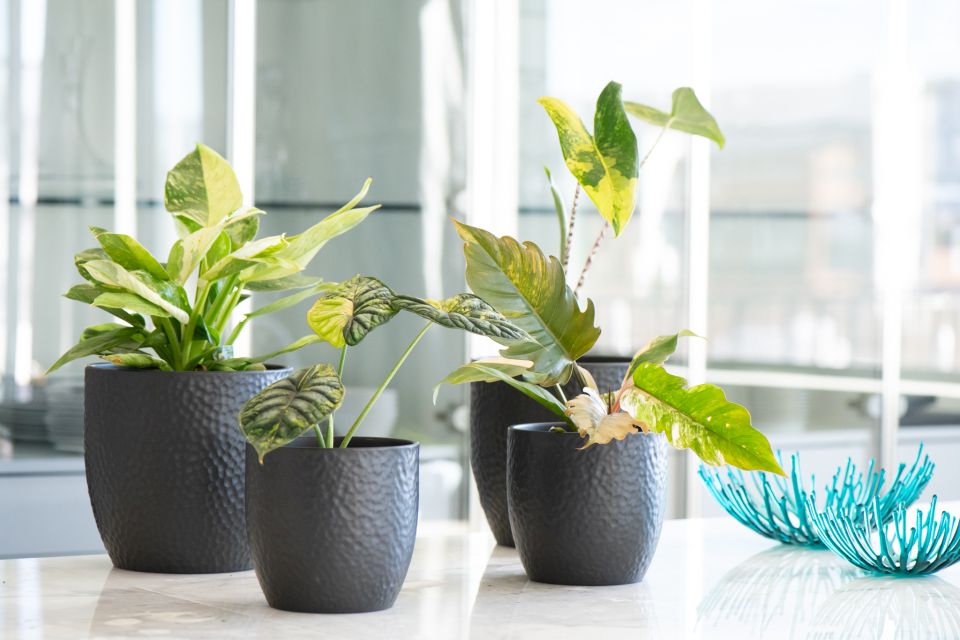
Dutch Heritage Gardens’ Lush and Rare program ships premium foliage to consumers seeking hard-to-find plants. | Dutch Heritage Gardens
Since Dutch Heritage began selling Lush and Rare offerings online, the company has expanded its social media and digital presence.
“We first tested e-commerce sales with some of our current customers, and they were excited to receive a plant that was healthy, vibrant, and mature,” Rozalia Van Wingerden says. “We decided we were ready to grow on a bigger scale, and provide a quality, locally grown plant that was hard to find in Colorado.”
Lessons Breed Future Success
Even with several advantages in place, Dutch Heritage Gardens says launching two new programs came with a learning curve. Key lessons included:
Dialing in Packaging for Shipping
“We had to play around with a bunch of different packaging materials to ship our rare plants,” Aaron Van Wingerden says. “We tested them by shipping plants to ourselves to see what held up during transport, and that helped us settle on what worked best.”
Staying Ahead of Plant Health Risks
“Tropical plants can be susceptible to a wide range of diseases, such as Fusarium, Phytophthora, and Pythium,” Aaron Van Wingerden says. “Make sure you have the protocols in place for a strong IPM program, because one problem can wipe out much of your inventory.”
Training Teams on Proper Handling
“This was important for both our young plants and our rare foliage plants,” Aaron Van Wingerden says. “We need our young plant customers to trust they’re receiving a quality product from us. For the tropicals, we had to remind our team to treat them with kid gloves.”
To strengthen the foliage program, the Van Wingerdens brought in an outside head grower with tropical experience. “Petunia or mum growers have an ingrained mindset on how to grow plants, which is great,” Aaron Van Wingerden says. “But some of the team members we moved into foliage did not have great success, which made us realize we needed someone with experience.”
Looking ahead, Aaron Van Wingerden says the focus will be on continuing to fine-tune both programs. “Change requires the ability to pivot, and we saw the need to change so we could cater to new markets,” he says. “We want our quality to define us, and we have a great team in place to help us succeed and great suppliers who have helped us along the way.”
Excited for the Future
Even with ongoing challenges, Aaron and Rozalia Van Wingerden say they are optimistic about what is ahead for floriculture. Here’s what they each had to say.
Aaron Van Wingerden: “I became reinvigorated with the floriculture industry post-COVID. It’s not fully recession-proof, but even in hard times, people still want to make their garden look pretty, or they want to put that potted plant on their mantel. Flowers make people happy, including me, and that’s why I got into the business. Seeing the enthusiasm of our customers when they come to purchase plants for their garden or their home bolsters me for the next season. This industry is not for the weak of heart, but it’s a very rewarding industry that I have loved my whole life.”
Rozalia Van Wingerden: “Even with the struggles we’ve had the past few years, I’m excited that we have customers who trust us and continue to come back to us. They’re excited about the products we offer, and I’m looking forward to new opportunities that might present themselves.”
Subscribe to eNewsletter