



Automonous Greenhouse Challenge for Lettuce Nearing Final Stages
 April 27, 2022
 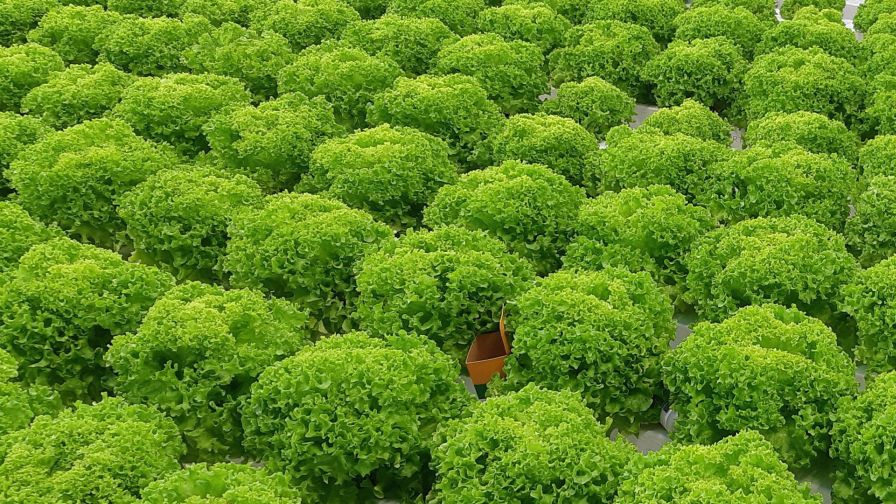 The five international teams participating in the final rounds of the third Autonomous Greenhouse Challenge have completed the first try-out experiment. The teams tested their algorithms and gained experience during a first crop cycle with lettuce. The teams now prepare for the final crop cycle to determine the winner.
The goal of the Autonomous Greenhouse Challenge is to grow lettuces in two crop cycles fully autonomously with an artificial intelligence (AI) algorithm on a cloud platform with good quality and little resource and energy use, and without any human interference, in the experimental greenhouses of Wageningen University & Research (WUR) in Bleiswijk, the Netherlands.
The first crop cycle of the third Autonomous Greenhouse Challenge started on February 2 with the planting of cultivar ‘Salanova’. Five teams (Team CVA, Team digitalcucumber, Team MondayLettuce, Team VeggieMight, Team Koala) participated in the first try-out experiment to test their algorithms and gain experience. The reference greenhouse was operated by WUR organizers. The goal was to maximize net profit of the lettuce cultivation.
Each team had a compartment at its disposal in the greenhouse with standard climate sensors and equipment. The teams’ algorithms had to determine the set points for temperature, amount of daylight and artificial light, heating, CO2 concentration, and cultivation-related parameters such as crop density. Vision technology provided the teams with online status information. The teams’ algorithms were mounted on a virtual machine on a protected WUR server. Data from the greenhouse is received via a digital interface from LetsGrow and Azure Cloud. At the same time, the algorithms autonomously send setpoints back to the process computer, which ultimately takes the action on climate control in the experimental greenhouse.
Teams followed different climate strategies, varying in temperature, assimilation additional LED light. and CO2 application. This resulted in different growth duration, use of resources, and lettuce head weights. Crop spacing strategies also varied, resulting in averages plant densities from 24 to 38 plants/m2. As a result, growth duration varied: dates of harvest ranged from March 10 to March 21, and average plant weight at harvest varied from 138 to 320 g.


Apart from the weight, the quality of the lettuce head is important to determine the price. Lettuce heads were classified in three categories: class A for lettuce heads heavier than 245 g, class B for lettuce heads between 220 and 245 g, and class C for lettuce heads lighter than 220 g and/or with poor quality such as tip burn of or botrytis. For some teams, tip burn and botrytis were very severe. The experiments showed that high radiation and temperature levels were associated with high levels of tip burn.
The reference crop was cultivated at a relatively low temperature (64°F) and low PAR levels, which resulted in very low levels of tip burn and no botrytis. However, it did not have the highest amount of class A lettuces and the growth duration was longer to reach the target lettuce weight (until March 15). But the reference was grown with a relatively low lighting intensity and a relatively low heating input, which resulted in the lowest electricity and consumption and costs.
The autonomous grown lettuces reached the desired lettuce weight with up to three times higher electricity costs, most of them also with higher heating costs. In the first try-out round teams did not yet succeed in realizing a positive net profit due to either lettuce quality issues or high amount of resource use.
All teams could gain experience with growing lettuce autonomously. Teams’ AI algorithms were able to determine setpoints and to control the lettuce cultivation. The realized controls, the crop, and climate measurements have generated valuable datasets and learning outcomes that the teams can use in the refinement of their algorithms. Data from all compartments will be used by WUR providing an updated computer simulation environment of greenhouse and crop to the teams in order to train and refine their algorithms during the next weeks.
The final crop cycle will start May 2. The team reaching the highest net profit during that crop cycle crowns itself as winner. The public can follow the competition and teams’ performance on a live dashboard.
A live International Autonomous Greenhouse Event takes place on July 1 at WUR, and most parts will also be broadcasted on YouTube. Click here for more information.
Subscribe to eNewsletter