



Ethephon Drenches Now Labeled and Approved with Collate
 October 7, 2025
 Ethephon is the Swiss Army knife of plant growth regulators (PGRs). It can inhibit stem elongation, promote branching and development, trigger flower senescence and abortion, and even ripen fruit. Traditionally, growers have applied ethephon as a foliar spray to manage crop height, enhance or replace mechanical pinching, or prevent premature flowering in ornamental plants during finishing. While sprays remain the most common application method, university researchers have shown for years how ethephon drenches can be highly effective for controlling plant height.
Until now, though, no ethephon product label included drenches as an approved method — Fine Americas recently changed that with an amended label for Collate.
Why Consider Drenching with Ethephon?
Although foliar sprays are the most common PGR application method, drenching offers unique advantages. They typically provide more uniform height control because each container receives a consistent volume of solution. Additionally, drenches control growth for a longer period compared to foliar sprays. With greater uniformity and duration, the appeal of drenching with ethephon is clear. However, there are a few additional best management practices to help you get the most out of your ethephon drenches, such as focusing on timing, drench volume, concentration, and pH.
When Should Ethephon Drench Applications Be Made?
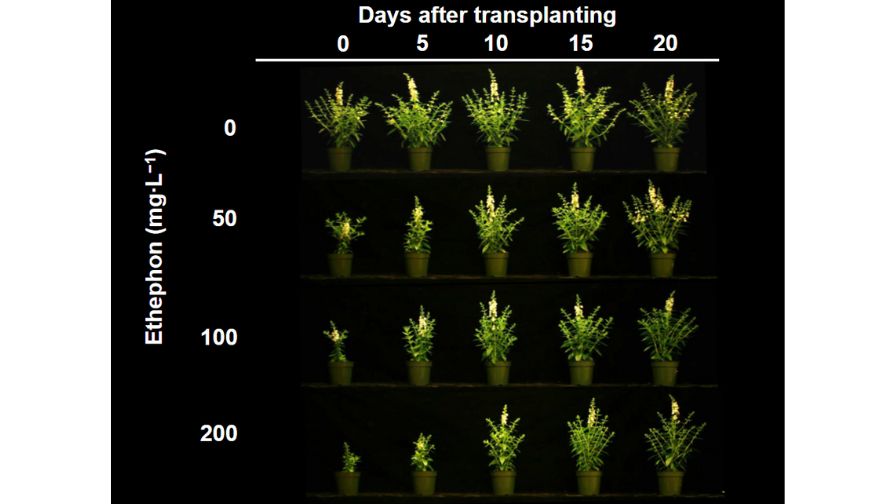
Angelonia (Angelonia angustifolia) grown in 4-inch containers and treated with 2-ounce drenches of 0 to 200 ppm ethephon 0 to 20 days after transplanting seedlings into containers. | Iowa State University
Drenches can be used successfully at different stages of containerized crop production, from early in the schedule (“early drenches”) to the final stages of finishing (“late drenches”). The key is timing:



Allow Plants to Root in Their Containers
While the rooting time varies by species, some general guidelines can be used, such as seven days after planting for packs, and 10 to 14 days for 4- or 6-inch pots, respectively.
Avoid Applying Too Early
If plants aren’t well established in their containers prior to an ethephon drench being applied, growth control can be excessive, and plants may finish too small. Early drenching can also delay flowering, with longer delays the earlier they’re applied.
Avoid Applying Too Late
Late drenches may not provide sufficient growth control to keep crops on schedule.
The Benefits of Drenching
One of the main advantages of ethephon drenches is uniform growth control, which comes from applying a standard volume of solution to each container. Keep these practices in mind:
Match Volume to Container Size
Ethephon application volumes are the same as other root-active growth retardants: about 2 fluid ounces for 4-inch pots, 3 ounces for 5-inch pots, and 4 ounces for 6-inch pots. Larger containers should always receive more solution than smaller ones.
Avoid Excessive Leaching
Try not to exceed more than 10% leaching of the applied PGR solution.
Manage Substrate Moisture
Don’t water too close to treatments — saturated media can increase leaching. However, don’t let the substrate get too dry either; aside from poor distribution of the solution, the surface can become hydrophobic and cause the drench to run off or “channel” down the container.
What Concentration Should You Apply?
As with other active ingredients, growth control with ethephon is proportional to concentration: The higher the concentration, the stronger the control, and vice versa. Because ethephon drenches are a relatively new PGR application, species-specific recommendations for target concentrations are more limited compared to other active ingredients and application methods.
Most label guides for herbaceous annuals call for less than 100 ppm ethephon, most 50 to 75 ppm. For crops not on the label, conduct in-house trials to determine the concentration that works best for the species and cultivars you are targeting.
Why pH Matters in Ethephon Drenches
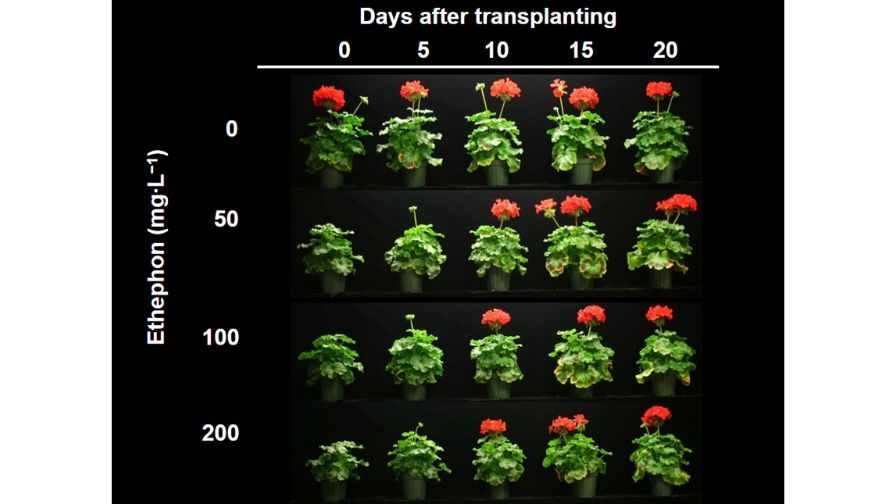
Zonal geranium (Pelargonium x hortorum) grown in 4-inch containers and treated with 2-ounce drenches of 0 to 200 ppm ethephon, applied 0 to 20 days after transplanting seedlings into containers. | Iowa State University
Another critical factor to consider with ethephon drenches is the pH of water and substrate. Once taken up by plants, ethephon generates ethylene when it encounters the cytosol in plant cells at around a pH of 7. At lower pHs, ethylene forms more slowly — or not at all.
To prevent premature ethylene and maximize efficacy:
Avoid Exposure to High pH
Although ethephon products include an acidifier to help keep solution pH low, their effectiveness can be reduced if they are mixed with high-pH water, water with high alkalinity (which resists pH reduction), or applied in substrates with an elevated pH.
Acidify Your Water Source When Needed
High alkalinity can buffer the acidifier in ethephon products, keeping the solution pH too high. Neutralizing alkalinity and lowering pH before mixing helps maintain effectiveness.
Account for Substrate pH
Substrate pH is less flexible — we can’t change the substrate pH just to modify the effects of an ethephon drench. However, we can modify drenches to account for substrate pH effects. For example, crops grown in high-pH substrates (like zonal geraniums or marigolds) may require a higher concentration of ethephon to compensate for the effects of the higher pH. Alternatively, crops grown in low-pH substrates (like petunias and calibrachoas) often respond well to more modest ethephon concentrations.
One of the best things a grower can have is a toolbox full of solutions — and ethephon drenches are simply another tool to use. By managing timing, volume, concentration, and pH, you can increase the consistency and effectiveness of your results.
Subscribe to eNewsletter