



What We’ve Learned About Tea Propagation in the Pacific Northwest

One node cuttings (L) and rooted cuttings (R). | Dr. Carol Miles
In the misty lowlands of northwestern Washington, fields better known for tulips, potatoes, and berries are now home to an unexpected newcomer: Tea. Camellia sinensis, an evergreen shrub that has fueled cultures and economies across Asia, Africa, and South America for centuries, is slowly making its way into the Pacific Northwest (PNW). What began as curiosity has grown into serious exploration as researchers, nurseries, and farmers ask:
Can this region support a specialty tea industry of its own?
At the heart of this effort is Washington State University’s Northwestern Washington Research & Extension Center (WSU NWREC) in Skagit Valley, WA. For several years, Dr. Carol Miles and her team have been testing how to reliably propagate tea plants for local nurseries and growers. Funded by a Washington State Department of Agriculture Nursery Grant, WSARE, and Washington State University, their work addresses a fundamental but often overlooked question of how to produce quantities of healthy, uniform planting stock that will not only survive but thrive in the PNW’s cool, wet, and often unpredictable climate.
Climate: A Challenge and an Opportunity
The Pacific Northwest is no stranger to specialty crops, but tea introduces a new set of challenges. Unlike annual vegetables, which go from seed to harvest in a matter of months, tea is a perennial, with soil needs similar to blueberries, which prefer a low pH. Tea requires four to five years from planting to the first harvestable flush of leaves. This time investment makes it critical to start with robust, well-rooted plants that are suitable for the region’s climate.


The region’s mild summers, frequent rainfall, and relatively cool average temperatures can slow vegetative growth. Yet these same conditions may enhance the chemical compounds — polyphenols, amino acids, and aromatic volatiles — that enhance tea’s flavor. Just as the various soil types and microclimates of wine regions create distinctive growing conditions, Skagit Valley and its neighboring counties could one day lend a signature taste to PNW-grown tea.
Seeds or Cuttings: Deciding How to Begin
A central question in tea propagation is whether to rely on seed or cuttings. Seeds bring genetic diversity, opening the door to discovering cultivars naturally adapted to the Northwest’s soil and climate. However, with diversity comes inconsistency, such as different sizes, shapes, and leaf quality of seedlings, which complicates uniform harvests and consistent product development. Seeds also test growers’ patience. They require warm stratification to overcome dormancy and take weeks to germinate, and often, the germination rate can be low, further extending the production cycle.
Cuttings, on the other hand, offer genetic uniformity and stability. For commercial production, this means uniform growth, predictable yields, and consistent chemistry in the harvested leaves. Still, cuttings bring their own hurdles in a cooler climate. Without controlled environments, rooting success can be erratic. Miles and her team of graduate students have developed a cutting propagation method with a greater than 90% success rate for tea. This includes collecting semi-hardwood shoots in early to mid-September, scoring the base of one-node cuttings and treating them with rooting hormones, placing them in tree pots with well-drained acidic medium, and maintaining them in a greenhouse mist chamber with high humidity and bottom heat for around six months.

Cuttings inside mist chamber. | McKenzie Shelton / Carol Miles, Washington State University
From Nursery to Field: The Critical Transition
Even after successful rooting, young tea plants face the delicate task of acclimating to field conditions. The sudden shift from the protected nursery to outdoor exposure — cooler temperatures, wind, and fluctuating rainfall — can shock tender plants. Placing potted plants in a hardening-off area, coupled with shelter from excessive rain and frost the first year, improves survival.
Timing matters, as planting tea into the field late spring through early summer offers the most favorable window for plants to become well rooted before temperatures dip in autumn.
Nursery practices themselves are equally important. Tea favors acidic, well-drained soils with a pH between 5.0 and 5.5. In WSU trials, potting mixes that included peat moss and perlite provided the right balance of pH (4.8), aeration, and moisture retention. Shade cloth is used to protect delicate leaves from the summer sun. Transplanting into raised beds with drip irrigation and covered with weed barrier/landscape fabric helps optimize soil moisture in the summer and avoid the waterlogging that can occur during the winter months.
The Bigger Picture: Can Tea Thrive in the Pacific Northwest?
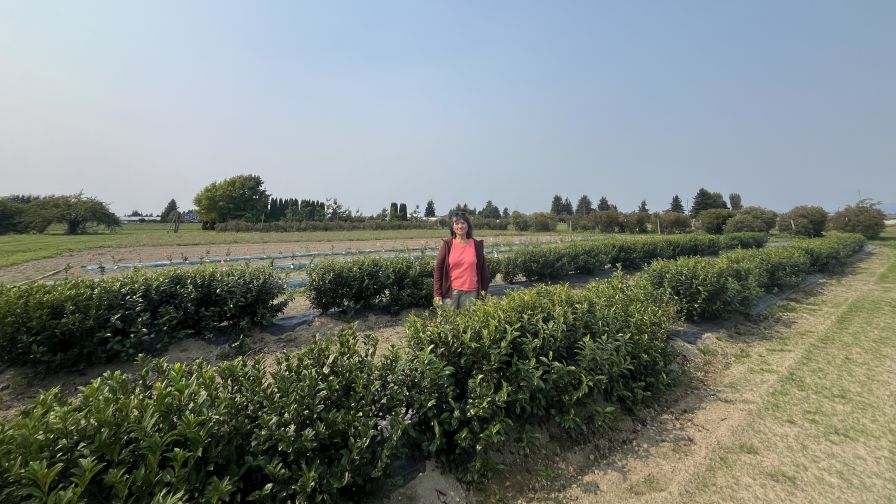
Dr. Carol Miles in a tea plant field at WSU Mount Vernon NWREC. | Carol Miles, Washington State University
Beyond the propagation bench, the larger question remains: can tea become a viable specialty crop in this region? Dr. Miles’ work suggests promising results. Specialty teas command high value in niche markets, and the PNW’s climate has parallels with northern Japan, Korea, and parts of China — areas known for premium green teas. The potential is not only in flavor but also in story: consumers increasingly seek locally produced, artisanal beverages. Imagine farms offering tea tastings, harvest experiences, and even small-scale processing demonstrations as part of agritourism ventures.
Still, profitability depends on careful attention to the basics:
- Lowering establishment costs
- Improving survival rates
- Selecting cultivars suited to the PNW’s conditions
These are the building blocks of a sustainable tea industry. Progress will require continued collaboration among researchers, nurseries, and growers — sharing best practices, refining propagation protocols, and establishing a reliable supply chain.
A New Chapter for Northwest Agriculture
What is happening in Skagit Valley and neighboring growing areas is more than an experiment; it is the opening of a new agricultural chapter. Growing tea in the Pacific Northwest is no longer just a curiosity whispered about at research stations — it is becoming a practical, if demanding, opportunity. From the first delicate cuttings rooted under mist to the eventual leaves steeped in a teacup, the journey is long. But as WSU’s trials demonstrate, with persistence and adaptation, the PNW could one day be known not just for hops, wine, and cider, but also for its own distinctive tea.
Subscribe to eNewsletter