




Why Growers Are Turning to UbiGro to Boost Yields Without Boosting Energy Bills
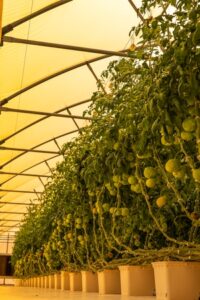 Greenhouse growers are under pressure. Energy costs are rising. Water is scarce. Climate conditions are unpredictable. UbiGro offers a solution that doesn’t rely on electricity or complex infrastructure upgrades. It modifies sunlight itself.
“Photoluminescence in luminescent films like UbiGro refers to the ability of the film’s embedded quantum dots to absorb ultraviolet and blue wavelengths of sunlight and re-emit that energy as longer wavelength light such as orange, red or far red,” says Damon Hebert, Director of Agriculture R&D, UbiQD, Inc., the manufacturer of UbiGro. “This red-shifted spectrum aligns with the peak photosynthetic absorption of chlorophyll, boosting plant energy efficiency, growth and yield.”
The technology doesn’t filter or supplement light. It transforms it. That distinction matters. UbiGro’s passive films retrofit easily into existing greenhouses, require no electricity, and deliver measurable results.
In trials and commercial deployments, growers have seen consistent yield improvements. “A tomato trial reported a 20 percent increase in fresh weight yield over five months,” Hebert notes. “In cannabis, we’ve shown between 8 and 16 percent yield increases with growers in California, New Mexico and Oregon. We’ve seen gains in strawberries, lettuce and microgreens. We’ve been testing for over five years.”
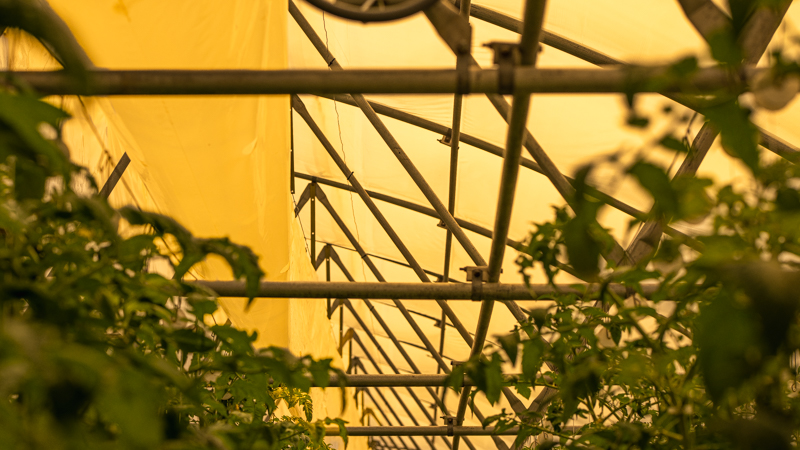
But it’s not just about yield. UbiGro also improves crop quality and operational efficiency. In a Canadian cucumber trial, growers saw a 15 percent reduction in waste. “Waste is usually defined as a cucumber that’s too curly or has split skin,” Hebert explains. “The diffuse light effect improves full canopy light penetration, reducing shading and promoting uniform growth.”
The key metric for crops like ornamentals and potted herbs is cycle time. UbiGro accelerates growth, shortens cycles, and increases the number of harvests per season. That means more revenue, faster. Because the films operate without electricity, growers cut energy costs and avoid installing supplemental lighting.
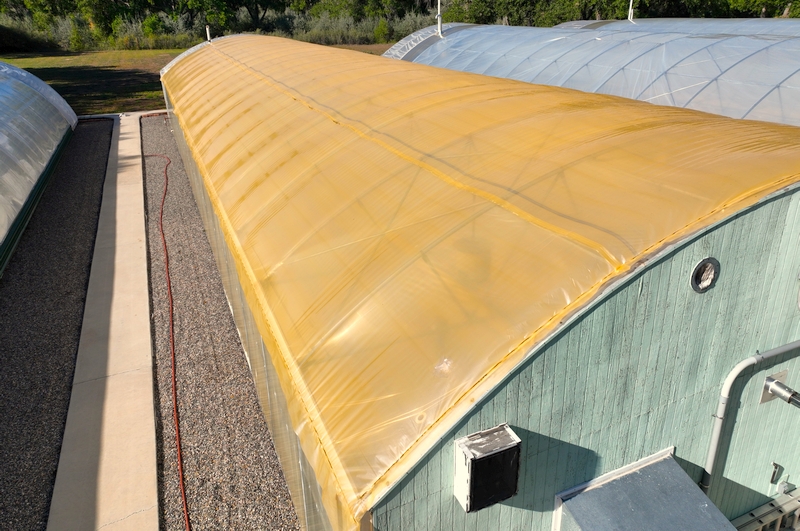
UbiGro is built for scalability. It comes in two formats: UbiGro Inner, an internal retrofit compatible with glass, polycarbonate, acrylic, and polyethylene structures; and UbiGro Cover, an external solution for hoop houses and high tunnels. Films are available in multiple spectral ranges to match crop needs. “We’ve seen deployments in over 100 trials across 50 greenhouse sites worldwide,” Hebert says.
The technology also supports sustainability goals. In a trial at North Dakota State University, UbiGro improved water use efficiency by over 30 percent. “That’s a key advantage in water-limited environments,” Hebert notes.
Looking ahead, UbiGro is working with the USDA and commercial partners to develop quantum dot-infused glass for Dutch-style greenhouses. “We’re excited about what’s on the horizon,” concludes Hebert.