



Five Trends Shaping AI Implementation in Horticulture
 March 5, 2026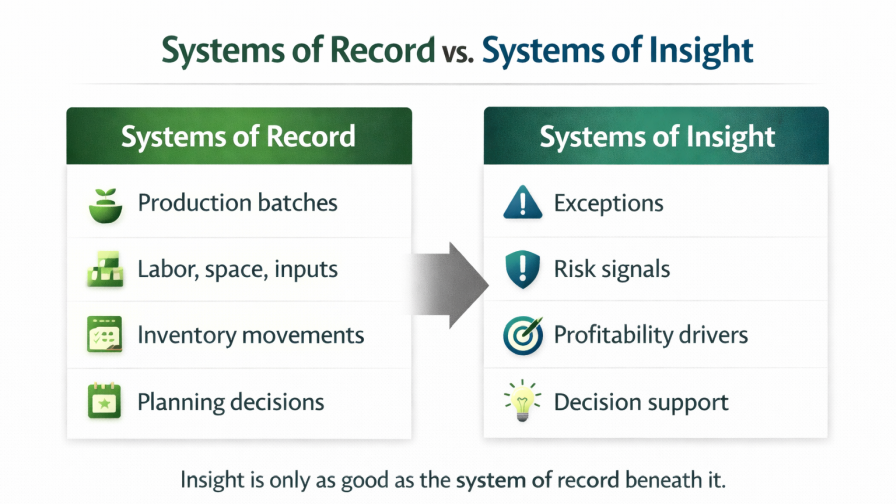
Image: Aster Software
Editor’s Note: In this article, Tony Van Oort, Sales Director at Aster Software and formerly Director of Business Development at Qualitree Propagators, offers five trends driving the future of AI implementation in the horticulture industry.
Trend 1: The Need to Upgrade Is Imminent
“I think we’re at a very unique time in history where the vast majority of the horticulture industry is aware that they need to update their systems. For the last 20 years, a small percentage of companies at any given time were looking to upgrade their software. But today everyone seems to be keenly aware of the need to modernize. They may be owners of old systems that are tabular-based, not on a platform, and they need to recreate themselves or they’re going to be in trouble.”
Trend 2: Clean Data Can Make AI Even More Valuable




“I don’t see AI as a feature. I see it as a multiplier on clean data, on disciplined workflows, and on operational truth. Without that foundation, AI simply accelerates bad decisions.
I also think that growers don’t have an AI problem. They’re keenly aware of AI, but they don’t have an AI problem. They have a clarity problem. AI only becomes valuable once businesses are operating on trusted, structured data. There’s a lot of hype out there that AI is going to make ERP systems irrelevant and unnecessary, and AI is going to take over. I think it’s all hype, but I also believe we’re living in a bit of an AI bubble right now that’s about to implode massively, and on the other side of that correction AI will become a workforce accelerator.”
Trend 3: The Importance of Systems of Record
“As I mentioned, there are some things the industry needs clarity on. For example, most growers don’t truly know what it costs to produce their crops. They might know at the end of the fiscal year that they’ve made money. But which crops contributed to the profitability, and which detracted from it?
Your sales team also needs to know what is available to sell without having to constantly go back to the operations team and look at numbers on spreadsheets. This is why systems of record are so important. Planning in our industry can be very reactive and unstructured, and if you forecast planning, trimming, or spacing too late, you can miss the most important production weeks of your crop.”
Trend 4: Connecting AI to Horticulture
“Unstructured data is a real problem. A lot of growers have outgrown QuickBooks and spreadsheets. They may have been burnt by manufacturing software that’s been shoehorned into the industry, or they built their own solutions that are not on a major platforms like Microsoft or Salesforce, and they’re realizing that the millions that they’ve invested in homegrown software for these many years is about to become obsolete.
The goal of our company is to first build out the operational spine. AI will sit on top of that spine, not replace it. We work on core functionalities like roll-up costing by batch. If we bring into that production batch sensor data, weather data, and production activities like spacing, spraying, or trimming, we can construct those final parts of the system that record things that we need to know. Then we will have a single source of truth for all of our data from CRM, ERP, and Accounting. That’s important because AI is powerful, but only when it understands horticultural context. Otherwise it’s just producing confident nonsense.”
Trend 5: AI Brings Critical Data to the Forefront
“We’re long past the days when every morning you get a report and you read the entire report. You need to be looking at the exceptions, the pieces of data that need your immediate attention, because there’s too much data in today’s world to absorb it all. You need to let systems automatically surface the data that needs your attention.
As we build systems of record, I’m most looking forward to surfacing nuanced information that the human brain would not have been able to extrapolate. For instance, let’s say you’re about to spray a fungicide on a hot July Afternoon, and another grower seven years ago sprayed that same combination on a crop with the same solar energy, and it resulted in massive burn that cost $100,000, and you’re about to do the same thing … When the data in the system of record can surface things that save you from making mistakes that cost massive amounts of money, that is truly awesome. So, I’m most looking forward to putting AI to work on structured data to surface that information that growers didn’t even know was present, and that humans brain couldn’t even extrapolate on their own.”
Subscribe to eNewsletter