



Managing Lepidotera Pests in Cannabis
 October 14, 2021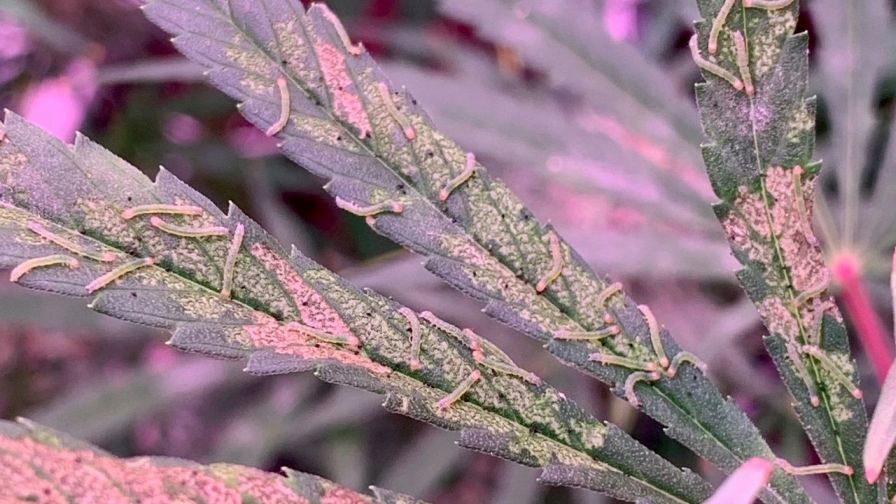
Photo: Flowering Flora Consulting
Loopers are among the most common pests in greenhouse cannabis. Through active monitoring, moth and newly hatched larvae can be detected early, and a proactive pesticide application scheduled. Physical traps and barriers can also be implemented, such as sticky cards/tape, vent screens, row covers, blacklight and pheromone traps. While there are biological options available, biopesticides seem to be the most effective, even though their number of uses are limited.
The color and size of looper larvae and adult moths depends on the species. Larvae can range from green to brown, and moths are usually a mixture of white, grey, and brown coloration and patterning. Loopers are easily distinguished from caterpillars based on their movement. Looper larvae have feet at their anterior and posterior ends. When the larva moves, it brings its rear towards its front forming a loop, and then extends its front forwards. Caterpillars, conversely, have feet along the entire underside of the larva’s body and moves in an undulating fashion.
When first instar larvae are found clustered together, they likely recently hatched and have not yet dispersed. More developed loopers can usually be found by following the progression of damage from smaller to larger holes where the larvae may be feeding or pupating. Larvae are also able to traverse down plants by secreting a silk thread. This aids in distribution as the larvae can be blown by wind or quickly travel vertically down the plant. Moths feed on nectar and do not damage the plants except by perpetuating the lifecycle.
Learn more in this post from Flowering Flora Consulting Inc.
Subscribe to eNewsletter