




How a Top 100 Grower Unlocked New Opportunities Through Customer Success
 May 20, 2025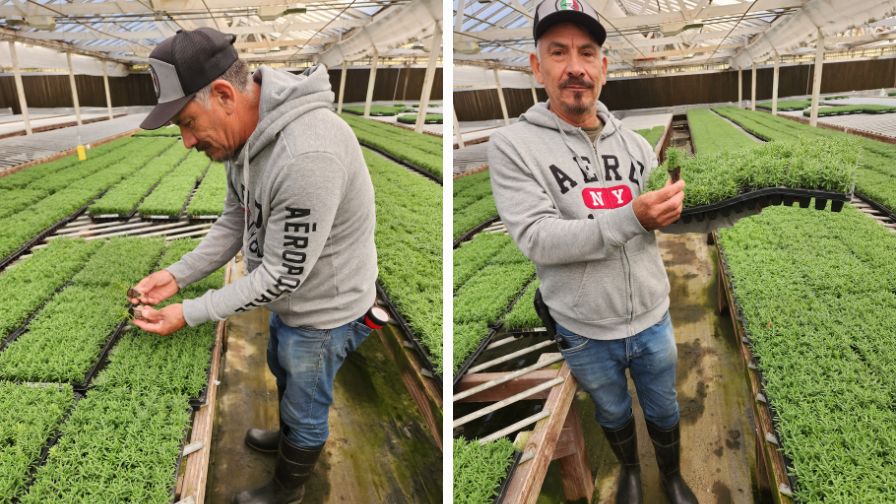
Since 1987, The Plug Connection has specialized in producing high-quality young plants, including plugs, liners, and grafted transplants. Here, Magdeleno Viramontes of The Plug Connection checks lavender lines.. | The Plug Connection
In today’s dynamic business landscape, standing still is akin to falling far behind. For horticulture businesses to truly flourish, a willingness to adapt, embrace transparency, and constantly seek fresh perspectives is paramount. Here’s Part 3 of a look at four forward-thinking growers, plucked from this year’s Top 100 list, who share their strategies for addressing challenges, improving operational efficiency, and boosting their bottom lines.
Stay tuned for Part 4, and catch up with Parts 1 and 2 if you missed them.
Stagnation to Success
Bruce Gibson, General Manager at The Plug Connection in San Diego County, CA, put it succinctly: “Our business is fundamentally about plugs and liners, plain and simple… we live and die off of it.”
However, The Plug Connection faced a fundamental challenge in recent years. The current market lacked significant growth potential. Consequently, finding new customers is a slow and often unrewarding endeavor. Therefore, Gibson says the strategic focus shifted to identifying opportunities that directly benefit their customers. The expectation was that client success would drive their own.
“We have numerous examples where initiatives designed to aid our broader customer base have also yielded positive results for our business,” says Gibson. “Ultimately, and perhaps it’s a well-worn adage, our growth is intrinsically linked to the success of those we serve.
“It wasn’t an ‘aha!’ moment, but more of a confluence of pressures from our customers coupled with the clear need to identify new avenues for expansion and enhance our value to our existing clientele,” he adds.
Since 1987, The Plug Connection has specialized in producing high-quality young plants, including plugs, liners, and grafted transplants. Recognized as the West Coast’s first specialist in ornamental young plants, the wholesale plant nursery has grown to become one of the largest producers in the U.S. It maintains more than 1 million square feet of covered greenhouse space across its two Southern California locations — Vista and Bonsall.
Over the last year, this collaborative approach revealed unexpected opportunities for The Plug Connection. Gibson says engaging in discussions about plug specifications led customers to recognize the benefits of transitioning between tray sizes, such as moving from a 288-cell to a 128-cell tray, which can benefit The Plug Connection.
Gibson further highlighted instances where perceived higher costs actually deliver greater value for the customer. For example, they witnessed product lines successfully shift from a 72-cell to a 50-cell tray. While one might assume resistance to a higher per-unit price, customers recognize the intrinsic worth.
“With our ipomoea production, despite a slight revenue adjustment, transitioning from a 50- to a 72-cell tray ultimately made more logistical sense for the customer,” he says.
Gibson acknowledged that, although not the ideal scenario for every product, adapting to customer needs necessitates adjustments that may initially seem unfavorable. However, they can benefit the grower.
“These changes, even if requiring us to modify our stock management and growing practices, often present unforeseen advantages,” he says. “Ultimately, if a change simplifies processes, enhances productivity, and reduces overall costs for the customer, we must thoroughly evaluate the potential for a corresponding opportunity for ourselves, rather than solely focusing on a potential penalty or increased expenditure.”
Gibson emphasizes there’s an important lesson to learn from this process. For a mature business, there’s always the risk of stagnation and of being confined by the assumption that “we’ve always done it this way; our customers only buy it in a 72-cell tray.” However, long-held beliefs may no longer be relevant.
Gibson believes they are only at the beginning of a much longer process of embracing change and detailed adjustments to meet customer needs. However, The Plug Connection has begun to experience an ROI (return on investment) from the initial strategic shifts.
“While we observe increased revenue in specific product lines where we’ve transitioned to larger sizes or alternative formats, I primarily view these changes through the lens of ensuring our long-term viability rather than solely pursuing immediate profit growth,” he says. “Ultimately, the critical question is our relevance to our customers — are we the most indispensable partner? When purchasing decisions are made, do we stand out as the clear first choice, or are we simply one among many? So, yes, I do believe we have made significant strides in that direction.”
Subscribe to eNewsletter