




15 Scientific Terms Every Greenhouse Grower Should Know
You can measure nearly everything in a controlled environment — EC, pH, DLI, VPD, substrate moisture — and still hesitate on the next move. Interpreting numbers can be tricky: Crops can drift while averages look “normal,” and progress often comes from understanding what the system is signaling, not from adding another input.
In greenhouse production, being “bilingual” is a real advantage. Speaking both grower and plant science allows you to translate measurements into mechanisms and mechanisms into decisions.
The 15 terms below show up in day-to-day conversations between growers, researchers, consultants, and technical staff. It’s more than just a glossary: It’s a set of working definitions that connect directly to decisions in the rootzone, fertigation, climate, and crop timing.
Rootzone and Substrate Science
1. Air-Filled Porosity (AFP)
Air-filled porosity is the fraction of pore space that remains filled with air after a substrate is saturated and allowed to drain. All growing media have some AFP, but the operational question is whether the rootzone returns to an adequately aerated state often enough to support steady root function. AFP depends on particle size distribution, container geometry, irrigation frequency, and how the media settles over time. When the profile stays wet for extended periods, oxygen diffusion can become limiting, and roots often lose efficiency before obvious symptoms appear.
2. Container Capacity
Container capacity is the water held after free drainage. In practice, it is the baseline condition that the rootzone returns to after each irrigation event. Higher container capacity can increase water availability, but it can also keep parts of the profile wetter for longer, affecting oxygen status and where roots concentrate. Container geometry matters: In shallower containers, the wettest portion of the profile often represents a larger fraction of total volume. Matching container depth, substrate, and irrigation strategy helps avoid a rootzone that’s consistently wetter than intended.
3. Cation Exchange Capacity (CEC)
CEC describes a substrate’s ability to retain and exchange positively charged nutrients such as potassium, calcium, and magnesium. Operationally, CEC influences how strongly the rootzone buffers changes in fertigation. Higher-CEC mixes (often peat- or coir-based) can adsorb and release cations over time, which can reduce short-term swings in rootzone solution concentration. Lower-CEC media tend to reflect recipe changes more directly. CEC is best viewed as a management characteristic: It shapes stability, responsiveness, and how forgiving a system is when timing, mixing, or water quality varies.
4. Hydraulic Conductivity
Hydraulic conductivity describes how readily water moves through a substrate under operating conditions. It influences how evenly irrigation water distributes and how uniformly the profile re-wets between events. When conductivity is low, water may move preferentially through certain pathways, leaving other zones comparatively dry; over time, this can contribute to uneven rooting and localized salt concentration. Conductivity also changes with moisture status, so a mix that wets easily when moist may become harder to re-wet after partial dry-down. In practice, conductivity is a quiet driver of uniformity.
Water and Nutrient Dynamics
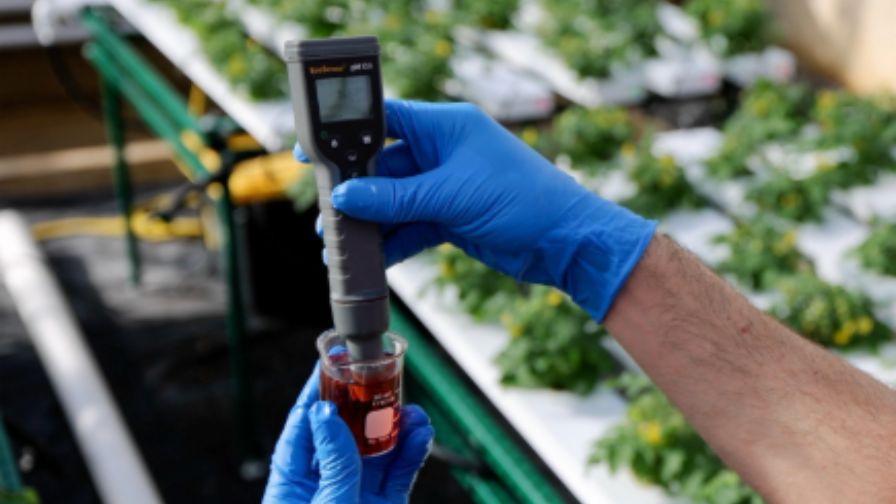
Measuring nutrient solution pH is useful on its own but becomes more powerful when tracked as a trend alongside EC, drainage, and environmental demand. | Luke Hayes – Virginia Tech.
5. Electrical Conductivity (EC)
EC reflects the total concentration of dissolved ions in a solution. It’s most useful as a trend indicator because it does not identify which ions are driving the reading or whether nutrient ratios are appropriate. EC becomes more diagnostic when paired values are compared over time, such as inflow versus drainage or leachate EC. Rising drainage EC relative to inflow often suggests accumulation in the rootzone, while a consistent drop can indicate strong uptake, dilution, or insufficient replenishment. In recirculating systems, EC can drift through selective uptake and evaporation, so periodic solution analysis may be needed when ratios matter.
6. pH
pH describes the acidity or alkalinity of the rootzone solution and influences nutrient availability, especially for micronutrients. Most crops perform reliably within a relatively narrow operating range, but targets depend on crop, substrate, water alkalinity, and whether the system is open or recirculating. In practice, pH management is less about a single “perfect” number and more about stability. Drift can be driven by water source, fertilizer formulation, plant uptake patterns, and microbial activity. When pH moves outside an effective range, deficiency-like symptoms can appear even when nutrients are present.
7. Osmotic Stress
Osmotic stress occurs when the salt concentration around roots becomes high enough to reduce the plant’s ability to absorb water. The key operational point is that plants can show drought-like behavior even when moisture is adequate. Osmotic stress becomes more likely when EC is intentionally elevated for steering, when leaching is limited, or when uneven wetting concentrates salts. It can present as slowed growth, reduced expansion, or transient wilting during high-demand periods. Because symptoms overlap with water stress, confirming rootzone or drainage EC is often what clarifies the diagnosis.
8. Nutrient Mobility
Nutrient mobility refers to whether or not a nutrient can be redistributed from older tissues to support new growth. This framework helps interpret symptom location: Mobile nutrients often show deficiency first in older leaves, while relatively immobile nutrients tend to show symptoms in new growth and developing tissues. Mobility does not replace tissue testing, but it improves troubleshooting speed and can reduce misdirected corrections. It also helps explain why increasing nutrient supply does not always resolve symptoms quickly when uptake or transport is the actual constraint.
9. Transpiration
Transpiration is the movement of water from roots to leaves and its loss through stomata. It matters because it links the environment to nutrition by driving water flow through the plant and influencing the delivery of several nutrients. Transpiration responds quickly to light, vapor pressure deficit (see below), temperature, and air movement, meaning the same fertigation program can behave differently from day to day. When transpiration is suppressed, certain nutrient-related disorders become more likely even when solution concentrations are adequate; when demand is high, irrigation timing and root function become more limiting.
Environmental Control and Light
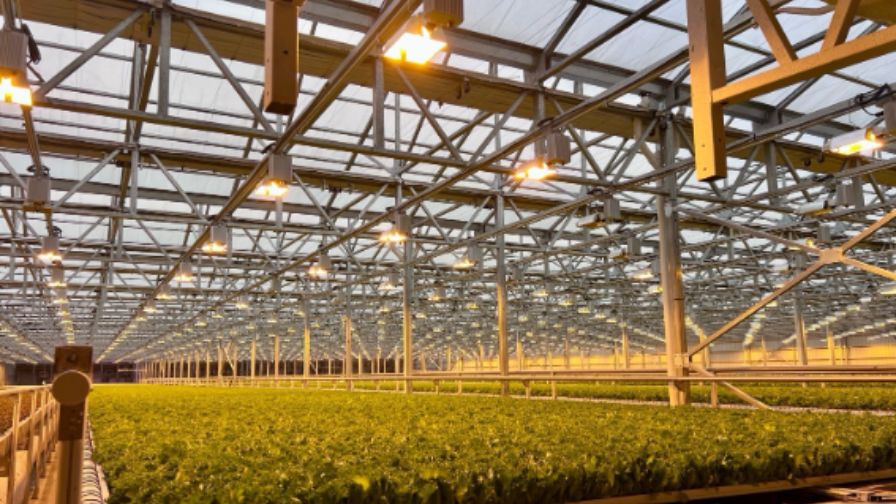
Supplemental lighting strategy is easier to manage when intensity (PPFD) and total daily light (DLI) are treated as measurable targets. | Brandan A. Shur.
10. Vapor Pressure Deficit (VPD)
VPD describes the difference between the moisture currently in the air and the moisture the air could hold at saturation at the same temperature. Because it accounts for temperature, it often reflects evaporative demand more directly than relative humidity alone. VPD influences stomatal behavior and transpiration: Low VPD tends to reduce demand, while high VPD increases demand and can raise water-stress risk if root uptake or irrigation timing can’t keep pace. Monitoring VPD helps connect humidity management to plant water movement and downstream effects on growth and tissue quality.
11. Daily Light Integral (DLI)
DLI is the total photosynthetically active radiation a crop receives in a day. While instantaneous intensity matters, DLI captures cumulative light available for photosynthesis and is closely tied to growth rate and yield potential. DLI helps explain seasonal shifts in crop speed and quality and supports planning when supplemental lighting is used. It can also clarify variability across bays when nutrition and irrigation are consistent, but light exposure differs. Practically, DLI keeps the focus on total daily light, not just whether a moment looks bright.
12. Photosynthetic Photon Flux Density (PPFD)
PPFD is the instantaneous intensity of photosynthetically active light at the canopy level. Unlike DLI, which is cumulative, PPFD is a moment-by-moment measure and is especially useful for evaluating distribution. A greenhouse can have an acceptable average PPFD and still produce uneven growth if intensity varies across the crop due to fixture spacing, structural shading, or canopy architecture. Measuring PPFD at crop height supports decisions about fixture placement, dimming strategy, and the run-time needed to achieve a target DLI without over- or under-lighting parts of a bay.
13. Photoperiodism
Photoperiodism is a plant’s response to day length. Some crops respond strongly, influencing flowering and developmental transitions, while others are less sensitive. In controlled environments, photoperiod matters because it can be managed consistently. It can help schedule flowering in photoperiod-responsive crops, maintain vegetative growth when desired, and improve uniformity by reducing variability driven by changing natural day length. Photoperiod also interacts with DLI because day length affects total daily light exposure when intensity is held constant.
14. Growing Degree Days (GDD)
Growing degree days are a heat-unit metric used to relate accumulated temperature exposure to plant development. Rather than treating time as calendar days, GDD treats development as a function of thermal accumulation within a crop-specific range. GDD is most useful when temperature varies, such as during shoulder seasons or when day and night setpoints shift. Using heat units can improve timing predictions, support staggered production planning, and help align harvest windows across batches when conditions are not uniform week to week.
Plant Physiology and Resource Flow
15. Source-to-Sink Relationships
Source-to-sink relationships describe how plants allocate carbohydrates and nutrients from sources (primarily mature leaves producing sugars) to sinks (developing fruit, new leaves, roots, and growing points). In fruiting crops, developing fruit can become a dominant sink, and performance depends on whether source capacity (leaf area, light capture, and photosynthetic potential) is sufficient to meet demand. If it’s not, competition among sinks can increase, and growers may see slower filling, more variability in size, and delayed ripening. Crop load, pruning, leaf retention, and light management all influence this balance.
Final Thoughts
CEA rewards precision, but precision depends on shared language. These terms are not meant to make production more academic; they’re meant to make observations more actionable and communication clearer across growers, researchers, and technical teams.
One of the most valuable skills in greenhouse production is interpretation: knowing which numbers are signals, which are symptoms, and which are simply noise. Fluency in how water moves, how nutrients behave, how the environment sets demand, and how plants allocate resources helps turn daily adjustments into a consistent strategy.
This article was first published on our sister site CEAg World. To read the original article, click here.
Subscribe to eNewsletter