



Tips on Identifying Water Stress in Container-Grown Plants
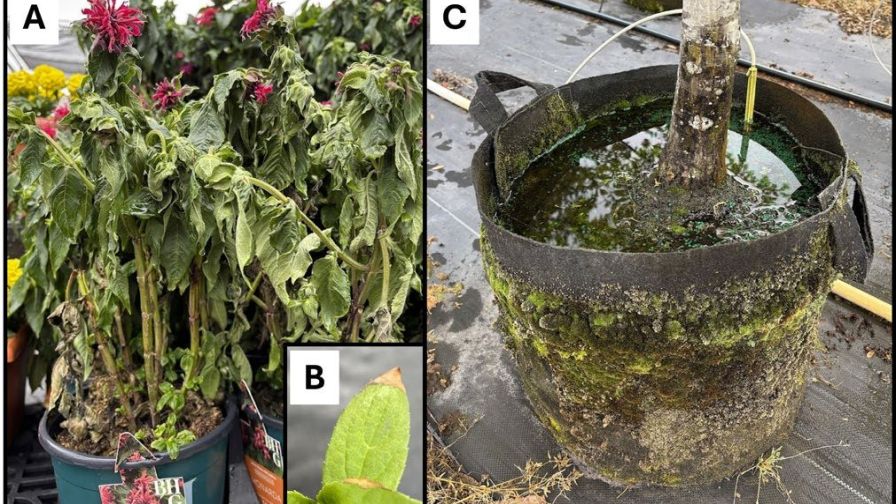
A drought-stressed plant and (B) the beginning signs of leaf scorch. (C) Heavily overwatered rootzone conditions. Photo; Virginia Tech
Container nursery operations can be daunting to manage because they often span many acres and encompass hundreds of plant species and cultivars. A single nursery can produce a variety of annual bedding plants in one corner and cultivate woody perennials in another.
Producing a wide range of plants certainly extends marketing diversification and reaches a broader horticultural audience. However, the standard practice of grouping different plants in the same irrigation zone, or using the same soilless substrate for most plants, can lead to water-related stress during production due to varying nursery-plant water requirements. Therefore, it’s important to understand the visual symptoms of water stress and which plant characteristics can exacerbate water-related stress.
A recent Virginia Cooperative Extension online publication is designed to briefly walk growers through identifying water-related stress by evaluating shoot and root visual symptoms, and to improve growers’ understanding of water requirements for popular nursery stock and the different plant characteristics that may influence water use.
Plants exhibit multiple physical indicators when they are water-stressed. Sometimes these indicators can look similar, making it more challenging to identify the source of the stress.
Shoots
As plants experience drought, roots are the first to detect when water in the rootzone becomes less available. A stress hormone called abscisic acid (ABA) begins to accumulate. Since plants communicate through hormones, roots will send ABA signals to the leaves and convey that there is low water availability. Plants can be sensitive to ABA, and when they detect ABA in the leaves, the stomata will typically close. Thus, the first symptom of drought is wilting or flagging.
Roots
Roots are highly sensitive to water stress and are the first to detect water-supply-related issues. Typically, but not always, healthy nursery stock roots will appear white and turgid to indicate a strong and vigorous root system. However, not all nursery plants will have traditionally “white” roots. Take, for instance, the roots of arborvitae or loropetalum. Both the color and turgidity of the roots can be used to evaluate root health. In drought-stressed plants, roots will appear thin or frail. In overwatered plants, roots will appear mushy, brown/black, or may not even be visible at all (i.e., root dieback or root rot).
Learn much more about this topic in the original Virginia Tech article, which can be found here.
Subscribe to eNewsletter