



How Organic Mulches Can Reduce Short-Spined Thrips Numbers
 June 25, 2026
 Short-spined thrips (Thrips parvispinus) is an invasive pest that poses serious challenges to ornamental crops due to its wide host range, with 43 plant species in 19 families. It has become one of the most difficult pests to manage for many growers since first recorded in the U.S. in Florida in 2020. Since then, it has spread rapidly to many other states.
Once infestations become established, populations can increase rapidly and spread throughout a greenhouse crop. T. parvispinus larvae and adults feed on plants, especially on young leaves, flower buds, and fruits. Symptoms of pest feeding include silvering, scarring, leaf distortion, and flower damage, leading to heavy scarring of affected tissues, premature flower drop, leaf curling, and ultimately reduced plant marketability.
Besides the wide host range of T. parvispinus, another reason short-spined thrips is difficult to control is its life cycle. It takes 12 to 15 days for T. parvispinus to complete the lifecycle from egg to adult at the temperature of 80°F, which is easy to reach in the Southeastern U.S. Under greenhouse conditions, a generation may be completed in as soon as two weeks, allowing multiple generations to occur during a single crop cycle. This rapid development enables populations to build quickly before visible damage becomes severe.
Additionally, females insert eggs directly into leaf tissue, where they are protected from many contact insecticides. After feeding on leaves and flowers, second-instar larvae move to the substrate and develop through the prepupal and pupal stages beneath the substrate surface. Because important life stages occur both inside plant tissue and in the root zone, insecticide sprays often fail to reach the entire population.
To manage outbreaks, growers often rely heavily on insecticide applications. Although insecticides can provide effective suppression, repeated applications increase production costs and may contribute to insecticide resistance over time. As a result, growers continue to seek additional management practices that can complement chemical control and target thrips during vulnerable stages of their life cycle.
Can organic mulches be part of the solution? Absolutely! Because short-spined thrips spend part of their life cycle in the substrate, practices that target these soil-dwelling stages may offer new opportunities for management. Organic mulches may provide a cultural practice that completes existing insecticide-based management practices.
How Organic Mulches Affect Thrips
Organic mulches may influence short-spined thrips through several ways. First, mulch creates a physical barrier between the plant canopy and substrate. The second-instar larvae move from the plant canopy to pupate in the substrate, and a mulch layer may interfere with their ability to reach suitable pupation sites. Second, mulch layers may prevent newly emerged adults from moving back from the substrate surface to the plant canopy. Third, certain mulch materials may contain chemical compounds that influence pest behavior (e.g. eucalyptus mulch contains aromatic compounds that affect insect activity). Fourth, mulches could modify the microenvironment (e.g. moisture and temperature) at the substrate surface, affecting the survival and development of soil-dwelling stages. These physical and environmental effects from organic mulches may disrupt the life cycle of short-spined thrips and reduce population growth.
Best Practices for Using Organic Mulches to Manage Short-Spined Thrips
To evaluate whether organic mulches could manage short-spined thrips, we conducted greenhouse trials using four commonly used and commercially available mulch materials: eucalyptus mulch, pine bark mulch, rice hull mulch, and coconut fiber discs (Fig. 1).
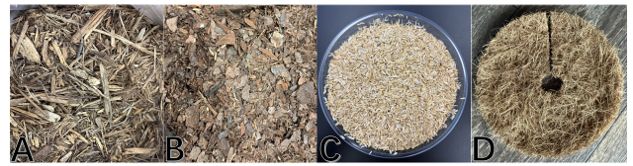
Fig.1. Mulches used in greenhouse experiments. (A) Eucalyptus mulch; (B) Pine bark mulch; (C) Rice hull mulch; and (D) Coconut mulch.
Four host crops were included in the study: gardenia, Mandevilla, ‘Black Pearl’ pepper, and hybrid hot pepper. These crops were selected because they are important ornamental crops and susceptible to short-spined thrips
To maximize the benefits of organic mulches, growers should apply mulch at transplanting and maintain consistent coverage throughout the production cycle. For eucalyptus mulch, pine bark mulch, and rice hull mulch (Fig. 2A-C), an even layer approximately 2 cm thick can be applied across the substrate surface. Complete coverage is important because exposed substrate may allow thrips to enter the growing medium and complete development. Coconut mulch is typically applied as a preformed fiber disc placed on the substrate surface (Fig. 2D). The center opening should fit around the plant stem without direct contact.
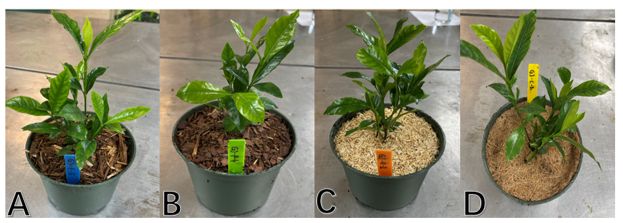
Fig. 2. Mulch application at transplanting. A) Eucalyptus mulch. B) Pine bark mulch. C) Rice hull mulch applied as an even layer on the substrate surface. D) Coconut fiber disc mulch placed on the substrate surface surrounding the plant stem.
During production, growers should periodically check mulch coverage after irrigation and routine crop maintenance. If mulch is displaced, it should be redistributed to maintain a continuous barrier over the substrate surface.
To monitor mulch performance, we used two methods: tapping and sticky card. Plant tapping was used to estimate the number of thrips present on plants (Fig. 3), while sticky cards placed over the substrate surface were used to monitor adult thrips emerging from substrate. These methods provided information on both plant infestation and adult emergence from the substrate.
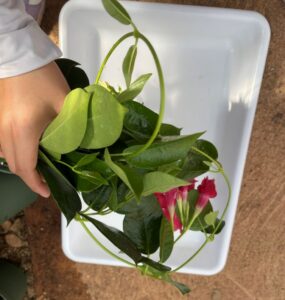
Fig. 3. Collecting adult and larval short-spined thrips by tapping plants over a white tray.
What the Data Showed
Among the crops evaluated, gardenia showed the most effective results (Fig. 5). Gardenias grown with eucalyptus, pine bark, and coconut mulches had fewer thrips than plants grown without mulch. Eucalyptus mulch provided the greatest reduction in thrips numbers, making it the most effective one among all the materials tested in the trial. However, the benefits of mulching were not consistent across all crops. In Mandevilla, ‘Black Pearl’ pepper, and hybrid hot pepper, mulch treatments did not reduce thrips populations compared with non-mulched plants (Fig. 5). These findings indicate that mulch effects may depend on crop species.
Reduced Thrips Does Not Always Mean Reduced Damage
Although some mulch treatments reduced thrips numbers (e.g. eucalyptus on Mandevilla), reductions in visible feeding damage were not statistically significant. In all the tested crops, leaf damage ratings were similar among treatments despite differences in thrips reduction.
This result provides an important consideration for growers when using mulches. Feeding injury can occur before population suppression becomes apparent, and even relatively small thrips populations may cause noticeable damage to susceptible crops. Consequently, mulches should be viewed as a tool for reducing pest pressure rather than a stand-alone solution for preventing crop injury.
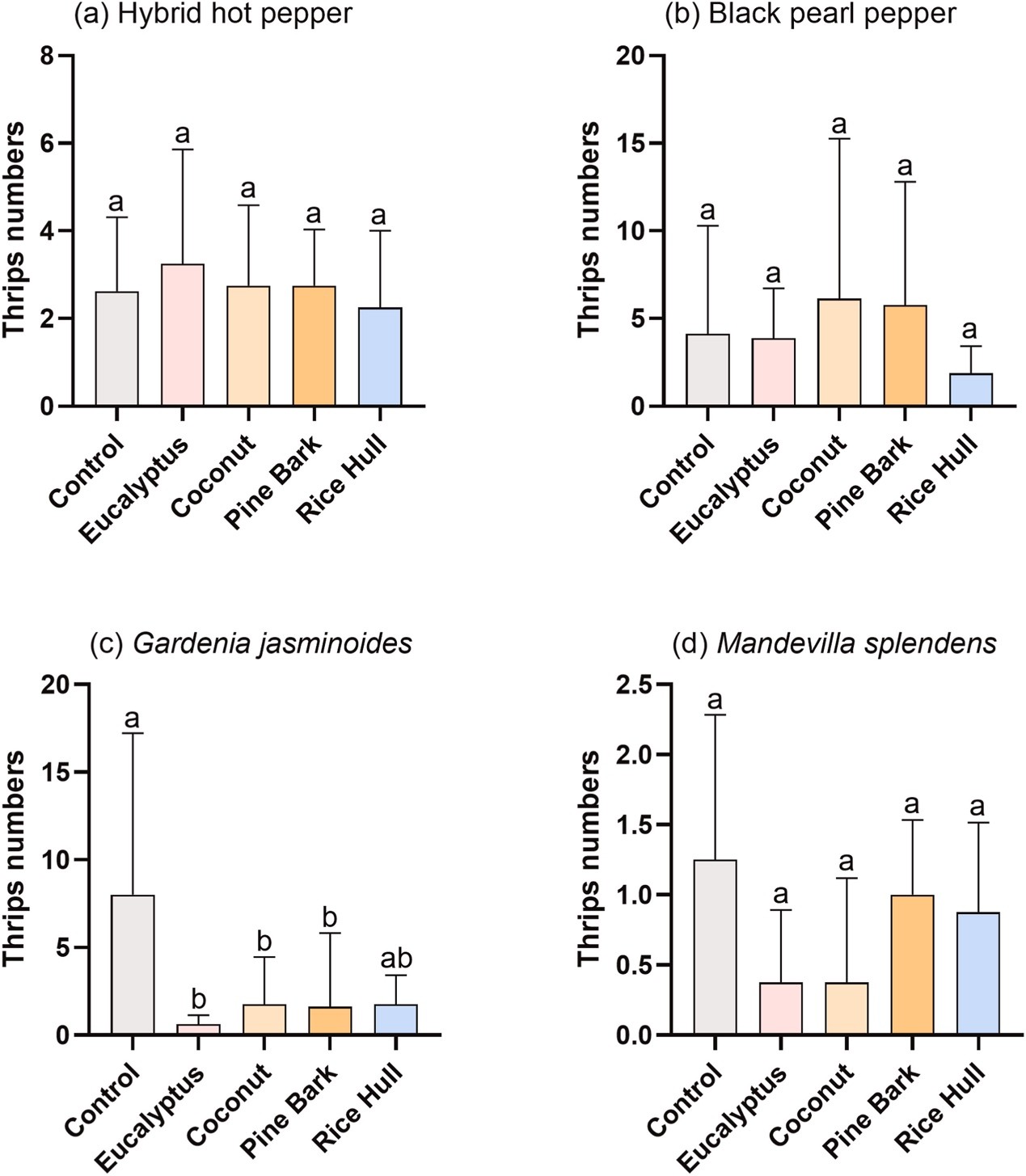
Fig. 4 Numbers of adult and larval Thrips parvispinus collected by tapping and sticky card sampling on four ornamental plant cultivars under different mulch treatments.
Looking Ahead
The results of this study suggest several practical considerations for ornamental growers’ interested in using organic mulches as part of an integrated pest management (IPM) program.
First, mulches should be applied at transplanting so that developing larvae encounter the mulch barrier when they move to the substrate to pupate. Delayed application may allow thrips to complete part of their life cycle before the barrier is established.
Second, maintaining complete substrate coverage is important. Exposed substrate areas may allow larvae to reach pupation sites and reduce the effects of the mulches.
Third, growers should recognize that mulch performance may vary among crops. In our study, gardenia responded most strongly, while effects in other crops were limited. Small-scale trials may help determine which mulch materials are best suited for individual production systems.
Finally, mulches should be used as part of an IPM program and combined with other management practices, including insecticide applications when needed. By targeting soil-dwelling stages that are difficult to reach with foliar sprays, mulches may help reduce overall pest pressure and support a more comprehensive IPM strategy.
To read more, the full article can be found here.
Subscribe to eNewsletter