



How AI-Powered Drones Are Transforming Greenhouse Crop Monitoring
 August 6, 2026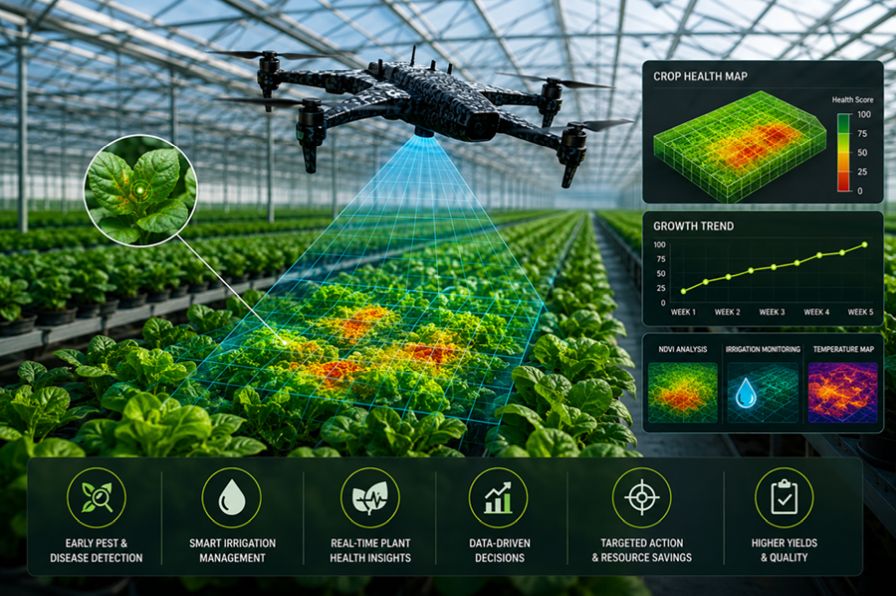
Photo: Andrew Mabry, ZenaDrone
Greenhouse production has grown by leaps and bounds in the last several years in an effort to optimize yields and conserve resources. However, ensuring the health of thousands of plants in a greenhouse can be both time and labor intensive. Growers find themselves spending countless hours scouting their crops to detect plant health or production problems, disease, nutrient issues, or irrigation concerns, among other challenges to crop production.
However, artificial intelligence (AI) and drones are bringing a new level of insight into greenhouse crop production. Use of AI in combination with unmanned autonomous vehicles (UAVs) provides growers with the information they need to manage their crops in a more efficient manner. By doing so, it allows growers to better monitor and manage their own operations. These emerging technologies provide value to growers in that it is an additional layer of precision on top of their existing production systems.
The Need for Smarter Greenhouse Monitoring
Modern greenhouses are highly sophisticated systems that require an optimal environment in order to grow high-quality crops throughout the year. However, there are numerous factors that can influence the process and lead to lower yields.
Manual crop inspections remain valuable, but they often face several limitations:
- Large greenhouse facilities require labor for regular scouting.
- Early signs of plant stress can be difficult to detect visually.
- Frequent inspections consume valuable production time.
The use of AI drones can resolve many of these issues and provide extensive data for further analysis.
How AI-Powered Drones Work
The technology of AI drones is based on autonomous flying of drones equipped with various sensors and cameras as well as artificial intelligence software. Drones take photos and gather data about the environment in several different places within the greenhouse during their pre-planned flights. The data is then analyzed by AI programs.
AI drones can detect:
- Plant stress area or health
- Early pest infestations or attacks
- Disease symptoms and signs
- Irrigation inconsistencies and problems
- Nutrient deficiencies and issues
- Uneven crop development
- Temperature variations
Through the use of drones, collected information is organized into reports that growers can review to make informed management decisions.
Applications in Greenhouse Crop Monitoring
Early Pest and Disease Detection: One of the most important tasks of drones with AI in a greenhouse is the early detection of pests and plant diseases. Time spent on conventional scouting can be expensive, and in many cases, scouting efforts may fail to notice developing problems. Left unchecked, an infestation can spread to several different crops. Meanwhile, AI drones can capture high-resolution images and analyze them in real-time to find early signs of plant disease or insect assault, enabling growers to act promptly.
Early interventions can help protect the crop, manage resources efficiently, prevent diseases and pests from spreading, aid in developing integrated pest management strategies, and reduce the use of pesticides.
Monitoring Plant Health: Good greenhouse management requires plants to grow well under the best possible conditions. Growers know that plants grow vigorously and produce the best yields when their leaves are healthy, colorful, and of good shape. Problems can arise due to a variety of causes, and there are several signs that something is wrong. By regularly inspecting the crop, AI power agriculture drones can detect deviations from normal growing conditions and inform growers about irregularities. Drone technology can find problems like poor soil, lack of water, plant health, and uneven crop growth. After finding problems, farmers can make decisions for better results.
Irrigation System: Proper irrigation is critical in a greenhouse. By observing a crop, the drone can alert growers to areas of concern, whether too much or too little water is being distributed or if plant stress occurs due to incorrect water regimes. Such issues will inevitably lead to lower yields if they are not corrected.
Crop Growth Monitoring: Using drones in greenhouses makes it easier to track the crop’s progress during the growing season. Thanks to the possibility of autonomous flights, growers can monitor crop growth and development at intervals during the growing season. In addition, they can evaluate crop production practices, conduct studies, and analyze results at specified times throughout the season. All this helps growers get the best possible yield
Key Features of AI-Powered Greenhouse Drones
Modern greenhouse drones offer a variety of advanced features:
- Autonomous flight: Drones can fly and work on their own inside greenhouses to collect data the same way every time.
- AI Image analysis: Drone AI systems help quickly analyze images and understand plant conditions.
- High-resolution imaging: Drone 4k cameras capture clear images help identify and study plant health accurately.
- Repeatable inspections: Some survey routes help operators compare results from different AI drone flights.
- Useful reports: Clear data or real information helps farmers use drone information to improve their crops.
Benefits for Greenhouse Growers
- Automated inspections shorten the time taken in crop scouting, and hence, the staff can concentrate on other value-added activities.
- Early detection of plant diseases enhances the possibility of taking preventive measures, thus helping safeguard the crop yield and quality.
- The historical data from monitoring enable growers to review trends for improved cultivation practices and optimize the performance of the greenhouse.
- The inspection process is standardized by utilizing autonomous drones that ensure consistency across the entire greenhouse.
- The data acquisition process supports near real-time analysis helping growers detect problems at an early stage.
- Early identification of irrigation, nutrition, and pest control problems promotes optimal water, fertilizer, and pesticide use.
Integrating AI Drones into Greenhouse Operations
Successful implementation does not require replacing greenhouse management practices. Instead, AI drone technology complements current scouting programs.
A typical workflow includes:
- Autonomous inspection should be done regularly.
- Obtain high resolution pictures of the crops.
- Analyze the data through AI algorithms.
- Inspect the areas that need attention.
- Verify the findings through manual inspection.
- Perform corrective actions.
- Monitor and assess the findings.
The above process forms a comprehensive approach to crop inspection.
The Future of Greenhouse Crop Monitoring
As the technology of artificial intelligence progresses, greenhouse monitoring systems are bound to become increasingly predictive in the future. Possible features include disease outbreak prediction, detection of crop stress before the symptoms become visible, integration with the greenhouse climate control system, and automated decision-making processes.
This can be of great help in maintaining productivity and ensuring sustainability in the increasingly sophisticated greenhouses of the future.
The use of drones that utilize artificial intelligence technology is changing the way crop monitoring is done inside greenhouses because this technology can provide farmers with detailed information regarding their crops. This includes finding pests early, checking irrigation, and tracking crop growth. ZenaDrone develops intelligent drone solutions for agriculture, farming, and aerial field monitoring. Its AI-powered drones collect data and provide smart insights to help farmers monitor crops monitoring and make better decisions. With advancements in greenhouse technology and AI, these solutions will help growers increase efficiency, save time, and support more sustainable practices.
Subscribe to eNewsletter