


How Greenhouse Data Helps Grow Better Orchids

 October 20, 2026
Photos and graphics courtesy of Neda Vaseghi
Floricultura Pacific already had a functioning climate control system at its Salinas, CA, orchid operation when it began participating in a California technology demonstration in 2023. The question was not whether the greenhouse could control temperature, light, and other environmental conditions. It was whether growers could see how those conditions varied around the plants across different locations and elevations in the greenhouse.
The operation began testing additional wireless sensors alongside its existing controls, with measurements taken at the root zone, plant canopy, and above and below the climate screen. The project has since expanded to a wireless crop-weighing system that allows the growing team to compare greenhouse conditions with irrigation and crop response.
The project brought together Energy Resources Integration (ERI), which led the research team, and Microclimates, which supplied monitoring technology for the field demonstrations.
Orchids also prefer light intensities of roughly 100 to 300 µmol/m2/s throughout production. Growers use greenhouse climate screens to moderate sunlight, along with heating, ventilation, and cooling systems, to maintain target conditions for each production phase.
The additional sensors provide measurements from more locations within the greenhouse, giving growers more information to compare with the actions of the existing climate control system.
Adding More Monitoring Points
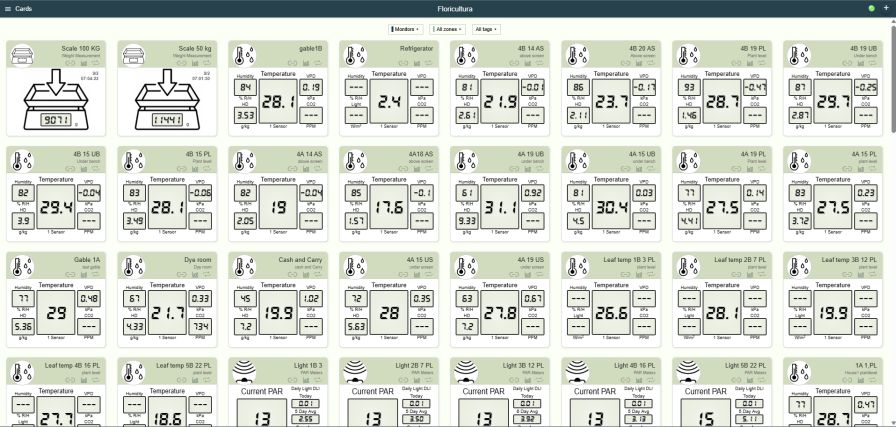
Floricultura can review readings from multiple greenhouse zones through a single monitoring interface. | Neda Vaseghi
In 2024, Microclimates added hardware and software to monitor environmental conditions and energy use from equipment including pumps and fans. ERI published the results of the field evaluation in 2025.
The evaluation found that even large greenhouses with established climate control systems could have gaps in monitoring. A single sensor might represent a large zone, some facilities lacked light sensors, and many growers did not have system-level energy monitoring showing how much power individual systems such as lights, fans, and pumps were using.
Additional wireless sensors expanded monitoring from the root zone and plant canopy to areas above and below the climate screen. Those readings could then be compared with trends from the existing climate control system.
The field demonstration also showed that growers can expand monitoring alongside existing equipment rather than replace an entire control system.
Floricultura’s customized Microclimates interface uses cards for each sensor, allowing the growing team to review temperature, light, and other measurements across greenhouse zones.
Since the initial field demonstration, Floricultura has expanded its monitoring network to more than 100 wireless sensors across its Salinas operation. Visual maps allow growers to scan across houses and identify areas where temperatures or other measurements fall outside target ranges.
“For a long time, I was looking for remote sensors to add to the climate computer,” says Floricultura Orchid Specialist Edwin Knijnenburg. “You want to compare the measurements from the remote sensors with the actions taken by the climate computer — heating pipes, screen positions, or whatever you use to create the best possible climate for the crop.”
Each of the three houses in Zone 3 has temperature sensors at different elevations, allowing growers to compare conditions within and among houses. Sensors in the flask room also capture light levels during early orchid production.
Connecting Climate With Crop Response
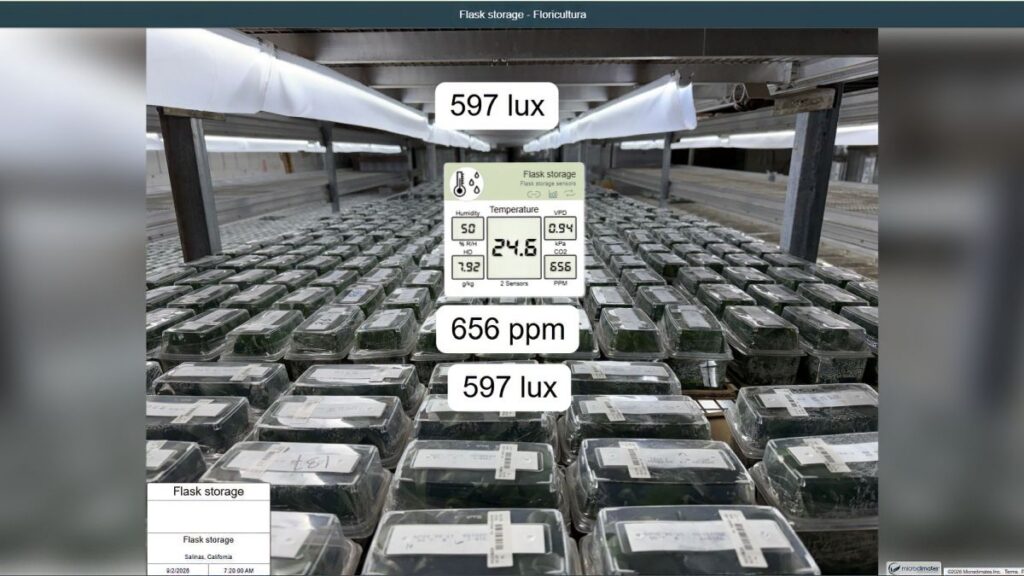
Sensor readings in Floricultura’s flask room provide additional data on light and environmental conditions. | Neda Vaseghi
The next phase of the project moves beyond measuring greenhouse conditions to examining how the crop responds.
Floricultura has added a wireless weighing system to study how irrigation schedules and environmental conditions affect orchid crop weight. Because its automated logistics system moves crops throughout the facility around the clock, a stationary wired weighing system was not practical.
To work within that system, the operation developed a custom platform sized to hold approximately 70 orchid pots, allowing the team to track an average crop weight. The platform sits on a load cell that measures changes in weight and transmits the readings wirelessly without interfering with crop movement.
The weight data gives the growing team another way to evaluate irrigation. By tracking crop weight before and after watering, as well as water loss between irrigation events, growers can see how moisture changes over time and compare results across locations.
“The weighing scale is going to be very helpful to see if we are watering at all three locations on the same schedule, to understand evaporation differences, make sure every plant reaches the same target weight, and improve irrigation timing, which is crucial for growth and health,” Knijnenburg says.
Viewing crop weight alongside temperature, humidity, vapor pressure deficit, and light data allows the team to compare changes in plant moisture with the conditions surrounding the crop. Growers can then examine whether variations in temperature, humidity, or screen position correspond with faster or slower water loss.
Knijnenburg is particularly interested in screen positions and gap strategies. Opening a screen can help manage humidity and evaporation, but opening it too far can release valuable heat.
“How big of a gap do I need for the most evaporation without losing too much heat by opening the screen too far?” he says.
Bringing the Data Together
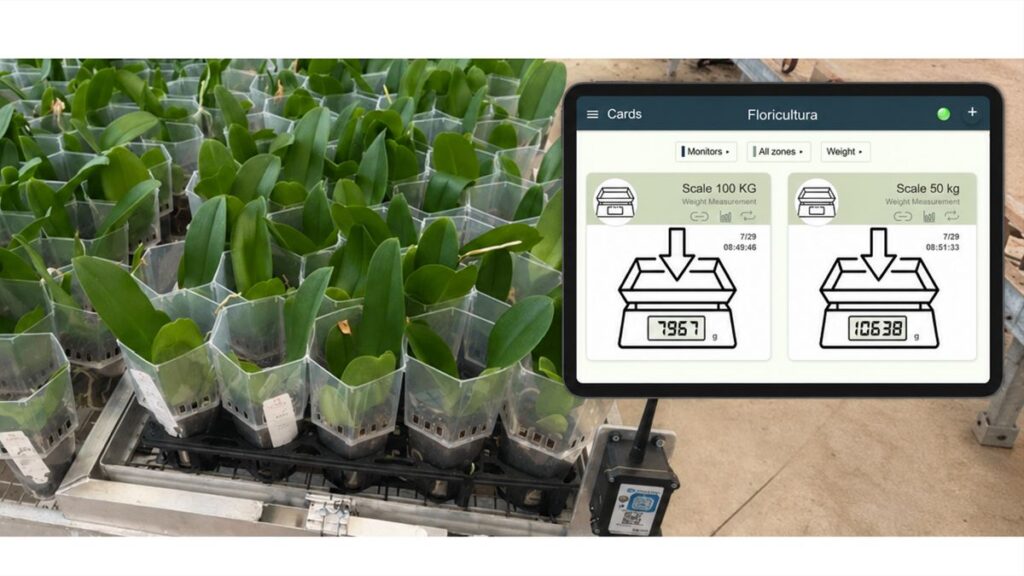
Wireless crop-weight monitoring helps Floricultura evaluate irrigation and water loss. | Neda Vaseghi
As the monitoring network expands, the next challenge is making the measurements easier to compare in one place.
Floricultura’s Ridder climate control data is already fed into LetsGrow, its existing greenhouse data platform, while its wireless environmental and crop-weight data is currently viewed separately through the Microclimates interface.
The growing team and Microclimates are discussing sending the wireless data to Let’s Grow as well, allowing growers to compare climate control actions, greenhouse conditions, and crop-weight trends in one location. This would use Let’s Grow as the common destination for the datasets rather than requiring direct integration with Ridder.
For Knijnenburg, having those measurements together becomes more important as the number and variety of sensors grow.
“It’s a big value to have all the sensors in one dashboard,” he says. “You don’t want sensor A and B with company X and sensor C and D with company Y. You want everything together.”
The monitoring work now extends beyond the Salinas operation. Following Color Orchids’ acquisition of Floricultura Pacific, facilities in Virginia and Texas are also part of the monitoring effort.
What began as a field demonstration at one greenhouse has developed into a broader effort to connect environmental measurements with crop response. For the growing team, the goal is not simply to collect more data, but to better understand how climate control decisions translate into conditions around the plants and changes in plant moisture.
Subscribe to eNewsletter