


Back to Basics: Better Branching in Bedding Crops
 October 19, 2026
What makes a good, finished bedding plant? In addition to being in flower, free of visible nutrient deficiencies, and free of pest damage, plants that are “full” and “filled in” are desirable. One of the best ways to fill out crops as we finish them is to enhance branching, with more foliage covering the substrate and additional flowers developing on additional stems.
Better branching isn’t just for hanging baskets and bigger planters; it also benefits those smaller containers like quarts and 4-inch pots. This article focuses on efficient and effective approaches to enhance branching in your bedding crops this spring.
How Branching Works
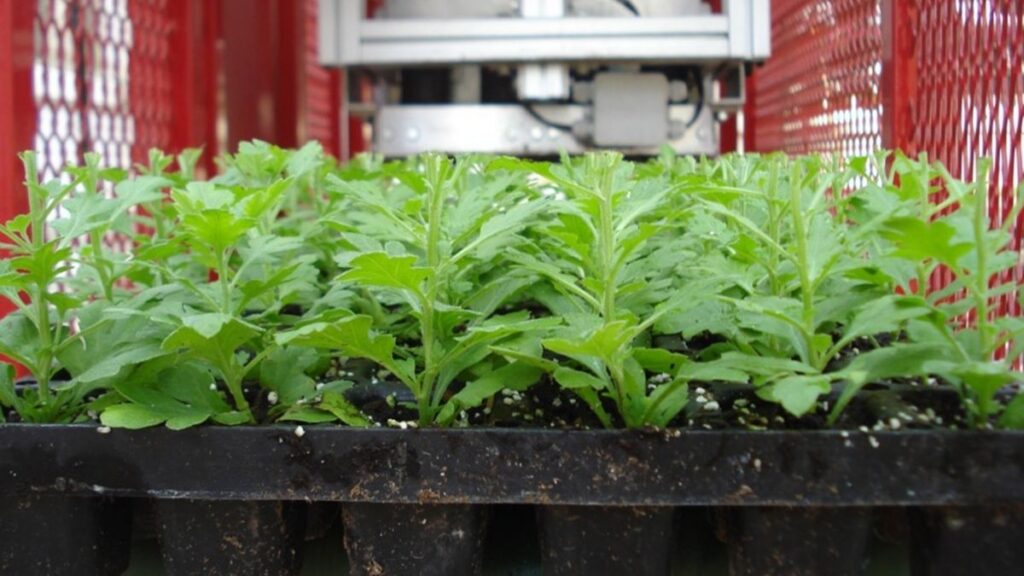
Automated shearing can be a great way to reduce some of the labor costs associated with pinching, but be sure to sterilize blades between crops to reduce mechanical transmission of problematic diseases. | Christopher Currey, Iowa State University
Branches on annual bedding plants originate from axillary buds between the leaf petiole and stem. Apical dominance from the shoot tip inhibits the growth and development of these buds into branches.
When the ratio of auxin to either cytokinin or ethylene is high, apical dominance is maintained, and branches don’t develop. Alternatively, when the ratio of auxin to cytokinin or ethylene is low, apical dominance diminishes, and branches can grow and develop. By decreasing auxin or increasing cytokinin or ethylene, we can enhance branching in bedding plants.
Pinching — Or Not
The most common way to enhance branching in spring crops is by pinching. Removing the apical meristem, or growing point, releases apical dominance and allows axillary buds to develop into branches.
Young leaves on the shoot tip are where auxin is synthesized. When plants are pinched, we are removing that source of auxin, reducing the ratio of auxin to both cytokinin and ethylene, and diminishing apical dominance.
Pinching is certainly an effective approach to increase branching. However, it is labor-intensive, carries some risk, and can increase crop time. Whether you are hand-pinching containers of geraniums on benches or moving flats through a shearing machine, pinching increases labor costs by adding more “touches.”
Additionally, whether using hand-held pruners or machine blades, equipment used to pinch plants needs to be sterilized frequently to limit the spread of mechanically transmitted diseases through the crop. Finally, when crops are pinched, buds on shoot tips are removed, and new growth must develop before the crop is marketable.
BA for Branching
There is a great alternative to pinching crops to enhance branching: benzyladenine (BA). As a cytokinin, BA reduces the ratio of auxin to cytokinin and can promote branching.
Commercially sold as Configure, BA has been used for years to enhance branching and phylloclade numbers on Christmas cactus when applied during the vegetative phase and to increase the number of shoots on hosta and coneflower crops. BA can also be used on annual bedding plants to enhance branching.
Using BA can offer several advantages over pinching. While there are costs associated with applying BA, they may be lower than the labor required to pinch crops. The risk of spreading pathogens is also eliminated. Finally, BA won’t delay crop time in the same way pinching can; because flower buds are not removed, they can continue to develop as the crop approaches marketability.
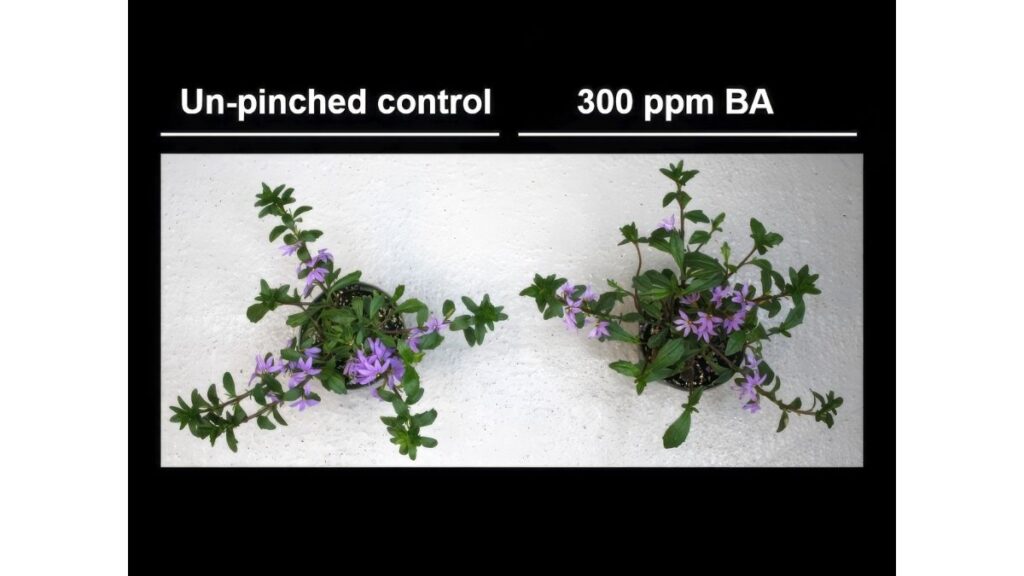
Applying a foliar spray of 300 ppm benzyladenine (BA) to scaevola cuttings one week after liners are transplanted into 4-inch containers enhances branching without delaying flowering.
Both shoots and roots can take up BA, and both sprays and drenches may be effective. Sticking with sprays may be most useful for annual bedding plants, where responses among different species are not widely characterized.
Concentrations between 50 and 500 ppm are a good place to start when determining effective spray rates for the species and cultivars you produce; drench rates should be much lower for annuals. Drench volume should be proportional to the container being treated — for example, 2 fl. oz for a 4-inch container and 4 fl. oz for a 6-inch container — while sprays should be applied at the standard 2 quarts per 100 square feet of growing area.
Applications are usually made after transplant, once seedling plugs and rooted cutting liners have rooted into their container. There are also opportunities to apply BA at the end of Stage 4, or toning, during liner and plug production. Trays of propagules may be treated before transplant as well.
Ethephon
In addition to BA, ethephon is another branch-promoting PGR. When ethephon is applied to plants, it is taken up into cells and generates ethylene. This reduces the ratio of auxin to ethylene and promotes branching.
The challenge is that ethylene has several effects on plant growth and development. In addition to promoting branching, ethylene inhibits both stem elongation and flowering.
While some growth control is usually beneficial in containerized crop production, delayed flowering poses a problem for annual bedding plants, which are typically sold in bloom. Ethephon applications should stop six to eight weeks before the target sale date, so flowers have time to develop.
However, that timeframe essentially eliminates ethephon as a tool for producing smaller containers such as 1-quart or 4-inch pots. While some genetics have flowers that are less sensitive to ethephon, delayed flowering remains a concern across annual taxa.
The Take-Home Message
Better branching is something nearly all containerized annuals can benefit from. But don’t think you are stuck with pinching. Plant growth regulators (PGRs) can also be used for enhancing branches, and BA has great potential for spring bedding crops.
Conduct in-house trials to see how you can put BA sprays to work in your production program next spring.
Subscribe to eNewsletter