



Managing Resources to Navigate Uncertainty in the Floriculture Market
 May 15, 2025
 Though economic landscapes are constantly shifting, we are experiencing a particularly volatile period in floriculture right now. While U.S. greenhouse producers are primarily catering to domestic markets with their finished plants, the inputs to grow our crops are multinational in nature. This article will go through the most widely used inputs to produce crops and address how you can minimize or mitigate the negative impacts of an uncertain trade landscape.
Containers
In the container market, while not hard and fast, there is some division between the more basic containers (flats and inserts, trays, and containers 12 inches or less) and the larger, more decorative containers used for higher price-point hanging baskets and mixed containers. Many of the more basic containers are manufactured domestically, while a greater proportion of the larger, more decorative containers are manufactured offshore. Sourcing domestic manufacturers is going to be the best bet to mitigate tariff impacts for large containers.
Substrates
Our industry relies on sphagnum peat moss for our growing mixes. The most widely used substrates contain (by volume) about 70% to 80% coarse ground peat moss. Canadian producers are the primary source of our peat, so the current state of trade with our northern neighbor clearly has the potential to affect the substrates we use.
Growing all your products in smaller containers just to reduce the volume of peat needed isn’t an option (fairy gardens aren’t that popular, yet). Looking at individual components or blends containing domestic products is a path to mitigating peat problems. Though they are not the sole supplier of many substrate components, domestic producers can provide several, including perlite, rice hulls, and wood products such as composted bark and wood fiber, which can reduce the amount of peat needed. These alternative substrate components and mixes may provide some relief to your bottom line and supply chain.
Plant Materials
Many of the seeds and cuttings we use to grow our crops are produced offshore and imported, making them subject to trade barriers like tariffs. Reducing the number of propagules (i.e., seeds and cuttings) used is one potential approach to reduce costs associated with plant materials. This is already commonly done for poinsettias, with the single pinched cutting replacing the traditional straight-ups and reducing plant inputs.
However, using fewer plants in containers will require more production time for them to bulk up and fill in containers. Using fewer propagules — whether seeds or cuttings — to produce a finished product will take more time to size up to specs compared to the same product planted with more propagules. As a result, you may want to use this strategy when bench space is more available, such as later spring crop turns or during the summer, and/or when overhead costs are less, such as using outdoor production space. Using growth regulators to enhance branching, such as benzyladenine (Configure) or ethephon (Florel, Collate) can also help bulk up crops as well.
Fertilizers
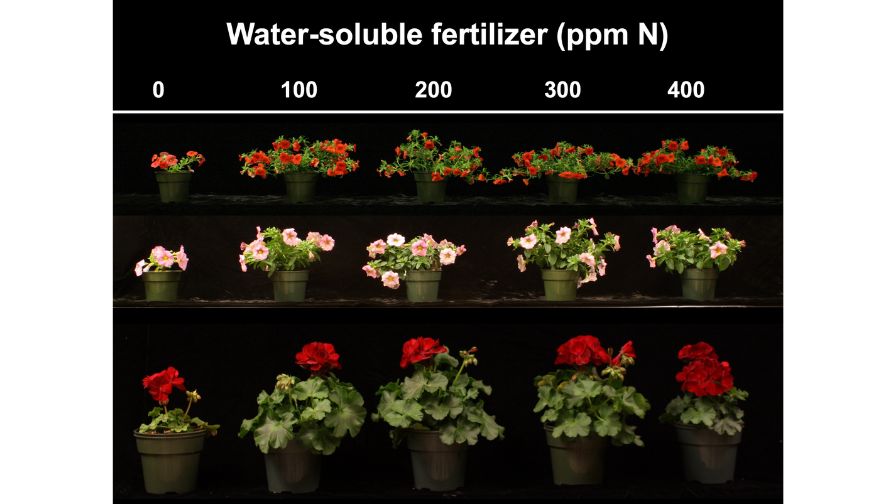
Figure 1. Looking at these calibrachoa (top row), petunias (middle row), and zonal geraniums (bottom row) fertilized with 0 to 400 ppm nitrogen (N) from a complete, balanced, water-soluble fertilizer, the plants provided with 100 ppm N look healthy and are appropriately sized, even though one-half to one-third the recommended amount of fertilizer was provided. | Christopher J. Currey
Many fertilizer concentrations still recommended for production are greater than what crops need, and lowering your fertilizer use can still produce high-quality crops while reducing the amount of fertilizer used (Fig. 1). In addition to reducing total fertilizer concentrations, reducing the use of specific elements such as phosphorous (P) can minimize excessive stem elongation and use of other resources like plant growth regulators. Since Canada is the world’s largest producer of water-soluble P (potash), low-P formulations may be more economical as input costs increase.
Plant Growth Regulators
The active ingredients used in plant growth regulators (PGRs) that are imported to mix products here may increase, along with those products that are mixed internationally and imported. Applying PGRs on an as-needed basis helps avoid unneeded growth regulation and chemical use. Graphical tracking is a useful approach to making objective decisions on when growth retardants are necessary.
For those crops you know will need PGRs to control growth that receives early treatment, consider efficient application methods when possible. For example, using plug or liner dips (Fig. 2) and bulb or tuber soaks can enhance the efficiency of application by using a much smaller volume of PGR solution to treat crops, while the solution can be reused, tray after tray, until there is insufficient solution left for treating crops.
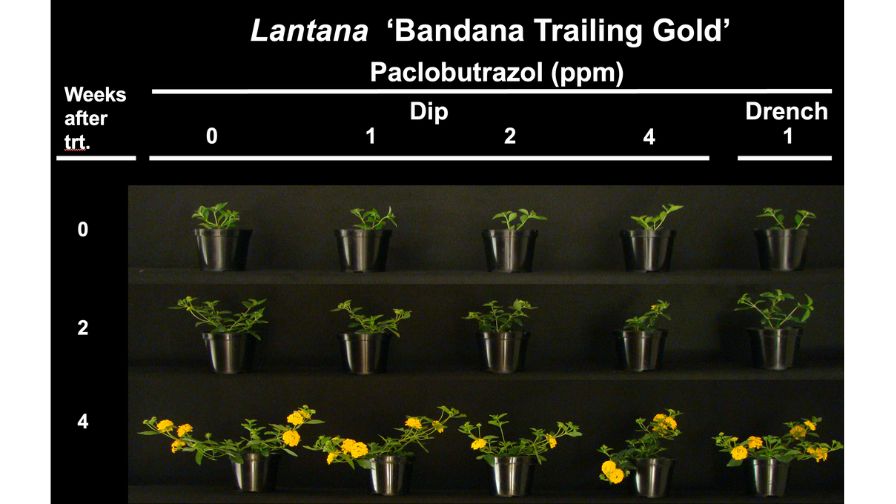
Figure 2. Liner dips are both effective at controlling unwanted stem elongation, as well as efficient with growth retardant use and labor for application. The lantana here treated with 2 or 4 ppm paclobutrazol liner dips achieved comparable or better control than the containerized crop that was drenched. | Christopher J. Currey
Pest and Disease Control
To minimize insect and disease problems, it is best to start clean and stay clean. Like using graphical tracking to determine PGR requirements, regular monitoring, and measuring pest populations and disease incidences make use of both biological organisms and pesticides more judicious. Biological controls and pesticides are most effective when they are applied earlier than later for controlling insect and mite infestations and disease outbreaks. As with plant growth regulators, the nature of where an active ingredient is sourced and final products mixed will determine how the prices of insecticides, miticides, and fungicides are affected. Additionally, there are both domestic and international suppliers of beneficials, so avoiding tariffs will take a little bit of sourcing and working with different suppliers to avoid tariffs and interruptions.
Diversify Suppliers
The uncertainty we are facing makes so many aspects of greenhouse crop production less predictable. One piece of advice to help avoid catastrophes is to avoid putting all your eggs in one basket and diversify suppliers for your products. If you run into problems with one brand of product or a supplier, having alternatives is important.
Not Just for Tariff Times
The strategies presented in this article are meant to abate some of the challenges we are facing in this time of uncertain global trade. However, once the dust finally settles and everything is sorted out, you can still implement many of these ideas so you can judiciously manage your inputs and hedge your bets against future disruptions.
Subscribe to eNewsletter