



How to Identify and Control Common Chickweed in Greenhouse Production
 June 12, 2025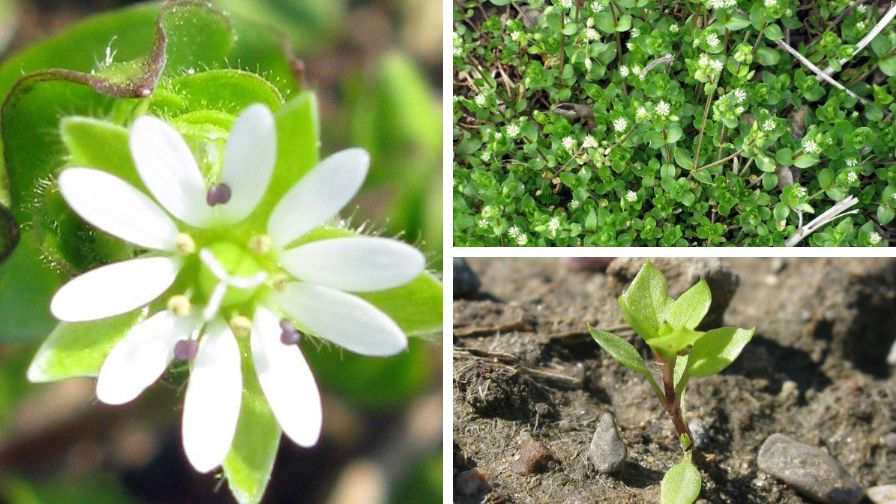
(Clockwise from left) Common chickweed flower contains 5 white petals that are deeply lobed giving the appearance of ten petals. Common chickweed in its natural dense growth habit. Seedling of common chickweed. | MSU, Plant & Pest Diagnostics
In a recent e-Gro Alert, Debalina Saha and Carolina Fitzgibbon of Michigan State University (MSU) cover the spread of common chickweed in greenhouse environments and how growers can safely control its proliferation and propagation within their operation.
What is Common Chickweed?
Common chickweed, also known as birdweed and chickenwort, was originally native to Eurasia and North Africa before being “introduced to North America accidentally by early settlers transporting seed in soil or animal feed.” Chickweed is a fast-growing annual that can “quickly colonize bare ground.” However, this aforementioned strength and efficiency of common chickweed to “add ecological value” to otherwise barren landscapes is also a double-edged sword, especially within greenhouse environments. Its ability to spread quickly, covering vast swathes of land and other surface areas, leads to competition among other plants for “space, light, and nitrogen.” This extreme proficiency of common chickweed is what has led to it being classified as a weed.
Lastly, according to the Missouri Department of Conservation (MDC), chickweed’s “nectar and pollen attract bees, butterflies, and songbirds,” while also acting as a host plant to many butterfly and moth species. However, its ability as a host plant can also be used by many unwanted insects and pests that can quickly become destructive in greenhouse settings, “such as lygus bugs and thrips,” in addition to becoming “a reservoir host for tomato spotted wilt virus and cucumber mosaic virus.”
Common Chickweed Biology and Behaviors
Habitat
According to Saha and Fitzgibbon, “Common chickweed is a winter annual in the Caryophyllaceae (pink) family and grows most vigorously in late winter and early spring. It can thrive in “full sun or partial shade,” and prefers moist, neutral soil, but can also bloom and spread in infertile soil, albeit at a “smaller plant size.”
Root System
The root system of common chickweed is “shallow and fibrous,” according to North Carolina State University. Saha and Fitzgibbon note that, within a greenhouse setting, the creeping stems of common chickweed can “overlap between pots and take hold by rooting, creating a connected system of roots that spans over multiple pots,” in addition to creeping up from the ground on walls or through aisles and walkways.
Propagation
The fast spread of common chickweed is facilitated by its ability to reseed itself and “by rooting at the leaf nodes along the stems,” which can occur even quicker when present in moist soil, according to Cornell College of Agriculture and Life Sciences (CALS). Chickweed “sets flowers and seeds at the same time,” with mature seeds able to “germinate without a dormancy period,” between 54° and 68°F.
Common Chickweed Greenhouse Management Practices
Non-Chemical Control
When possible, chickweed should be “removed before it flowers,” due to its ability to both quickly dispense and germinate seeds. Within greenhouse environments, hand weeding is recommended to prevent further spread. Additionally, for container production, Saha and Fitzgibbon propose organic mulch for supplemental control, including:
- Pine bark
- Rice hulls
- Wood chips
For additional information on the common chickweed biology and behaviors, and recommended chemical control practices, please read the full e-Gro (Electronic Grower Resources Online) alert “Identification and Control of Common Chickweed (Stellaria media) in Greenhouse Container Production.” Additional and current e-Gro alert pieces from Volume 14 (2025) can be found online.
Subscribe to eNewsletter