



Fighting Mites the Right Way
 September 8, 2025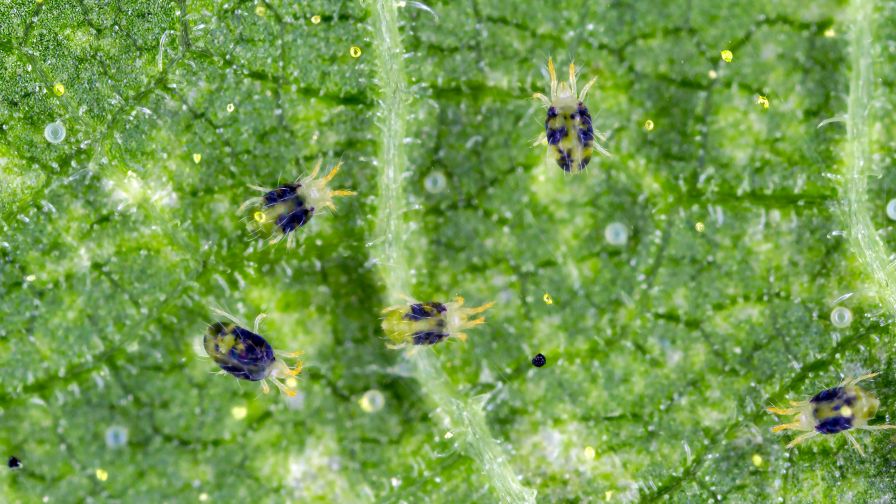
Two-spotted spider mites (Tetranychus urticae) feeding on a leaf. | Tomasz via Adobe Stock
In a recent e-Gro Alert, Dan Gilrein, an Entomology Specialist at the Cornell Cooperative Extension of Suffolk County, covered his experience helping a grower combat an entrenched two-spotted spider mite population problem, including actions taken to curb its presence and lessons learned along the way.
How to Tackle a Particularly Bad Mite Infestation
The particular mite population in question had “a long history of exposure to a few selective miticides that were no longer working well or at all,” according to Gilrein, with built-up resistance suspected as the factor of their diminishing returns. Biocontrols were considered, but both parties felt that the population had exceeded levels where that would be a viable option. Therefore, Gilrein suggested, and the grower implemented, products with new modes of action, which saw initial, but minor, application improvements.
Next, “a regime of several regular (weekly or so) 1% horticultural oil sprays to control both active mites and eggs” was set in motion, keeping a close eye on the plants and inspecting material samples to ensure the oils weren’t causing damage. After the treatment, leaves were examined under magnification, showing that “many, if not all, mites and eggs were killed by the oil treatment.” Additionally, examination of leaf samples from different levels of the plant showed where spray coverage was lacking. In these underserved sections, an effort was made to improve applications through:
- Multiple spray angles
- Plant rotation and spacing
- Thinning and removal of old lower leaves
Additional methods proposed by Gilrein include:
- Adjusting nozzle pressure
- Repeated applications
However, these last two methods should be implemented with greater care and caution. While the growers’ plants proved to be durable and tolerant when receiving higher pressure and repeated applications, even in more sensitive stages prior to blooming, not all plants may follow the same habit.
With propagation now underway, the plan is to implement a cutting dip treatment to get rid of any mites that survived application sprays, as was the case for a previous Lewis mite population that plagued the operation.
For additional information on the control of mite populations, including plans for weed control and the addition of mite predators to prevent a resurgence of the pest, please read the full e-Gro (Electronic Grower Resources Online) alert “Fight Mites Right.” Additional and current e-Gro alert pieces from Volume 14 (2025) can be found online.
Subscribe to eNewsletter
