


An Introduction to Biochar as a Container Substrate Component
 September 17, 2025
 Biochar has been considered to be beneficial to the environment and plants. However, many people have no idea about what biochar is, what biochar can do, or how biochar can be used. This “Biochar Basics” series, consisting of four articles, will attempt to answer the above three questions. This article is the first article of the series, answering what biochar is. We provide introductory information on biochar to partially replace peat moss as a container substrate component. The second and third article will focus on what biochar can do, and the effect of biochar on container-grown plant growth and disease. In the last article, we will further discuss what biochar is, focus on its properties, and provide a guideline (based on its properties) for growers to better use biochar.
View all
What Is Biochar?
The International Biochar Initiative (IBI) defines biochar as a solid material obtained from the carbonization of biomass, which may be added to soil to improve soil functions and reduce emissions from biomass that would otherwise naturally degrade to greenhouse gas. Other researchers define biochar as a multifunctional material related to carbon sequestration, greenhouse gas reduction, soil contaminant immobilization, soil fertilization, and water filtration (Lehmann, 2007).
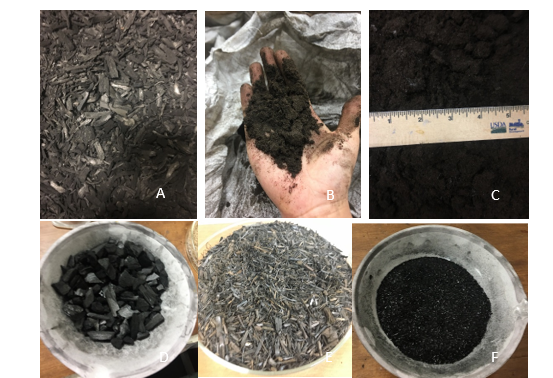
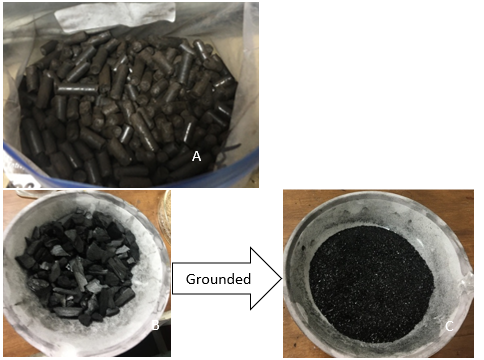
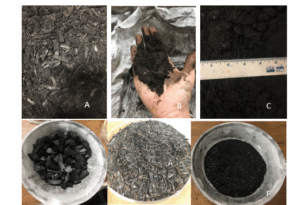
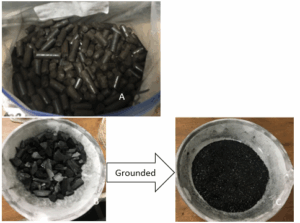
To make things easier, we’ll adopt the most popular definition: biochar is a black carbon-enriched solid with a porous structure and mainly used in agriculture and environmental industry (Figure 1). Biochar is normally made from thermal decomposition of biomass materials at high temperature (300 to approximately 1,200°C) in a little oxygen or no oxygen environment (this process is also known as pyrolysis). Biochar can be produced from pyrolysis of different materials such as pine bark, sugarcane bagasse, rice hull, and straws (Hina et al., 2010 ).
Who Started Biochar Production?
Bioenergy companies are major biochar producers as they produce bio-oil or syngas through pyrolysis with biochar being the by-product. The growing interests of biochar research and use date back to the 2001 energy crisis when a significant number of bioenergy companies launched their facilities for the thriving bioenergy market. For the past year, the fuel price skyrocketed again and presented more opportunities for biochar development.
How is Biochar Produced?
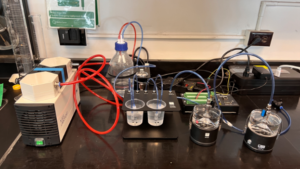
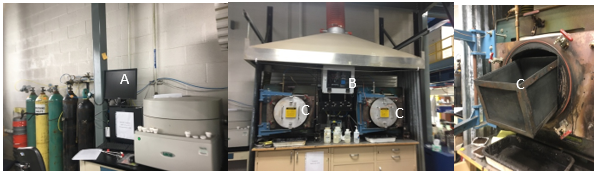
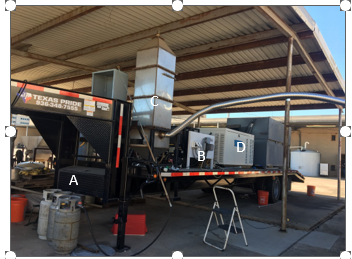
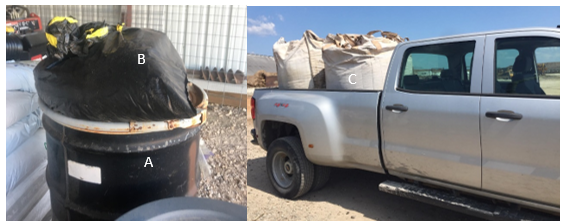
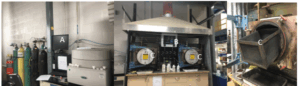
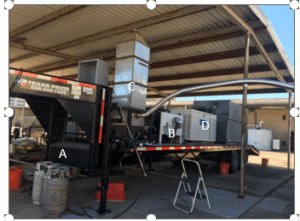
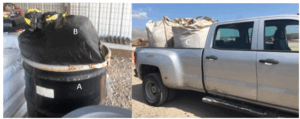
Biochar production system, also called pyrolysis system, normally consists of three basic parts: heating system (Figure 2A, Figure 3A), conditioning control system (Figure 2B, Figure 3B), and biomass receptor/biochar collector (Figure 2C, Figure 3C). In larger biochar production systems, a cooling system is also included (Figure 3D). Industrial pyrolysis systems vary from what’s shown in Figure 2 and 3 in sizes, but the major components are similar. After biochar is produced, they’ll be collected, cooled down and then stored. They can be either stored in open fields (industrial scale) or indoors. They’re normally stored in barrels or plastic bags indoors (Figure 4), which will not cause any dust and safety issues and make transportation easier.
The feedstock for biochar production can be different from the origins and treatments. Feedstocks can be subjected to pre-treatments, such as washing the raw material with distilled water, dilute alkali, acid, or tannery slurry. For the same reason, the end production biochar can vary from feedstock to feedstock. Biochar can also be further treated with post-treatments such as pelletizing, grinding, or blending with other materials such as peat moss, perlite, fertilizer, wood flour, polylactic acid, starch, and soybean-based bioplastics for different purposes (Figure 5).
Many agriculture by-products such as green waste, wood straw, bark, sugarcane bagasse, rice hull, wood, and wheat straw could be used as feedstock for biochar production. The huge agriculture industry in Georgia could potentially provide tremendous amount of agriculture by-products as biochar feedstocks, such as forestry industry wastes, cotton gin trash from the cotton farms, manure from dairy, cattle or equine farms, sugarcane bagasse, pecan shell, rice hull (or other types of hulls), corncob, and crop residuals.
Why use Biochar to Replace Peat Moss?
Peat Moss Environmental Concerns
Over-harvesting peat moss from peatlands has caused many ecological concerns due to the interference of peatland’s ecological functions. Peatland serves as a large natural carbon sink to mitigate climate change, which has been overlooked for years by people, including researchers. Harvesting peatlands for peat moss could reduce the compacity of the C sink, hindering peatlands’ climate change mitigation capacity. Peatland also provides rare habitats for wild animals. Interfering too much with a peatland ecosystem by peat moss extraction may bring challenges to the native animals, forcing them to find new habitats. In some instances, it leads to extinction.
The production and use of peat moss remain a relatively stable trend. From 2015 to 2019, around 165 million tons of peat moss have been produced worldwide. In the U.S., an average about 0.47 million tons peat moss is produced every year, being used in multiple areas. In Canada, around 27,615 tons have been or is currently used for horticulture peat moss production. Among the total acreage, 65% is under production, 17% has been restored or reclaimed, 14% still needs to be restored, and 3% has been converted to other land use. The horticulture-geared peat moss used in the U.S. is mainly imported peat (1.1 million tons in 2019) from Canada, the biggest sphagnum peat producers in North America.
Researchers believe that worldwide peat moss production will decrease in the coming years. The volume of global peatlands has been decreasing at a rate of 0.05% annually owing to harvesting and land development. The good news is that several major peat moss-producing European countries have announced restriction plans. For instance, Ireland’s peat production is expected to decrease over the coming years due to its transition to alternative fuel sources. In 2019, the country announced it planned to stop all peat harvesting by 2028, two years ahead of the previously announced schedule. Finland announced its goal of becoming carbon neutral by 2035, and peat production will be phased out in favor of other forms of noncarbon energy.
Besides all the potential environmental concerns associated with peat moss, the cost is another major concern. The price of peat moss is constantly increasing from $0.62 per cubic feet in 1986 to $4.87 per cubic feet in 2018. The high price of peat moss cuts into growers’ profits.
Biochar and Peat Moss Comparison
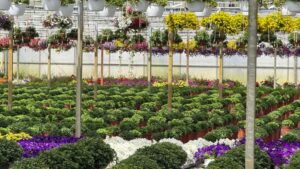
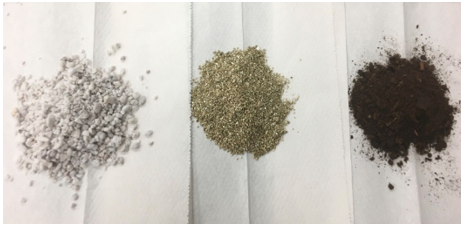
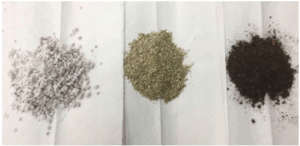
In greenhouse production, major container substrate components include peat moss, vermiculite, and perlite, with peat moss being the key component (Figure 6). Peat moss has long been used as a major container substrate component due to its desirable properties such as low pH, bulk density, high cation exchange capacity, appropriate aeration, and good water holding capacity (Nelson, 2012). However, questions have been raised about peat moss among environmentalists and researchers due to its potential environmental and economic concerns.
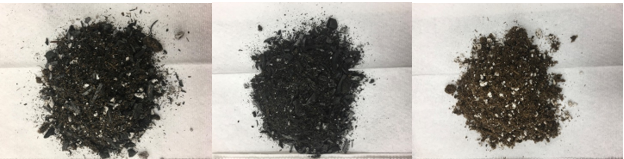
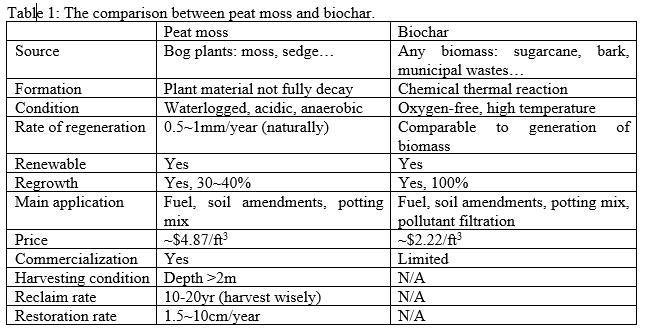
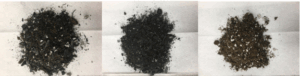
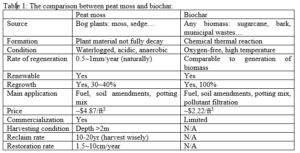
Finding environmentally friendly, cost-effective peat moss alternatives has gained interest among researchers and growers. Biochar, a byproduct of pyrolysis, is considered as a good peat moss alternative for the horticultural industry. Biochar presents a huge potential to address environmental and economic concerns associated with peat moss. Due to the diverse nature of biochar, this substrate can have certain limitations. We compared peat moss and biochar from different perspectives (Table 1) and the mixed hardwood biochar mixed with peat moss-based commercial substrate at 50% and 70% are the two of the most successful biochar-based mixes (based on our research) (Figure 7).
Environmental Benefits
Biochar as container substrate is environmentally and economically friendly. Compared to peat moss, biochar is renewable and faster to regenerate. The raw materials for biochar production can be agricultural wastes such as green waste, rice hull, straw, wood, bark, and organic waste such as city, kitchen and other types of wastes. Those raw materials can be renewed and regenerated within a short period of time, making biochar a renewable and sustainable material. Peat moss needs at least 10 years to renew after being harvested, let alone the fact that the existing peatlands took thousands of years to be established.
Economic Benefits
Since biochar can be generated from various feedstocks, it could be manufactured locally to reduce shipping and handling costs. The average price of biochar is $2.22 per cubic feet, less than half of peat moss ($4.87 per cubic feet). If biochar can be produced on a large scale from local suppliers, the price could be as low as 99 cents per cubic feet. In 2017 in the US, the total amount of substrate used in the special crop (including bedding plants, hanging baskets, flowers, nursery plants etc.) was 5.4 million cubic feet, with 91% being peat. If 70 percent peat moss could be replaced by biochar (studies have successfully proven), a 3.44 million cubic feet peat moss market could be turned into a biochar market, generating $7.64 million value annually.
With the interest in biochar rising, the number of biochar producers has grown accordingly. In 2015, there were approximately 150 biochar supply companies in 2013, with most of them being small garden and specialty retailers. The number of biochar companies increased to 326 and is still growing.
Limitations
Like peat moss and other peat moss alternatives, biochar also has limitations. These limitations come mainly from the potential toxic substances it may contain, the limited awareness of using biochar as container substrates, the unmatured biochar supply-demand loop, and the insufficient production practice involving biochar.
Biochar may contain potential toxic compounds
Biochar may contain potential toxic compounds such as heavy metals, polycyclic aromatic hydrocarbons (PAHs), and dioxin, depending on the feedstocks and producing conditions. Heavy metals including copper, zinc, lead, chromium, manganese and nickel could cause severe damage to plants. PAHs are hydrocarbons—organic compounds containing only carbon and hydrogen—that are composed of multiple aromatic rings. A high PAHs concentration could harm plant growth.
Biochar made from toxic feedstocks contains toxic compounds, which includes heavy metals, PAHs, or chlorine. For instance, biochar made from heavy metal contaminated willow leaves and branches still contained a large portion of the heavy metals from the feedstock. Biochar made from pine wood, switchgrass at certain temperatures could contain PAHs. Similarly, biochar made from feedstocks like straws, grasses, halogenated plastics, and food waste containing sodium chloride could contain dioxin.
Although biochar contains PAHs and/or dioxin, the amounts were usually not a significant problem because they were normally below the threshold values recommended by International Biochar Initiative (IBI) and European Biochar Certificate (EBC), which are 6~20 mg kg-1 and <9 ng kg-1 respectively (Wiedner et al., 2013). Cautions are needed for selecting free or low heavy metal-containing feedstocks for biochar production.
Biochar dusty problem
Biochar tends to have a dust problem, which may lead to safety issues if not addressed correctly. Due to the high temperature in the biochar-producing process, biochar tends to have dusts (very fine, ash-like biochar particles) in the final product. When using biochar, the black dusts could be blown in the air and inhaled by workers. Simple safety practices such as wearing a mask and goggles could be helpful. If safety cautions are not addressed, workers’ safety could be at risk.
Lack of awareness of using biochar as container substrates
Lack of awareness of using biochar as container substrate presents another limitation in biochar application. Even if there is a lot of research of biochar as container substrates in the horticulture industry, people are still unaware of its benefits and thus reluctant to use it. People from both sides (supplier and users) may benefit from knowing about the potential of using biochar as container substrate. Currently, biochar suppliers are not sufficiently aware of research of this product as container substrate. Biochar suppliers are not investing enough on research of biochar as container substrate. Currently, most growers in horticulture are unaware of using biochar as container substrate. Even when some of them are, lack of availability may cause some logistic issues.
Lack of availability
Even with the growing number of biochar suppliers, the number is still small compared to that of peat moss. The demand for container substrate is around 5.4 million cubic feet with 91 percent being peat moss. There are only around 300 biochar companies worldwide, and not all the biochar produced is suitable for container substrates. Because of the unawareness of using biochar as container substrate, growers tend to stick to peat moss as a major container substrate component, which makes the demand for biochar as container substrate small. Companies are not able to produce container substrate-targeted/grade biochar. Even when some growers want to use biochar as container substrate, most of the time they can’t find the biochar they want on the market.
References:
Brioche, A.S. 2020. PEAT., p. 118-119. In: U. United States Geological Survey (ed.), Mineral Commodity Summaries. National Minerals Information Center, Reston, VA.
Carlile, B. and A. Coules. 2011. Towards sustainability in growing media, Milan, Italy 24–28, June 2011.
Hina, K., P. Bishop, M.C. Arbestain, R. Calvelo-Pereira, J.A. Maciá-Agulló, J. Hindmarsh, J. Hanly, F. Macìas, and M. Hedley. 2010. Producing biochars with enhanced surface activity through alkaline pretreatment of feedstocks. Soil Research, 48:606-617.
Lehmann, J. 2007. A handful of carbon. Nature, 447:143-144.
Locke, J.C., J.E. Altland, and C.W. Ford. 2013. Gasified rice hull biochar affects nutrition and growth of horticultural crops in container substrates. Journal of Environmental Horticulture 31:195-202.
Nelson, P. 2012. Root substrate. Greenhouse operation and management. 7th ed. Prentice Hall, Upper Saddle River, NJ:161-194.
Shotyk, W. 1988. Review of the inorganic geochemistry of peats and peatland waters. Earth-Science Reviews, 25:95-176.
Wiedner, K., C. Rumpel, C. Steiner, A. Pozzi, R. Maas, and B. Glaser, 2013. Chemical evaluation of chars produced by thermochemical conversion (gasification, pyrolysis and hydrothermal carbonization) of agro-industrial biomass on a commercial scale. Biomass and Bioenergy, 59:264-278.
Subscribe to eNewsletter