




New Tools Help Cut Flower Growers Make Smart Financial Decisions
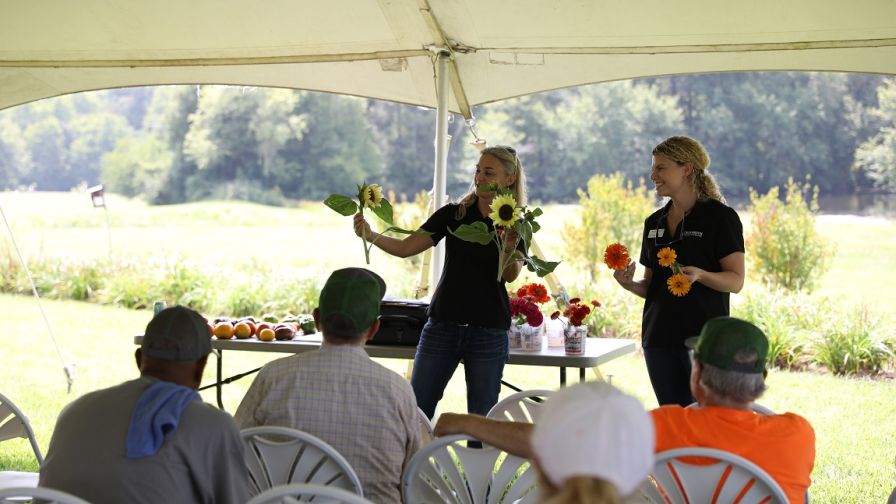
Natalie Bumgarner, left, and Rachel Painter from the University of Tennessee Institute of Agriculture | Celina Menard, courtesy UTIA.
Cut flowers are a rapidly expanding crop in Tennessee, driven by growing consumer interest in locally grown products and by farms diversifying to manage risk and efficiently utilize limited acreage. Population growth and increasing demand for local cut flowers have created opportunities for both new farms and existing operations to enter or expand into this specialty crop sector.
The USDA National Agricultural Statistics Service census data estimates cut flower operations in Tennessee increased by 70% from 2012 to 2017, with nearly 80 farms reporting sales of cut flowers and florist greens exceeding $400,000 in 2017. From 2022 USDA census data, the number of cut flower operations in Tennessee increased to more than 180 cut flower farms, an increase of 133% in the number of cut flower farms from 2017 to 2022.
Tennessee Cut Flower Summer Annual Enterprise Budgets and Publication
To support current and prospective cut flower producers in making informed decisions, University of Tennessee (UT) Extension specialists Rachel Painter, Eryn Bell, and Becky Bowling from the Department of Agricultural and Resource Economics developed five summer annual cut flower enterprise budgets and an accompanying publication. They collaborated with cut flower farmers across the state and Natalie Bumgarner and Celeste Scott, Extension specialists in the Department of Plant Sciences, to ensure the budgets reflect practical production and management considerations for Tennessee growers. Bumgarner and Scott provided data from two cut flower production trials conducted at two UT AgResearch and Education Centers across the state.
These tools allow users to evaluate the potential costs and returns of producing and marketing cut flowers under typical Tennessee conditions. The budgets include projected costs for inputs, labor, and marketing, as well as estimated revenues for popular summer annual crops, including single-stem sunflowers, zinnias, cosmos, celosia, and gomphrena.
“Our goal in developing these budgets is to provide Tennessee farmers with practical, research-based tools to plan and make informed business decisions,” says Rachel Painter, UT Extension Farm Management Specialist. “They offer a clear view of the financial considerations in cut flower production and help producers evaluate profitability before planting a seed.”
The Tennessee Cut Flower Summer Annual Enterprise Budgets and publication are available on the UT Department of Agricultural and Resource Economics website at arec.tennessee.edu/extension/budgets.
As prices and production conditions vary by region and season, the budgets are intended as planning tools to guide decision-making. Producers are encouraged to adjust inputs, prices, and practices to reflect their own operations for the most accurate results. For assistance in utilizing any of the budgets or decision aid tools for your farm, contact your farm management specialist at manage.tennessee.edu.
Agriculture Research at the University of Tennessee System
In cooperation with the Tennessee Department of Agriculture, the project is funded in part by a USDA Specialty Crop Block Grant. Additionally, the University of Tennessee Institute of Agriculture is comprised of the Herbert College of Agriculture, UT College of Veterinary Medicine, UT AgResearch, and UT Extension.
Subscribe to eNewsletter
