



Green Legacy: Building a Legacy From the Ground Up
 November 16, 2025
 Planning a floriculture trial often takes months of prepping grounds, contacting breeders, and getting the word out. Planning your first trial should take even longer. Now imagine tackling that while also launching a brand-new business, and the timeline stretches even further.
But once you meet Dan Van Wingerden, the owner of Green Legacy in Orient, OH, it quickly becomes clear how he managed to establish a successful trial garden in just a few short months, all while building his company from the ground up.
So, how did he do it? Van Wingerden credits two key factors:
- Support from others in the industry.
- A refusal to overthink the process.
“Sometimes you spend too much time thinking about what to do,” he says. “In our case, we decided to just take action and see what happens.”
How Green Legacy was Formed
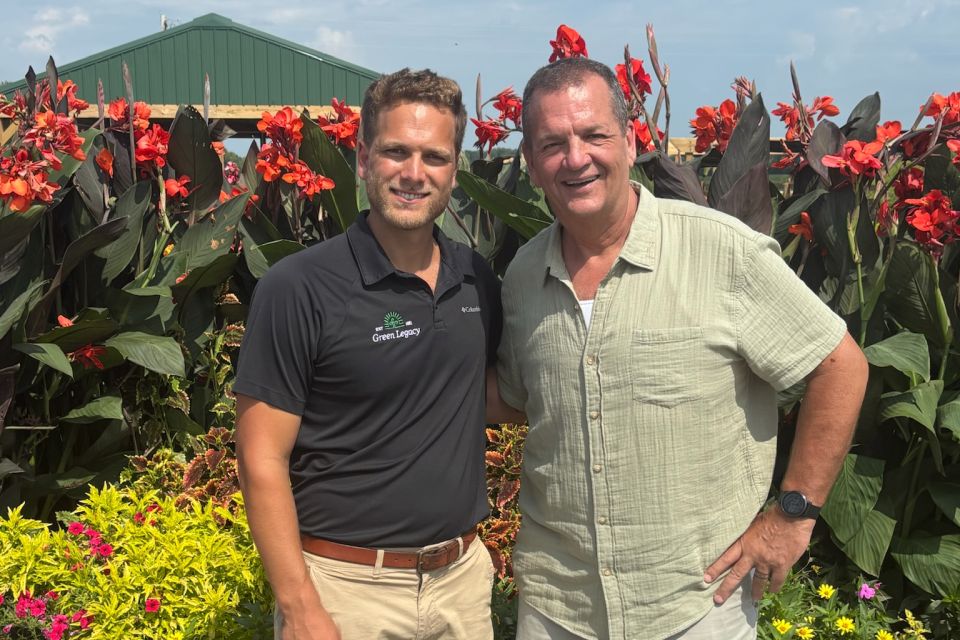
Green Legacy’s Dan Van Wingerden (L) and Gary Clark (R) of EMI Landscaping at Green Legacy’s trial gardens. | Brian Sparks
The roots of Green Legacy go back to 2019, when Van Wingerden was still working at Color Point Nursery, a family-run business in Kentucky. When Color Point announced it was shifting to hemp production, he decided it was time to step away and forge his own path.
“At that time, I didn’t know if I was going to be a greenhouse operator or work for a family member,” says Van Wingerden. “To buy time, I went back to school to learn more about engineering ideologies and lean flow processes.”
Van Wingerden soon learned of a property outside Columbus, OH, owned by Cuthbert Greenhouses, that was about to go on the market. Along with his uncle John Van Wingerden (owner of Green Circle Growers) and his dad Art Van Wingerden (co-owner and founder of Color Point in Paris, KY, and Granville, IL), he met with David Cuthbert in June 2020, toured the facility, and immediately saw its potential.
“My uncle John even jokingly told me, ‘If you don’t buy this property, I will,’” Van Wingerden says. “That was his way of saying it was a great opportunity.”
Both parties hoped to close the deal by January 2021, but there was one obstacle. As a recently unemployed grower, Van Wingerden wasn’t sure how he’d secure the financing to make it happen.
A Little Help from His Friends
The next step in turning Van Wingerden’s vision into a reality came through Aaron Stoller at Ag Credit, who helped him secure a government grant for young, first-time farm owners. The grant covered the down payment on what would officially become Green Legacy.
“My dad and uncle have fantastic relationships with vendors and banking partners, which was a big help,” Van Wingerden says. “It just goes to show what good, honorable business does in the long term.”
From there, he visited growers and family members across the country, letting them know he had just bought a greenhouse and was ready to fill it with plants. Those conversations led to a series of contract-growing arrangements, providing a foundation for early business and ensuring that once the greenhouse upgrades were complete, the plants would be waiting. “We couldn’t have succeeded without this early support,” says Van Wingerden.
Still, the next hurdle came quickly. Growing on spec proved especially challenging in the years following the COVID-19 pandemic, as the industry worked through a period of reset and uncertainty.
Fortunately, that early industry support, paired with Van Wingerden’s persistence, soon began to pay off.
A Landscape Focus
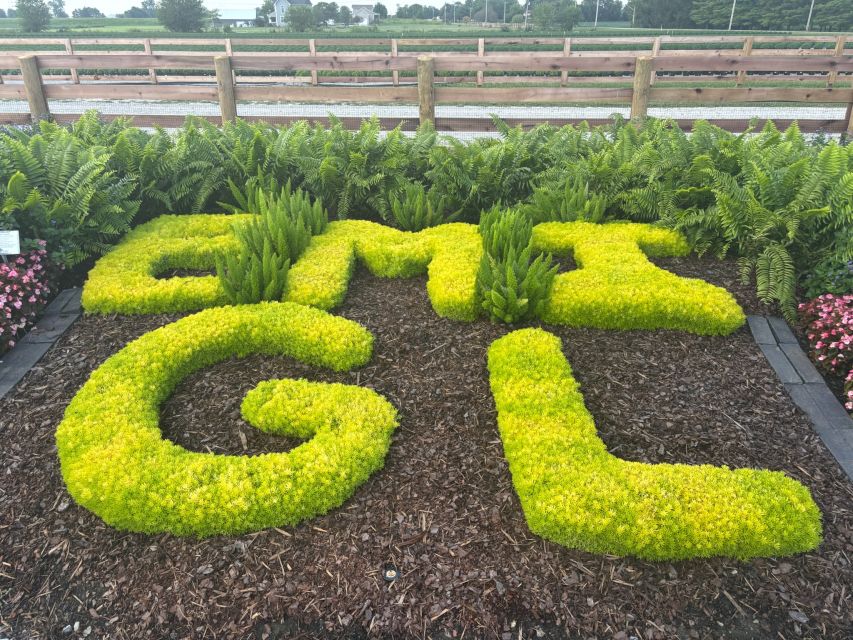
Green Legacy and EMI Partnership
“Our intent was to identify a local marketplace that was underserved, and we landed on landscapers and independent garden centers,” says Van Wingerden.
While upgrading the newly purchased facility, Van Wingerden reconnected with a family friend, Tom Kurtz, who ran a landscaping consulting business serving customers throughout Ohio. Kurtz suggested that Van Wingerden meet with some of his clients to explore potential opportunities.
That advice sets things in motion. Over the next few weeks (in early 2022), Van Wingerden drove around the state trying to schedule in-person meetings. At first, progress was slow, and he nearly gave up. Then a timely follow-up call with Kurtz led to an introduction to Gary Clark, Chief Operations Officer at EMI Landscaping in February 2022.
“Tom opened that door for us, but we also knew we had to execute EMI,” Van Wingerden says. “Once that hit, it opened other doors and allowed us to build our landscaping division and shape our business based on the needs of our now expanding customer base.”
Launching the Trials
It wasn’t until October 2024 that the idea of setting up a trial garden at Green Legacy developed. But once that decision was made, things moved very quickly.
“We were really excited about doing it, but because winter was approaching, prepping the grounds for a trial took a while,” says Van Wingerden. “We didn’t break ground until March 2025 when the ground started to thaw, and by that point, we had already started making calls to breeders to see if they wanted to participate.”
Nearly every breeder Van Wingerden and his team reached out to was immediately on board — something he attributes to two factors: a shortage of Midwest trial gardens and Green Legacy’s focus on landscape performance. “That was a value add-on for us,” says Clark. “We’re able to show our customers how landscape plants should perform in their region.”

Van Wingerden agrees. “For us, it was a great way to add credibility to our name and build connections with both breeders and sponsors.”
The turnaround was fast — just five months from breaking ground to opening the trial gardens — and Van Wingerden admits it’s not a timeline he’d want to repeat. Still, he views it as proof of what’s possible when everyone is committed.
“Our growing team and our customers were all in from day one,” he says. “This could not have happened without the tireless effort from our team and the support of our partners.”
Top Trial Performers
When we asked Dan Van Wingerden about some of his favorite performers from the first year of trials at Green Legacy, his initial response was “Come to the garden and see for yourself!” However, he does mention a couple of personal standouts.
Flossflower Ageratum houstonianum Monarch Magic (Ball FloraPlant)

Flossflower Ageratum houstonianum Monarch Magic. | Ball FloraPlant.
“It’s not just a catchy name. When we would walk through the garden, we’d see 50 butterflies hanging around it.”
Spider flower Cleome hybrid Señorita Rosalita (Proven Winners)

Spider flower Cleome hybrid Señorita Rosalita. | Proven Winners
“To see how they’ve bred it to perform all season long has been incredible.”
4 Lessons Green Legacy Learned in Launching a Trial
- Start with a solid foundation. Preparing your plant beds properly is critical – without it, you won’t get a good finish.
- Fertilization matters. Green Legacy plans to incorporate slow-release fertilizer applications moving forward to maintain consistent performance.
- Focus on fundamentals. Staying on top of irrigation, pruning, and general maintenance makes all the difference.
- Balance show and science. Find the right middle ground between a beautiful display garden and a true trial garden. Collect data from your trials that you can share with your customers.
First-Year Success Leads to Future Plans
While the first year of plant trials at Green Legacy focused on beautification and demonstrating the potential of the new gardens, Van Wingerden says the next few years will shift toward performance and measurable results.
“We hope that those who came to our trials this year, whether they are customers or not, left wanting to do business with us,” he says. “Now, it’s about delivering what they want. Our quality will be defined by our customers, which means we need to provide 100% of what they want. It doesn’t matter if we give them the most beautiful pink petunia if they wanted a red one.”
Ultimately, Green Legacy’s goal is to strengthen the local marketplace for independent garden centers and landscape professionals by helping them solve challenges and meet customer needs more effectively. “That’s our vision,” says Van Wingerden. “That’s the ultimate purpose of our trial gardens.”
Subscribe to eNewsletter
