



4 Plant Consumer Insights to Watch in 2026
 January 10, 2026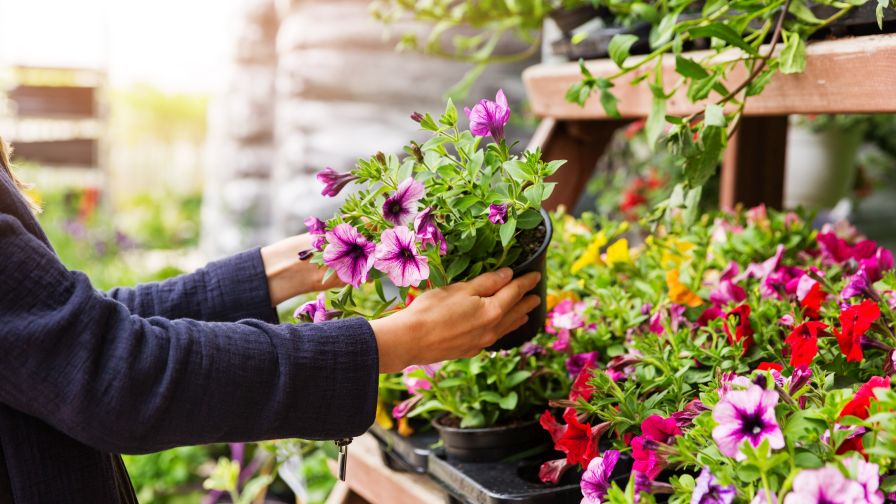
A woman shopper choosing petunia flowers at a garden plant nursery store. | ronstik via Adobe Stock
It’s the season to start thinking about 2026. As we wrap up 2025, we can look ahead to a new year and new opportunities. As a human behavior specialist, I’m often asked, “What will consumers want and do next?” To answer that, I took a close look into my magic professor crystal ball (also known as data) and pulled a few insights growers can put to work.
1. Sustainability
Horticulture consumers care about the environment. New data from the Knuth lab shows that many plant buyers are knowledgeable about sustainable practices and are intrinsically motivated to choose sustainable products.
Historically, that interest hasn’t always translated into higher spending. Over the past five years, however, that has shifted. U.S. consumers, including plant buyers, are increasingly willing to pay more for products tied to sustainable practices, especially when claims are verified and clearly communicated on products. That creates a major opportunity in the new year to re-engage loyal customers and strengthen value perception.
2. M-commerce and E-commerce
New word alert: m-commerce. Short for mobile commerce, m-commerce has taken over much of the digital marketing space and is now a key metric being tracked. While e-commerce once referred broadly to online sales, most consumers today are searching for and browsing products on their mobile phones rather than on desktops or tablets.
In 2023, one report showed that 80% of e-commerce traffic came from mobile devices (e-Marketer). More recent data from 2025 indicates that mobile still dominates, accounting for approximately 78% of traffic, compared with 21% on desktop devices, while mobile sales represent 71% of total sales versus 29% from desktops (Statista).
Why should you care? If most consumers are browsing and buying on mobile devices, the industry must be prepared to present products in the way consumers are looking for them. If mobile experiences fall short, consumers simply will not “see” the products and will be blind to available offerings.
In addition, horticulture does not compete only within its own industry. It also competes with alternative products in other categories, many of which already offer mobile friendly websites. To remain competitive, the industry must be visible and accessible to consumers on mobile platforms.
3. Conversational Marketing and Digital Word of Mouth
Short-form social media video has been popular in the U.S. for a while, and my colleagues and I have discussed it often at industry events. What I’ve seen take off recently is a casual, conversational style of short-form videos. This format builds connections and encourages dialogue in the comments between the video creator and viewers. It has become highly effective.
In practice, it often starts with simple openings such as, “Hey everyone, here’s what we are doing today,” or other familiar introductions that create a sense of relationship with followers, whether an account has 50 followers or 50,000. That conversational tone also translates well when recommending products and services.
This connects directly to digital word-of-mouth behavior. Trust is an area I have focused on closely over the past two years (and we will have more research from my lab on this topic in 2026). In the U.S., people trust recommendations from family and friends more than any other source, and that has remained true from 2019 through 2025. When we apply this to horticulture, nearly all consumers consider reviews and peer opinions (family, friends, and other shoppers) before purchasing products online.
Research that Dr. Alicia Rihn (University of Tennessee), Dr. Bridget Behe (Michigan State University), and I have conducted also shows that nearly half of horticulture consumers are browsing and purchasing online.
For growers, this creates an opportunity to build digital relationships with consumers and encourage online word of mouth. The goal is to satisfy consumers so well with products and services that they talk about their experience and share recommendations in digital spaces. That kind of peer-to-peer engagement carries weight because it comes from the sources consumers trust.
One of the easiest ways to start is by observing what already works. Review high-engagement accounts (strong comment sections, reposts, and shares) in product categories outside of horticulture and study how they interact with their audience. Bonus points if those accounts target similar markets to yours. Then adapt the approach to your brand.
Key questions to study:
- How do they start the video?
- On average, how long are their videos?
- Do they link product pages in the video and in their profile?
- How do they prompt and sustain engagement?
4. Be Aware of Negative Perceptions About AI
The word “AI” has been on everyone’s tongue this year, so I’m sure you aren’t surprised that I’m sharing a perspective on it. It can help improve operations and process large datasets, but the conversation around AI is not universally positive. Growers should be aware of both the benefits and the skepticism. I’ll discuss some general concerns below, but this is far from a comprehensive list, and I won’t get into policy or labor considerations here.
Why Skepticism Matters
Not everyone trusts AI, and some people are afraid of it. Research suggests logic and emotion are not opposites, but separate forces that shape decisions. In other words, someone can understand the facts about AI and still feel cautious or mistrustful.
People also trust AI unequally based on its application. For example, in healthcare, AI is used to find trends in medical data across populations and streamline information processes. Some concerns center on individual personal data protection when AI is used with sensitive healthcare information. Yet consumers are generally okay with AI use in smartwatch and fitness tracking applications, though they may not realize AI is involved, which can change their attitudes towards these features.
Another domain is autonomous vehicles, which is a highly contentious use of AI due to concerns about safety and situational failure (Afroogh et al., 2025).
In marketing, AI is commonly used as a “virtual assistant”, which many consumers see as generally trustworthy, though sometimes annoying when a chatbot isn’t intuitive enough to handle a complex request.
Deepfakes and the Trust Gap
Recently, an interesting article came out about YouTube’s AI deepfake tracking tool, which removes AI-generated videos that exploit creators’ likenesses without their permission (CNBC, Dec. 2, 2025). Deepfake videos are controversial and create mixed feelings among online users.
Many people can’t tell what an organic video is versus an AI-generated video. This is generally true for AI-generated text content as well (Diel et al., 2024). I’m sure some of you get videos shared from family members asking, “Is this real?” where the video shows something like inserting a kiwi into a banana peel and growing a “new hybrid species”, which is not physically possible.
Why is this a big deal? If misinformation spreads and people can’t tell what’s real, we enter an era where trust erodes. If you’ve read my content before, you know my main message to industry members: Trust is loyal. Loyalty is repeat purchasing. Repeat purchasing is the golden ticket to sustained sales.
Without trust, we risk losing repeat consumers. If consumers feel duped, they can become mistrustful and turn away from your business in the future.
Infrastructure Impacts Shape Public Perceptions of AI
There are also some high-impact discussions happening about AI and general data centers being built in rural communities across the U.S. Some communities report negative impacts from increased electricity costs and reduced water pressure.
Data centers use a considerable amount of water to cool the hundreds of processors and are high-demand consumers of electrical energy. Indirectly, high electricity demand can lead to higher per-watt costs for other users. When suppliers can’t keep up with demand, costs can increase. Some communities report cost increases of up to50% i from 2024. In other communities, water pressure has been severely affected due to overburdened water infrastructure that wasn’t upgraded before the data center was built (BBC; NPR; Stanford University; Lincoln Institute of Land Policy).
For example, a Google hyperscale data center uses 550,000 gallons of fresh water every day last year. This equates to about 0.26-2.4 gallons of water used per kWh of server energy. Hyperscale data centers are on the larger end of the spectrum, but there are approximately 11,000 data centers globally, for perspective (University of Illinois).
As a South Dakota native, I care greatly about rural Americans and rural communities. I’ve been keeping my finger on the pulse of this discussion, and I hope you consider looking into it as well.
Takeaways for Growers
The takeaway is transparent, practical AI usage. Though these discussions are ongoing and public opinion is mixed, if you use AI, the best way to build trust (positive emotional connection) is to be upfront about where AI is used in your business and how it is used (logic).
If you use AI to create a marketing image, let consumers know. Second, focus on practical use. When you pull up a generative AI tool, consider whether you really need the AI assistant toggled on for each search. There are opportunities to use AI in ways that benefit society, but we also need to be aware of its positive and negative implications.
These are a few of my magic crystal ball “visions” for the new year. Growers have diverse opportunities to build relationships with consumers and customers in 2026. The conversation doesn’t stop here, either. As we gather more data and have more interaction, the conversation will evolve.
Subscribe to eNewsletter