


AI-Powered Sticky Card Analysis Trialed at Michael’s Greenhouses
 February 17, 2026
 Michael’s Greenhouses, in Cheshire, CN, has been trialing AI-powered analysis of sticky card traps using the PATS Trap-Eye system across three greenhouses. The system received a real-world test during poinsettia production this fall. We caught up with head grower Laurie Conlon about how the trial performed.
How the Trap-Eye System Works
The Trap-Eye system is a collaborative development between Biobest, a sustainable crop management company, and PATS Indoor Drone Solutions, a Netherlands-based greenhouse pest management company. While PATS is known for its autonomous scouting drones, the company has also been developing computer vision and AI tools for pest monitoring.
According to the companies, the Trap-Eye system automatically captures images of sticky traps and uses AI to identify and count insects on the cards. The system uses proprietary yellow Trap-ID sticky cards developed in cooperation with Biobest.
Hardware Setup and Greenhouse Placement
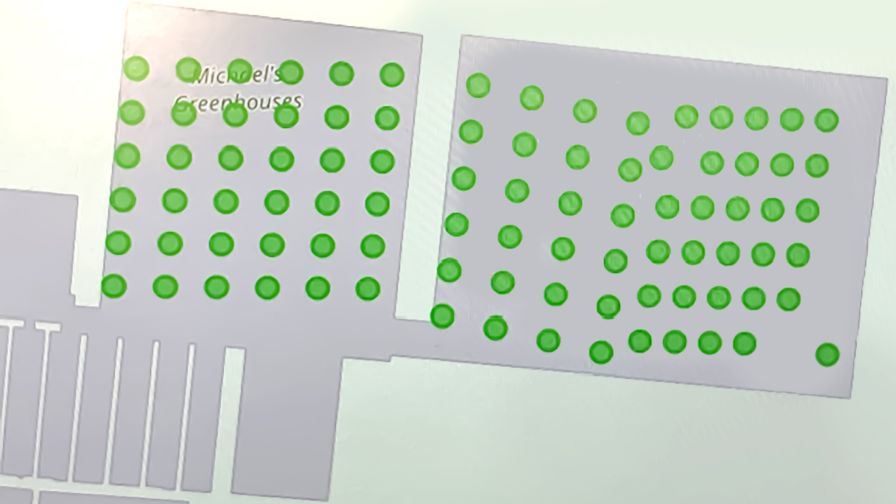
A digital greenhouse map displays monitoring device locations as green dots that change color as whitefly pressure increases. | Michael’s Greenhouses
Small devices equipped with a camera and sticky card holder are mounted throughout the greenhouse, positioned just above the crop canopy. The units are solar-powered, wireless, and networked to a central gateway. Only the gateway requires a power source and internet connection, eliminating the need for additional wiring or cables.
PATS recommends installing approximately 40 devices per hectare, or roughly one unit per 2,700 square feet. Each device is lightweight — about the size of a 13-inch pot — and includes a strong magnet for mounting, though it can also be secured with a zip tie when needed.
Images captured by the devices are uploaded to the cloud, where AI software analyzes the data, counts target insects, and tracks population changes over time. The system generates a dashboard that allows growers to view heat maps showing pest pressure by location within the greenhouse and compare insect counts against user-defined action thresholds.
Installing Trap-Eye at Michael’s Greenhouses
Michael’s Greenhouses has installed approximately 90 Trap-Eye devices, monitoring about 5 acres across three greenhouses. Laurie Conlon says they used the system for the first time on poinsettias during the 2025 season.
“The system takes a picture at noon on Tuesdays, Thursdays, and Saturdays,” Conlon says. In addition to AI analysis, she can review the images from her desk or even her phone, allowing her to verify what the system is detecting. She notes the images are very clear.
Each Trap-Eye device is mapped using a QR code and companion app, creating a visual layout of the greenhouse within the desktop interface.
“The desktop interface shows a map of the greenhouse with each monitoring device displayed as a green dot,” Conlon explains. “If whitefly numbers start to build, the dot turns yellow, then orange, and eventually red.”
Action thresholds for these color changes are set by the grower based on experience.
“If I don’t want the alert to turn red until there are 25 whiteflies detected on a single sticky card, I can set it that way,” Conlon says.
Results in Poinsettia Production
According to Conlon, the Trap-Eye system has performed well so far. While the system is currently limited in the range of pests it can detect on sticky cards — an area she would like to see expanded — it has proven highly accurate for whiteflies and thrips, two of her most persistent challenges.
“The system is very accurate,” Conlon says. “When it first started identifying whiteflies on the cards, I pulled up the images and counted them myself, and was shocked at how accurate it was. Whiteflies and thrips are both hard to identify on a sticky card, and it does a very good job with both.”
Earlier Detection and Decision-Making
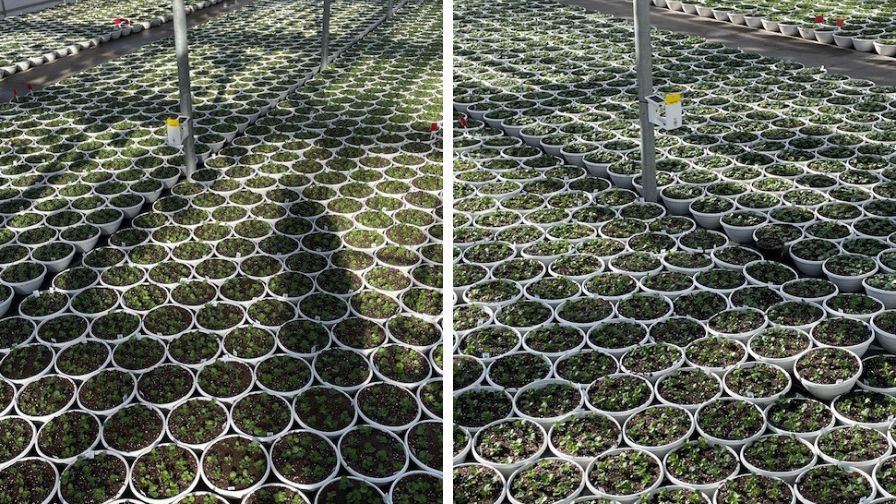
Trap-Eye sticky traps are deployed throughout the greenhouse to monitor insect pressure across the crop. | Michael’s Greenhouses
Although the Trap-Eye system does not replace the need for experienced decision-making, it has provided earlier detection than traditional scouting methods. Conlon says the system identified whiteflies one to two weeks earlier than she believes her staff would have through routine scouting, giving her more flexibility in how she responded.
Michael’s Greenhouses uses a biological control program on all poinsettias and aims to minimize chemical applications. Conlon says the operation did not apply any insecticides to its poinsettia crop during the trial.
“I was watching the whitefly population, and there were a few areas where numbers were starting to build and make me nervous,” she says. “My plan was to come in over the weekend and spot spray so I didn’t have to treat everything. The system showed the population had started to dip, so I waited for the next round of images before deciding. When Saturday came, the population had stabilized enough that I felt comfortable not spraying.”
Labor Savings and Operational Benefits
The system also delivered labor savings by reducing the time required to manage sticky cards. Trap-Eye cards only needed to be changed once per month. “It’s not replacing a person, but it saves the labor of changing sticky cards every week,” Conlon says. “With our regular cards, one person might spend six hours replacing them.”
In the greenhouses where Trap-Eye is in use, Michael’s no longer relies on traditional sticky cards, though they are still used in other houses. Between fewer card changes, automated counting, and simplified data tracking, the system has reduced labor-intensive tasks.
Earlier detection also allows Conlon to target biological controls more effectively and, in some cases, delay or avoid chemical applications. She expects the benefits to become even more pronounced as the season progresses and thrips pressure increases.
Subscribe to eNewsletter