



Rethinking Recruitment in Floriculture
 February 27, 2026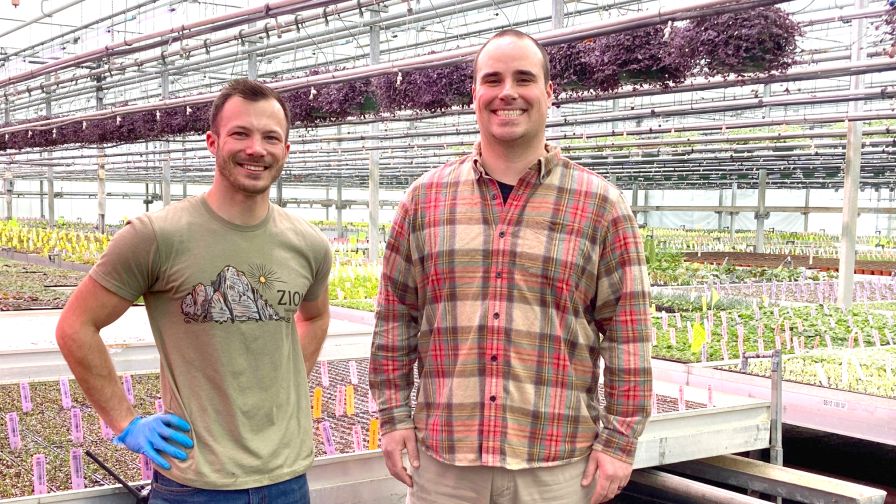
Eric Zett (left) recently joined the growing department at D.S. Cole Growers, while Ian Hanson (right) began working in the young plants planning department this fall. Both cited company culture as a key factor in their decision to join the operation. | D.S. Cole Growers
The floriculture industry has placed a strong emphasis on training and employee retention in recent years, and for good reasons. But before either of those efforts can take hold, businesses must first succeed in bringing new people through the door.
That’s where many operations face their greatest challenge. Posting job openings is only part of the equation; recruiting today also requires being intentional about the type of team members you’re seeking and the workplace culture you’re able to offer.
In this article, three growers in leadership roles at long-established companies share the strategies they’re using to attract new talent in an increasingly competitive labor market.
Sustainability as a Recruiting Advantage
D.S. Cole Growers in Loudon, NH, was an early adopter of integrated pest management, and the company’s focus on environmental sustainability has become a meaningful differentiator in its hiring efforts.
“A lot of our potential employees, whether they’re working in production or in the office, have degrees in sustainable agriculture or environmental sustainability,” says Head Grower Chris Schlegel. “When we talk about having a strong IPM and biologicals program, it really resonates with them. If they haven’t been part of the horticulture industry before, it becomes a common denominator.”
That interest is reflected in how the company allocates resources. “We spend more on beneficial insects and their application than we ever have,” Schlegel says. “We do so not only because they work, but because for new employees, it’s far more appealing than being in the greenhouse spraying chemicals.”
D.S. Cole Growers has also participated in several certification programs over the years, including MPS-ABC for sustainable practices and the Systems Approach to Nursery Certification (SANC).
“When we’re recruiting, we’re able to say that we maintain a high level of customer satisfaction because of our environmentally sound practices throughout production,” Schlegel says.
Rethinking What Job Candidates Value
Biocontrols also play a role in the recruitment process at Foertmeyer & Sons in Ohio. In fact, any job posting for the company often references its commitment to biological pest control.
“Whenever I interview someone, I give them a peek behind the curtain into how we run our IPM program,” says Matt Foertmeyer, Owner and Growing Operations Manager at Foertmeyer & Sons. “If the candidate will be directly involved in growing, I also include our IPM manager in the interview.”
Beyond highlighting the company’s approach to pest management, Foertmeyer has also drawn from personal experience to rethink how his operation attracts talent. He was part of the Horticultural Research Institute’s inaugural Leadership Academy (HRILA) class in 2023, where the group’s capstone project focused on workforce recruitment.
“For my HRILA project, we surveyed students enrolled in horticulture programs at seven universities to identify which benefits mattered most to them,” Foertmeyer says. “The top three responses were health insurance, overtime pay, and paid holidays.”
Since completing the Leadership Academy, Foertmeyer has applied many of those insights to his hiring approach.
“We highlight schedule flexibility and let people know that while specific weeks of the season or year will require an extra time commitment, there are opportunities for more time off during non-peak periods,” he says. “We don’t want our employees to average more than 40 hours a week over the course of the year.”
Foertmeyer notes that this approach still runs counter to traditional thinking in parts of the horticulture industry.
“We complain about how hard it is to attract young talent, but we haven’t changed our own mindset about what we demand from employees,” he says. “It’s time to make some concessions so we can build a healthy workforce, instead of scraping the bottom of the barrel just to get someone in the door.”
Hiring Beyond Horticultural Experience
One recruitment strategy that has worked well at Breezy Hill Nursery in Salem, WI, is looking beyond floriculture and even beyond the horticulture industry entirely.
“Running a nursery means running a business, and as we’ve scaled up, we realized we needed to focus more on processes and communication,” says John Terhesh, Vice President of Breezy Hill. “We’re comfortable training people on the horticulture side, but it’s much harder to teach someone how to follow procedures. That’s why we prioritize those skills when hiring.”
Aside from the head grower, who came from the controlled-environment agriculture (CEA) sector, the most recent hires at Breezy Hill, from sales to inventory management, have had no prior experience in horticulture.
“Industry knowledge can be taught, but curiosity, organization, and leadership skills can’t always be taught,” Terhesh says. “Even for the head grower position, we looked at where we wanted to take the company. We didn’t need the strong grower side; we needed those other skills.”
Bringing in employees with outside perspectives has helped the Breezy Hill team challenge long-standing assumptions about how the business operates, Terhesh adds. “Good pay can only go so far today,” he says. “People want to work somewhere where they feel like they’re making a difference.”
Finally, Terhesh emphasizes the importance of setting clear expectations early in the hiring process.
“We have a ‘hire slow, fire fast’ mentality,” he says. “Our industry tends to hold onto people longer than we should, even when it’s clear they’re not a good fit. We need to get past that.”
Subscribe to eNewsletter