



Celebrating Nicki Graf’s 37-Year Floriculture Career at Rutgers University
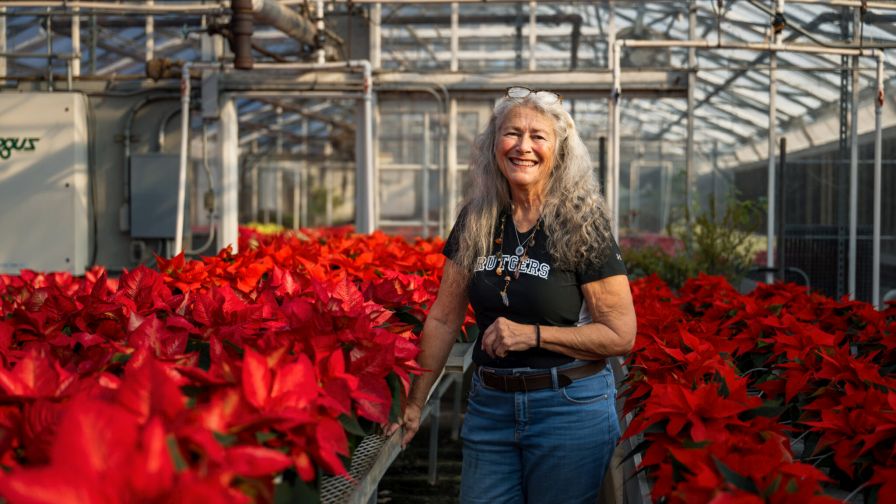
Nicki Graf in a floriculture greenhouse. | Rutgers University, School of Environmental and Biological Sciences, and Rutgers Office of Public Outreach and Communication, Photographer Chris Gutierrez
The Floriculture Greenhouse, with its towering smokestack, has long been a joyful place for plant-minded people at Rutgers University. One of the oldest buildings on campus, the Floriculture Greenhouse originally served as a research station focusing on cut flower production and preservation while doubling as a dynamic classroom for the teaching of Horticulture coursework. As research initiatives changed, so did the role of the greenhouse, which now serves as a hub for student experiential learning, plant related instruction, and Rutgers community wellness.
At the root of this evolution was Nicki Graf (CC’77), who operated and oversaw the greenhouse from 1988 to 2025. Nicki’s heart has been on the George H. Cook campus since studying here as a member of the first matriculating class of Cook College, and her efforts in supporting the educational capacity of the greenhouse have been unwavering.
An annual keystone of Nicki’s efforts was growing a trial of poinsettias, which showcased new varieties of the holiday flower while giving students an opportunity to engage, hands-on, with the commercial production of plants.

Beyond growing plants and supporting plant-related coursework, Nicki was a champion for the student experience at Rutgers. She curated and maintained the botanical collection at the Floriculture Greenhouse, an endeavor that gave students the opportunity to engage with hundreds of plants from around the world while honing their horticultural eye. Between the poinsettia project, caring for the collection, and the development of a raised bed teaching garden behind the greenhouse, Nicki mentored dozens of students, many of whom satisfied their Experiential Learning requirement while working alongside her. Nicki furthered our students’ experiences by building connections with alumni and industry partners, such as EcoWalls, an alumni-founded living wall company whose prototype wall still exists in the foyer of the greenhouse, serving as a site for student experiential learning.
She also empowered students to showcase their plant care efforts at events like the Philadelphia Flower Show, the Southeastern Pennsylvania Orchid Society Show, and the North Jersey Orchid Society Show, which meets on Cook Campus annually. The programs that Nicki started helped many students find their calling, including Lee Hazen (SEBS’19), now a professional gardener.
“If I hadn’t worked at the Floriculture Greenhouse under Nicki, I don’t know if I would’ve developed the confidence I needed to embark into the work of professional horticulture and end up proud of where I am today,” says Hazen.
Above all, the programs and plants that Nicki created served as a vector for wellness. Under Nicki’s watch, the greenhouse became a place where students found community, felt safe, and developed a sense of belonging. From welcoming people to explore and enjoy the botanical collection to always being a thoughtful listener, Nicki excelled in creating a comfortable environment for our community.
For a more thorough reflection on Nicki Graf’s many accomplishments, please read the original article published by the Rutgers School of Environmental and Biological Sciences and the New Jersey Agricultural Experiment Station newsroom.
Subscribe to eNewsletter