



Greenhouse Labor’s H-2A Lifeline
 January 15, 2026
 Chronic labor shortages have long plagued greenhouse and nursery operations. In recent years, that pressure on day-to-day efficiency has intensified, evolving into a broader threat to profitability.
For many operations, the H-2A program has become a viable, and often essential, tool for managing acute labor shortfalls that the domestic workforce cannot fill. While it is not a perfect solution, many growers say the program’s benefits outweigh the challenges, making H-2A a critical lifeline for securing the workforce they need to maintain production capacity and meet client commitments.
Why Growers Turn to H-2A
Many growers who adopt the program rarely leave it, a sign of its practicality and effectiveness, says Justin Bartlett, Co-Founder, Co-CEO, and Director of Sales and Marketing at Legacy Labor, a farm labor contractor providing temporary, seasonal labor to horticulture and agriculture clients in 19 states.
“They know the H-2A program works once they get into and start using it,” Bartlett says. “It’s a better solution than what they’ve been trying to do with domestic labor, which, honestly, is not always available or reliable. So, H-2A is a viable program.”
Below, floriculturists share their experiences and explain how the H-2A program has helped them maintain workforce continuity and better manage strategic market pressures.




Building Culture and Accountability at Moss Greenhouses

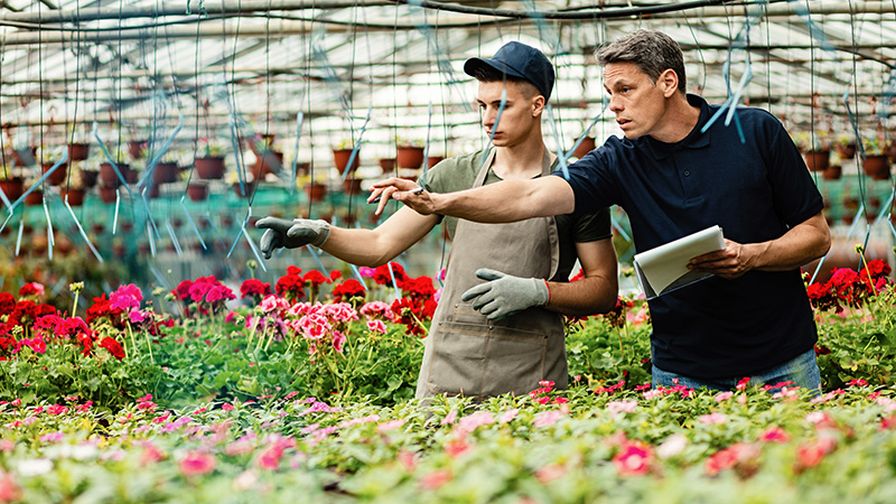
Seasonal H-2A workers at Moss Greenhouses support key production operations during peak periods. | Moss Greenhouses
Annual and perennial grower Dewey Moss of Moss Greenhouses in Jerome, ID, weighed the H-2A program’s pros and cons for nearly a decade before finally committing to it two years ago. Mandated wages that exceeded his starting pay and the need to provide housing were initial hurdles. However, crippling seasonal staffing fluctuations and consistently unreliable domestic labor ultimately pushed him to try the program, bringing in eight workers in 2025 to staff a department with a long history of attendance issues.
“I don’t know why we didn’t do this sooner,” Moss says nearly a year later. “We got a really good batch of workers … the eight guys were great. They work very hard, and they are eager to please. We had no issues, and they obviously value this program quite a bit.”
Strategically, Moss believes that fully integrating the eight workers into Moss Greenhouses’ culture, rather than treating them as outsiders, has been key.
“We really focused on making sure they felt like they were a part of our family here,” he says. “We incorporated them into everything that we do, so they didn’t feel like they were just sent here to work away. We involved them in our core values and recognized them when they did a good job. We really involved them rather than just treating them like the H-2A guys.”
An unintended but positive consequence was the reaction of the operation’s existing domestic labor.
“Our other employees got more engaged because they witnessed the complete shift in this one department we had the H-2A guys in,” Moss says. “Our domestic workers began working harder because they watched these guys work circles around them.”
Moss plans to double his H-2A labor force in 2026 to 16 workers, with the goal of replicating the success in another department that has struggled with labor inconsistency.
Creating a Stable Seasonal Workforce at T&L Nursery
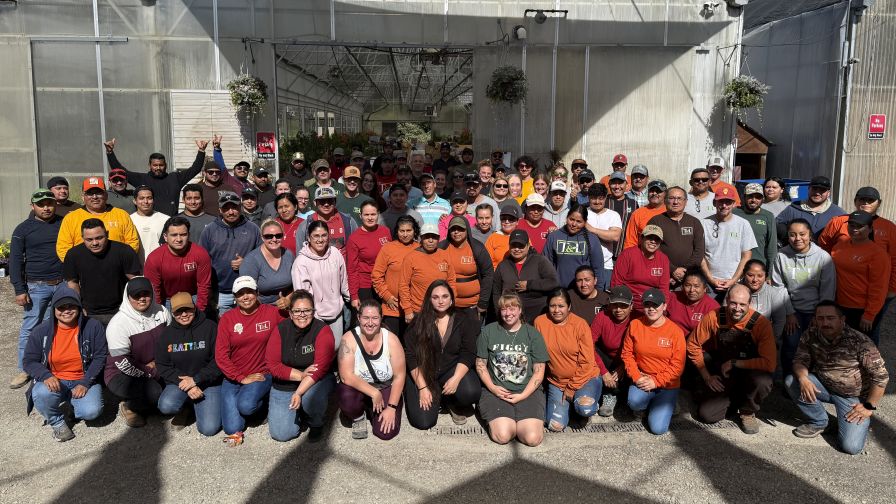
T&L Nursery relies on the H-2A program to support its spring operations. | T&L Nursery
Based in Redmond, WA, T&L Nursery, a finisher of perennial plants, faces a distinct labor challenge. The local workforce does not view horticulture as a traditional career path, and the nursery cannot sustain the area’s high wage expectations, where starting pay often runs around $25 per hour.
For the past two decades, H-2A has fundamentally transformed T&L Nursery’s operations, says Managing Director Ian Herrera. The program accounts for nearly half of its peak workforce of 150 during the busy spring production season.
“If I could reasonably find and hire everybody locally, I would,” Herrera says. “The reality is that, in my region, the available supply of those interested in seasonal jobs, at a rate that makes sense financially for us, is very limited. H-2A, first and foremost, has been able to provide us with a regular, consistent supply of talent that we otherwise struggle to fulfill.”
T&L has also achieved exceptional retention rates among H-2A workers, often reaching 95%. Returning workers reduce the need for extensive training because they’re already familiar with the nursery’s systems and processes, which Herrera considers a significant and ongoing competitive advantage.
“We’re at the point now where we’ve been doing this for so long that we have a couple of stories where a father has come and worked with us for so many years, retired, and then had his son come and fill his place,” Herrera says. “In fact, our H-2A employees have generated a pipeline for backfilling positions that open at the nursery. We have a good reputation with those employees as an employer of choice. So, if a spot opens up, they know a hard worker who would love to come and be part of our company.”
For T&L, H-2A is not a cost-saving measure. Herrera notes that an internal financial analysis has shown no economic advantage. Instead, he says the program delivers a consistent, predictable labor supply, which is essential for managing a seasonal workforce that is otherwise prone to high variability and unreliable performance.
That predictability allows the nursery to plan effectively and meet its operational goals.
“That helps us operate as a well-oiled machine,” he says. “The H-2A workforce is an essential part of our labor team that has flexibility. And we’re able to lean on that flexibility at times to fill scheduling gaps and to keep our year-round workforce more stable, more consistent.”
Subscribe to eNewsletter