


Separating Yourself from Your Greenhouse Business Requires More than Luck
 March 20, 2026
 A successful business transition, whether to family members or for an outright sale, is never accidental. The right buyer is unlikely to appear at the perfect moment, with a pot of gold large enough to fund the rest of your life. Value is something you build through strategic planning and by optimizing the key performance indicators (KPI’s) of your business. It doesn’t just happen. And family transitions fail when handled casually.
Your generation — likely Baby Boomer — is transitioning businesses to a new generation of Millennial business leaders who are very different, in every way. Accepting this reality is the first step in preparing for a smooth handoff.
Why Luck Isn’t a Strategy
Before diving into business mechanics, let’s start with the personal leg of succession —what your life looks like on day one of retirement. After decades of being the face of your company, that identity shifts immediately. Don’t take this lightly. Make sure you have plans: devoting more time toward a favorite hobby, volunteering in your community, expanding your garden, or finally taking that trip to Ireland you’ve been talking about for years. In our 2nd Annual State of Succession and Exit Planning in the Horticulture Industry survey, only 9% of owners said they were personally ready to leave their business.
Whatever it is, have momentum. Your identity in this next phase will be different, and stepping out of the old one is often harder than owners anticipate.
The business leg of the stool calls for you to have a business ready to operate without you. Operations should run smoothly. Your management team should have a book of documented processes, bench strength, and KPI-driven discipline that makes the business better. Successors need clean books, a documented process, and financial transparency. Luck may charm a leprechaun, but it won’t save a successor from sloppy records or tribal knowledge trapped in the founder’s head.




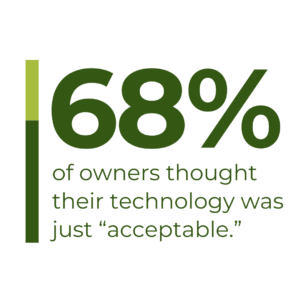 The business leg also includes technology. Automation, integrated systems, and a technology culture make a business stronger and more resilient. Successors want to step into a business where data flows cleanly, processes run predictably, and the team is comfortable using technology to make decisions smarter and faster. Our survey revealed that a whopping 68% of owners thought their technology was just “acceptable.”
To many, the financial leg represents both your personal and business financial leg. A business valuation is often driven by a multiple of EBITDA. Ideally, EBITDA has been steadily growing for the past three to five years. Quality of earnings matters as much as the raw numbers. Seemingly extraneous data points like customer satisfaction (measured by your Net Promoter Score), customer retention, and other KPI’s outside your P/L have a direct correlation to earnings when approached strategically.
Besides revenue, Cost of Goods Sold (COGS) and payroll are two of the most important numbers on your P/L. These two lines tell the real story of operational discipline in your business. If either drifts, spikes, or behaves unpredictably, it signals deeper issues in pricing, purchasing, staffing, or process control. Those issues must be fixed before a sale or succession.
The short version: use your data to build business improvement plans before a sale or family transition, not during one.
The Family (Where It Gets Interesting)
The Irish say, “A house without laughter is no home at all.” The same goes for a family business. And yet, a transition involving family can create tension quickly. Questions arise:
- How do you split ownership among siblings?
- Who has the education, experience, or temperament to lead?
- Who gets voting control?
- Is compensation structured fairly?
Start having the conversation. Our survey revealed that while 46% of respondents have family interested in taking over their business, only half of those owners have started succession conversations.
There are a myriad of truly unique emotional issues and challenges with family successions, but three points are essential
- There must be a person in charge — no co-presidents
- Become a woman-owned business if possible; the benefits are real.
- Do not gift 100% of the company. Your children need skin in the game. They need to make hard decisions about paying for the business, just as you did a generation ago.
Leave a Business with Runway
Build programs that make the business more attractive both to outside buyers and your children. Let them put their spin on it. They are going to be serving tomorrow’s customers for the next 30 years.
Encourage them to build new assortments, add flair to the in-store experience, and integrate organic or modernized products. A business with diversified revenue and strong customer retention is more profitable and resilient. A business that thinks and acts strategically at every level is a business set up to win.
Your Two- to Five- Year Succession Timeline
Assume you have such a window to prep your business for maximum results. You have time, but you must start now.
Map out a timeline, with phases and measurable milestones. Review financials and cash flow regularly. Plan regular stand-up meetings with your management team. Build internal communication plans for employees, customers, and supply chain partners. Know when to bring legal, tax, valuation, and governance advisors into the fold.
Bring in Outside Experts
Succession planning is not easy. If it were, everyone would get it right. Consider working with advisors skilled in exit planning. When done well, the result is a higher valuation, a smoother transition, and fewer conflicts among the family and across the management team.
Your Next Chapter
Ultimately, you want to leave a business that thrives beyond its founder, while giving yourself the freedom to write a new chapter in your story.
As the old saying goes, “The best time to plant a tree was twenty years ago. The second-best time is today.” You don’t need luck to understand that.
Get the Survey
View and Download Your COMPLIMENTARY Digital Copy of the 2025 State of Succession and Exit Planning in the Horticulture Industry Report by clicking HERE.
Also, ask us about the new complimentary PeerReview, a customized report that compares your responses to the full 2025 survey data. It shows where you’re ahead, where there’s room to grow, and what steps others are taking to prepare for transition.
Subscribe to eNewsletter