



Best Practices for Winter Storage and Handling of Growing Media
February is a busy month for most growers as they go into full swing for their spring crop production. Many growers purchase growing media well ahead of time in anticipation of their needs for spring production, whereas some may want to make sure they have the material on hand as needed. They may also be buying ahead of time to avoid delays associated with winter weather, or to take advantage of special pricing. Regardless, this growing media will be stored for many months prior to use. Some of that time will include winter storage, which makes this an opportune time to review best practices for growing media storage so that growers are well prepared.
Although winter storage does not dramatically differ from storage at other times of year, there are still a few key differences to keep in mind. This article offers best practices for growing media storage and the situations that are unique to winter storage, along with handling of media during the winter months.
General Review of Storage Best Practices
Indoor Storage
It is preferable to store growing media indoors whenever possible. When choosing a storage location, look for an area with clean, solid floors and minimal moisture. Avoid placing pallets next to heaters or in areas with excessive sunlight, because this can lead to deterioration of packaging and accelerate the degradation of wetting agents and nutrients contained in the mix.



Stored growing media should be kept on shrink wrapped and covered pallets until time of use to prevent contamination and keep products fresh. Keeping chemical products such as herbicides, insecticides, plant growth regulators, and fertilizers in the same location as growing media is strongly discouraged; however, this is not always possible in warehousing facilities with limited space. If products must be stored together, consider putting up physical barriers to prevent cross-contamination and designating separate zones for chemicals and growing media.
Outdoor Storage
Outdoor storage of growing media is common, and oftentimes necessary, because indoor storage space is unavailable and can require significant capital investment, which may be prohibitive to some operations. If growing media must be kept outdoors, it should remain stacked on shrink-wrapped pallets, and ideally it should be stored on a raised platform or well-draining gravel to minimize exposure to water, soil, and vegetation. Many operations opt to store potting mixes under an open-air roof because it provides protection from the elements at a reduced cost when compared to indoor storage facilities. Covering material with a tarp is the most cost-effective option, but growers should be careful to ensure that tarps are properly placed to prevent pooling of any precipitation and avoid excessive heat build-up.
The primary goal for each of these storage methods is to eliminate excessive sunlight and moisture while simultaneously providing ample circulation to prevent heat build-up. Prolonged heat exposure can result in drying or hardening of growing mixes and degraded wetting agents, resulting in poor wet-out. Excessive precipitation and moisture inside the mix can lead to nutrient loss or activate liming agents, causing rises in pH before planting. All these issues contribute to poor mix performance when growers begin to use the product. It is important to note that whenever products are stored outside, they should not be placed where they are subject to drift, splash, or spray from chemicals used on farms, roadways, or manufacturing facilities. Furthermore, bales or bags kept outside are more likely to pick up drifting weed seeds that get caught in folds or stick to packaging.
Controlled Release Fertilizers and Special Additives
Some growing media manufacturers offer flexibility and convenience by incorporating controlled release fertilizers (CRFs), fungicides, or other biological control products. In these circumstances, special precautions apply to ensure the viability of these components is maintained. Not all controlled release fertilizers are created equal, and therefore manufacturers have specific storage guidelines when they are added to potting mixes. Most CRF manufacturers suggest that potting mixes be used within one week after manufacturing, with some exceptions. Refer to the CRF product label or your growing media company’s technical specialist for specific instructions on longevity and usage of CRF incorporated mixes. Incorporated biofungicides and similar products can also have reduced shelf lives and are affected by storage conditions such as temperature, moisture, and UV radiation. It is critical that mixes containing these products are not only used quickly (typically within a week or two of receipt), but that they are also stored out of harsh conditions.
Shelf Life
Normal inventory rotation practices, i.e. first in/first out (FIFO) should be observed with growing media products. Ensure that your potting mix ships to you soon after being manufactured, and work with your potting mix manufacturer to be able to read and understand their dating/coding system. Many growers choose to mark pallets to clearly indicate which bales or bags to use first. Ideally, all plug and propagation mixes should be used within the first six months after receipt. Growing-on mixes should be used within six to 12 months after receipt. When in doubt, contact your soil supplier’s technical team to determine the viability of the mix.
Storage and Handling of Media in Winter
During the winter months, standard storage best practices still hold. The biggest difference is that mixes are subject to much lower temperatures, including freezing temperatures in many parts of the country and in locations where the growing media is produced. This can lead to some unique issues that growers might encounter that could impact their production. The table below provides a summary of these issues, their potential impact, and how to mitigate them.
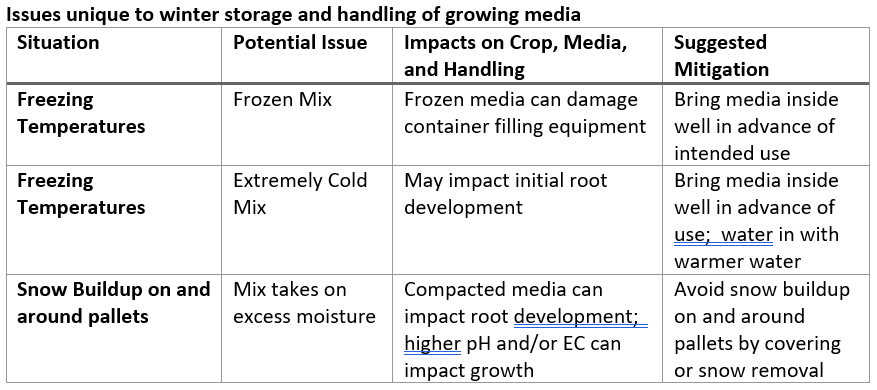
The unique issues that growers face with mix stored during the winter months are freezing temperatures and snow. The freezing temperatures will not dramatically impact the major issues typically associated with storage (wettability, pH, EC) but will affect handling of the mix. If mix freezes solidly, it cannot be immediately used in container filling equipment, because it will likely cause damage to the machinery. Growers will need to make sure they allow time for the mix to thaw. Depending on how deeply the mix has frozen, it can take many days and up to a week or more for the mix to completely thaw once brought in out of the cold.
The other benefit of bringing the mix in to warm up and thaw prior to use is that it will be closer to greenhouse growing temperatures. Plants transplanted into frozen mix are more likely to run into cold shock issues due to the initial frigid temperatures in the root zone. Adjusting the temperature of the irrigation water can also help mitigate potential issues with excessively cold growing media.
Another issue related to winter storage is buildup of snow on and around the pallets of growing media. Excessive amounts of snow can lead to increased moisture in the mix as the snow melts and some of the water from the melting snow finds its way into the mix through cracks and holes in the plastic. The snow can also absorb rain, thereby increasing the amount of moisture that could enter the packaging.
Issues related to the buildup of snow can be more problematic than freezing with respect to the starting pH and EC of the growing media. The mix is likely to have a much higher moisture level, and lime will have begun to react while fertilizer will have become more readily available. Wet mix also does not handle as well in container filling equipment and can lead to overly compacted mix in the flats or pots.
The best way to avoid issues with buildup of snow is to protect the mix in much the same way as you would for high exposure to sunlight. Covering with a tarp or moving mix out of the elements is best. If that is not possible, removing some of the snow before it builds up too much will help.
In the end, growers who follow the common best practices for storage of growing media and prepare for the impact of lower temperatures will successfully avoid any of the unique issues related to winter storage and handling.
Subscribe to eNewsletter
