



Biochar Properties and Guidelines for Making the Right Biochar Mix
 December 18, 2025
 Note: This is the fourth of a four-part series on biochar. You can find the first three parts of the series here.
Container substrates must fulfill several functions for plant growth: create a suitable environment for root growth, physically support them, hold nutrients and water, and enable gas exchange between the roots and the atmosphere. Suitable physical and chemical container substrates’ properties facilitate these functions. In this last article for this biochar basics series, we discuss biochar’s physical and chemical properties, and provide a guide for those who may want to make their own biochar mixes.
Physical Properties
Container substrate physical properties include air space (%), container capacity (%), total porosity (%), bulk density (g.cm-3), and water holding capacity. Air space measures the proportion of air-filled large pores (macrospores) after drainage. Air space influences gas exchange and water holding capacity. Container capacity measures the maximum percent volume of water a substrate can hold against gravity. Total porosity equals container capacity plus air space, and it measures substrate volume holding water and air. Bulk density measures how much one unit of the substrate weighs. Water holding capacity measures certain type of container substrate’s ability to physically hold water against gravity, and its maximum value equals container capacity (Huang 2019).
As mentioned in the first article, biochar can be derived from various feedstocks, processed under different pyrolysis temperatures, and subjected to various pre- or post-treatments, leading to dissimilar physical properties, which can affect container substrate physical properties. Adding biochar may affect air space, container capacity, total porosity, and bulk density with variable effects. For instance, substituting peat moss with 50% green-waste biochar (by volume) did not affect total porosity and container capacity, but significantly decreased air space, which was still in the optimal range (15%-30%) for container substrates. Similarly, a peat moss-based substrate’s total porosity decreased with increasing pelleted biochar (Dumroese et al., 2011). However, adding deinking sludge biochar increased the total porosity and air space of the container substrate. The impacts of biochar on a substrate’s air space, container capacity, and total porosity have been reported to vary, with no specific trends emerging.
Unlike the varied effects of biochar on air space, container capacity, and total porosity, the impact of biochar on bulk density and water holding capacity has been more consistent. Biochar has higher bulk density than commonly used substrate components, such as peat moss and vermiculite. Thus, replacing a certain percentage of peat moss and/or vermiculite with biochar can increase the overall bulk density of the substrates. Biochar addition can also increase the water holding capacity of soilless substrate. For instance, a proper mixture of 25% pelleted biochar and 75% peat (by volume) was shown to hold more water than 100% peat substrates when tested (Dumroese et al., 2011).


Chemical Properties
Container substrate chemical properties include electrical conductivity (EC) and pH. The EC is an index of soluble salt content and measures all the electrical charged ions dissolved in a solution. pH is a measure of the acidity or alkalinity of a substrate.
Chemical properties of biochar vary widely as well. The addition of biochar to a container substrate can have different effects on the chemical properties of the container substrate. The addition of biochar to peat moss-based substrates has been shown to increase the overall EC of those substrates (Rahman et al. 2016; Tian et al. 2012). In general, biochar has been reported to increase the pH of soilless substrates due to its alkalinity. However, the pH of biochar ultimately depends on the feedstock and pyrolysis temperatures. Under certain conditions with certain feedstocks, biochar may be acidic. The pH of biochar made from pyrolysis of oak and Switchgrass at 250ºC was 3.5, while the pH was 5.9 when made from switchgrass (Lima et al. 2009). Generally, the lower the temperature of pyrolysis, the lower pH of biochar is.
The addition of biochar to a container substrate may affect nutrient availability as well. Some forms of biochar can serve as a source of phosphorus (P) and potassium (K), increasing P and K availability, thus potentially reducing the total amount of fertilizer needed for plant growth. Pre-treatment of biochar feedstock bark with tannery slurry as an alkaline treatment also resulted in greater ammonium absorption capacity than untreated one (Hina et al., 2010). However, another study found that available N and K were decreased after the addition of green-waste biochar to peat substrates (50% v/v) (Tian et al., 2012). Biochar in a pelletized form soybean-based bioplastics has also been shown to be a source of nutrients in soilless substrate.
Make Your Own Biochar Mix
So how would you guarantee success when using biochar as a container substrate for plant production? When use biochar mixes, you must couple the right biochar with the right plant (based on the pH and EC tolerance). Choose a biochar with suitable properties (pH, EC, particle size etc.; check the first article in the series) and be careful with the amount of biochar added. For example, if you were growing blueberry, hydrangea, or azalea, which requires acidic substrate, you don’t want to grow them into an alkaline biochar at a high percentage. Furthermore, the highest percentage of biochar successfully being used for container plant growth is 80% by volume.
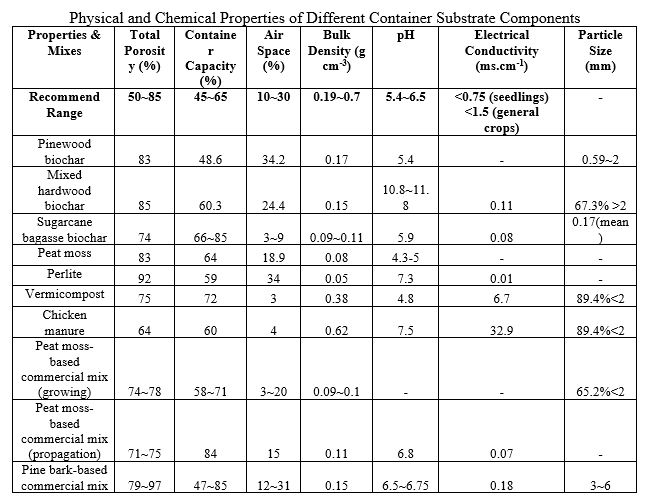
We compared the physical and chemical properties of the biochar we used with some commonly used commercial mixes and the recommended chemical and physical properties for those container substrates in the table below. While biochar may have different properties, many can be successfully used as container substrate for plant growth by mixing with other components.
There are two major ways of mixing your biochar mix:
- Option 1: Mix with the commercial substrate. A simple way to make the target biochar work is to mix it with commercial mixes which contain components such as perlite and/or vermiculite, lime, wetting agent, fertilizer charge, etc.
- Option 2: Create your own mix. You can mix biochar with other components such as peat moss, perlite, pine bark, etc.
No matter which way you choose to mix your biochar mix, particle size is important. If you choose option 1 and your biochar is coarse-textured (particle size is relatively larger), think about mixing it with peat moss-based commercial substrate to bring down the particle size of the final mix. If, however, your biochar is fine-textured (particle size is relatively smaller), think about mixing it with pine bark-based commercial substrate to increase the particle size of the final mix. The same concept applies to option 2. When the chosen biochar is relatively coarse textured (larger particle size), for instance, mixed hardwood biochar, mixing it with other components with fine texture such as vermiculite and peat moss would ensure appropriate particle size in the final mix.
Besides particle size, another important consideration is pH. A pH range of 5.4~6.5 is suitable for most greenhouse crops and acidic biochar used in greenhouses has a pH range from 5.4~5.9, which is within the suitable pH range as container substrate. Alkaline biochar, however, can have a high pH which may make nutrients less available to plants thus leading to adverse effects on plants. A way to solve this problem is to mix it with acidic components such as peat moss. Theoretically, alkaline biochar can also be mixed with acidic biochar if their particle sizes can compensate each other, but further research is necessary to support this concept.
The electrical conductivity (EC) of biochar can vary as well, but normally those used in greenhouse studies had a relatively low EC because they made from ligneous feedstock such as wood, bark, sugarcane bagasse, and so on. A lower EC may allow you to add more fertilizer before salt damage is an issue. Research has shown that you may be able to mix a low EC biochar with nutrient-rich components. Based on our research, the percent of nutrient-rich components should be low (<30%; by volume), otherwise the high EC could cause plant phytotoxicity.
Is Biochar Worth Using?
Does it make financial sense to use biochar as container substrate for horticulture production? The price of commercial peat moss-based substrate and locally sourced biochar was $4.87/ft3, and $2.22/ft3 (average), respectively in 2023. According to the biochar literature, 20% to 80% of peat moss in a substrate can be replaced by biochar (using 50% as the average) without any negative influence on plant growth or yield. If you switch peat moss to biochar, you may save money for media without sacrificing plant production. For example, if a grower uses 1,000 ft3 peat moss-based substrate for container plant production each growing cycle, by using biochar mixes at 50%, ($4.87/ft3-$2.22/ft3) ×1,000 × 50%=$1,325 could be saved each growing cycle. Not to mention the potential of reduced fertilizer and/or fungicide/pesticide costs.
References:
- Dumroese, R.K., J. Heiskanen, K. Englund, and A. Tervahauta, 2011. Pelleted biochar: Chemical and physical properties show potential use as a substrate in container nurseries. Biomass and Bioenergy 35:2018-2027.
- Hina, K., P. Bishop, M.C. Arbestain, R. Calvelo-Pereira, J.A. Maciá-Agulló, J. Hindmarsh, J. Hanly, F. Macìas, and M. Hedley, 2010. Producing biochars with enhanced surface activity through alkaline pretreatment of feedstocks. Soil Research 48:606-617.
- Huang, L. Effects of Biochar and Composts on Substrates Properties and Container-Grown Basil (Ocimum basilicum) and Tomato (Solanum lycopersicum). Master’s Thesis, Texas A&M University, College Station, TX, USA, 2018
- Lima, I.; Steiner, C.; Das, K. Characterization of designer biochar produced at different temperatures and their effects on a loamy sand. Ann. Environ. Sci. 2009, 3, 195–206.
- Rahman, A.A., F. Sulaiman, and N. Abdullah, 2016. Influence of Washing Medium Pre-treatment on Pyrolysis Yields and Product Characteristics of Palm Kernel Shell. Journal of Physical Science 27:53.
- Tian, Y., X. Sun, S. Li, H. Wang, L. Wang, J. Cao, and L. Zhang, 2012. Biochar made from green waste as peat substitute in growth media for Calathea rotundifola cv. Fasciata. Scientia Horticulturae 143:15-18.
Subscribe to eNewsletter
