



How to Tackle Lace Bug Infestations in Your Greenhouse
 August 12, 2025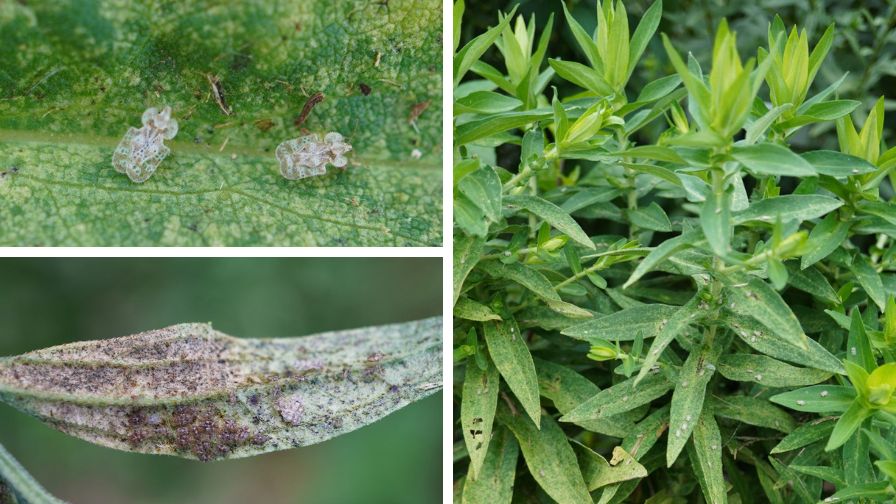
(Clockwise from top left) The chrysanthemum lace bug is a pest of herbaceous perennials in the Aster Family, Adult chrysanthemum lace bugs cause extensive stippling on New England Aster (Symphyotrichum novae-angliae) plants, and chrysanthemum lace bug adults, nymphs, eggs, and frass on the underside of tall coneflower (Rudbeckia laciniata) leaves. | Beth Scheckelhoff
In a recent e-Gro Alert, Beth Scheckelhoff at the Ohio Controlled Environment Agriculture Center of The Ohio State University covers the uncommon greenhouse pest of chrysanthemum lace bugs, which can be found infesting Asteraceae native plant containers, and how to manage them.
Greenhouse Plants Affected by Chrysanthemum Lace Bugs
Chrysanthemum lace bugs, Corythucha marmorata, “prefer to feed on plants in the Aster family, including many native perennial species that are increasingly grown in the horticulture trade as pollinator plants,” according to Scheckelhoff. Affected species and cultivars include:
- Chrysanthemum
- Helianthus
- Rudbeckia
- Soldiago
- Sympphyotrichum
Scouting for Chrysanthemum Lace Bugs
While most lace bug species are found on the underside of leaves, Scheckelhoff states that “chrysanthemum lace bugs can be found on both the lower and upper leaf surfaces,” making them trickier to spot. Using a “piercing sucking mouthpart to remove the content of plant cells,” the remnants of damage left by the lace bugs often appear similar to spider mites. However, yellow stipples left on plant tissue soon become bleached, then brown, followed by “plant dieback.”
Chrysanthemum Lace Bug Life Cycle
According to Scheckelhoff, “lace bugs overwinter as adults in the soil and around the base of plants.” Then, in late spring and early summer, adults began feeding on lower leaves, with female lace bugs laying eggs on the leaves’ underside. Newly born nymphs then feed on the lower surface of the leaf until adulthood.





Pest Management Practices for Chrysanthemum Lace Bugs
Usually, pest management practices for lace bugs are not needed, as their natural enemies usually take care of the job. Natural enemies that keep lace bug populations in check include:
- Assassin bugs
- Minute pirate bugs
- Lacewings
- Ladybugs
- Spiders
However, in the case of large populations, plants can be overrun, leading to severe aesthetic damage and possible plant death.
In such cases, Scheckelhoff suggests a few actions. First, water should be directed at the upper and underside of leaves to wash off any hidden nymphs and adults. Additionally, the direct application of “insecticidal soaps and horticultural oils” is an option. However, she notes that these practices do not affect already planted eggs, which means the preceding control methods should be repeated for effective management.
For additional information on scouting and pest management practices of chrysanthemum lace bugs, please read the full e-Gro (Electronic Grower Resources Online) alert “Lace Bugs on Asteraceae.” Additional and current e-Gro alert pieces from Volume 14 (2025) can be found online.
Subscribe to eNewsletter