



Peat Alternatives Help Reduce Costs and Ease Supply Chain Headaches
 November 23, 2022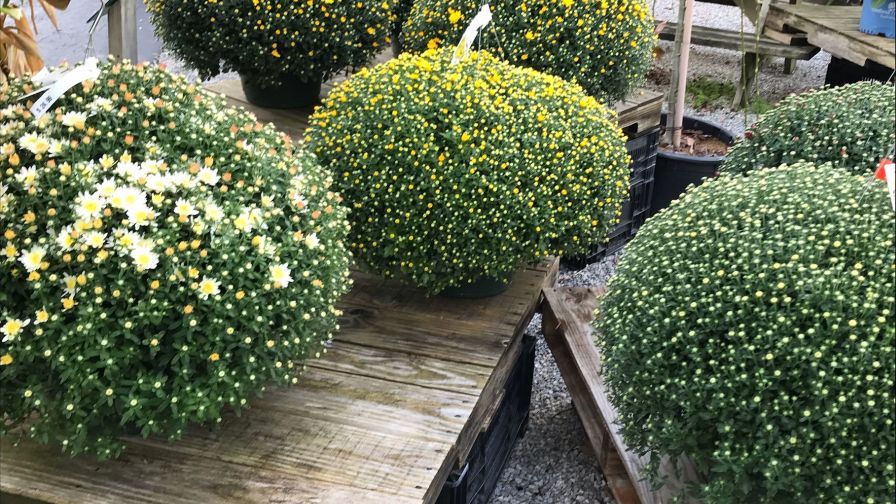
John Constantine of Constantine’s Garden Center in Richfield, OH, says his mums, which are grown with PittMoss, grow beautifully. Shown above are 12-inch hanging baskets. Photo: John Constantine
Growers across the horticulture industry rely on peat moss for growing media. It is an important component of many soil mixes, and difficult to replace. However, more growers are looking to reduce costs and engage in sustainable practices, which includes reducing their use of peat.
Wood Fiber Reduces Shipping Costs
One alternative to peat growing in popularity is wood fiber. Wood fiber can be used alone or mixed with peat and perlite.
Head Grower Steve Garvey of Dallas Johnson Greenhouses in Council Bluffs, IA, uses a 70/30 mix of peat and wood fiber. He has used this mix for the last six years to engage in sustainable production practices and to help reduce shipping costs. Peat and wood fiber are both in a condensed form when shipped, so more of the product can fit on a truckload. This helps reduce shipping costs compared to products such as perlite and bark that are not shipped in a condensed form.
When starting to work with wood fiber, there is a learning curve because it retains moisture differently than wood bark mixes.




“You need to adjust your watering practices, especially in the winter. The mix will stay wet. That’s what people get scared of,” he says. “We trained ourselves to do it. It saves labor and it saves time on watering. You must do that with any new technology.”
Garvey says it was challenging to retrain the growers on irrigation practices, many of whom have worked at Dallas Johnson Greenhouses for more than
15 years.
Recycled Paper Products Bank on Local Supply Chain
PittMoss is comprised of recycled paper, cardboard, and newspaper. This paper-based fiber is made into soil that is available in a variety of blends, says Ashley Mariani, Director of Business Development for PittMoss.
The base material for the commercial lines of PittMoss is 99% paper. Mariani says PittMoss works with a variety of recyclers, most of which are local in the Pittsburgh, PA, area.
“A lot of people don’t realize, but when you’re making paper products for commercial businesses, cardboard boxes for example, they make a lot of them, and then there are overruns,” Mariani says. “You have a significant amount of waste for products that are not even used by consumers that goes into a landfill. That is the ideal clean paper stock that we get.”
Growers around the world are facing significant supply chain challenges, including rising costs, limited availability of raw materials, and delayed delivery times. Since PittMoss sources its paper locally, Mariani says the company is protected from hiccups in the supply chain. The pre-consumer waste products it uses are readily available.
Over time, more growers are interested in sustainable practices. Mariani says growers are looking for peat-saving solutions, so they do not have to rely heavily on peat mined from bogs, which releases a significant amount of carbon dioxide into the atmosphere.
“Sustainability has become more and more of a factor for the growers,” she says. “They’re thinking about how to reduce their footprint, and whether their practices are contributing to sustainable horticulture and agriculture.”
Mariani says this growing medium made of paper is an ideal environment. This medium manages applied resources well, such as fertilizer and water. She compared the water distribution in PittMoss to how water wicks through a paper towel. The water is distributed evenly and there is less fertilizer runoff.
One of the elements in paper is carbon, which Mariani says is food for microbes. A paper-based growing medium is a good natural environment for plants to thrive. Soil nutrients are added to the mix in a soluble form. There are also peat-reduced mixes for growers who do not yet want to go peat-free.
John Constantine, owner of Constantine’s Nursery and Garden Center in Richfield, OH, says PittMoss works well for his operation as a replacement for peat. It holds water longer than peat products. He grows mums with PittMoss, which he says are “gorgeous and huge.”
Peat Suppliers Restore Peatlands Post-Harvest
Paul Short, President of the Canadian Sphagnum Peat Moss Association, reached out to Greenhouse Grower to offer insights on how peatlands are restored. He says the Peatland Ecological Research Group developed a technique that will return the harvested peatlands to peat-accumulating ecosystems. Through the application of the moss layer transfer technique, the restored harvest sites have typical bog plant biodiversity cover established within three to five years following restoration and are dominated by sphagnum mosses. Read more about restoring peatlands at https://is.gd/peatrestoration.
Subscribe to eNewsletter