



What to Know About Spotted Lanternfly
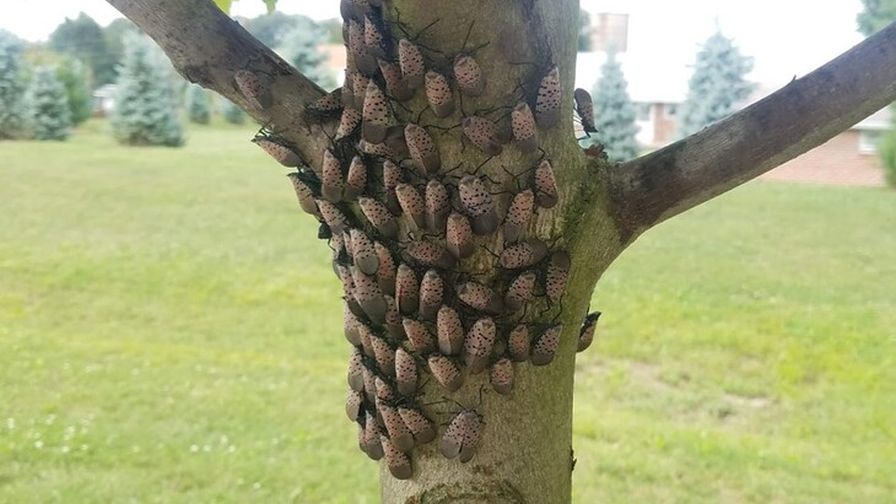
Spotted Lanternfly on Maple; Photo: Heather Leach
Spotted lanternfly is beginning to make its presence known in the U.S. The first step in deciding how to manage spotted lanternflies on residential properties and public spaces begins with a risk assessment, according to a Penn State Extension horticulture educator.
“Spotted lanternfly is a complex pest problem, and unfortunately, there is no one-size-fits-all solution,” says Emelie Swackhamer. “While spotted lanternflies can weaken landscape trees, they usually do not kill them, so that’s an important factor to consider when deciding on a control method.”
A Complex Pest Problem
The spotted lanternfly, an invasive insect from Asia, was discovered in North America in Berks County, PA, in 2014. The pest since has spread to at least 34 Pennsylvania counties and has also become established in New Jersey, New York, Connecticut, Delaware, Maryland, Ohio, Virginia, and West Virginia.
The planthopper feeds on important agricultural commodities — including grape vines, fruit trees, nursery plants, and hardwood timber — and on plants in natural habitats, parks, and backyards.





Many residents’ concerns center on the pest’s ability to harm ornamental trees on their properties, leading them to seek information on the why and the how of spotted lanternfly feeding.
Kelli Hoover, Professor of Entomology in Penn State’s College of Agricultural Sciences, says the pest uses its piercing/sucking mouthparts to punch into the tree and feed on the sap, which contains sugars and some nutrients.
While the spotted lanternfly’s preferred host in its early life stages is Ailanthus altissima, also known as tree of heaven, it will feed on plants including multiflora rose, cultivated roses, Virginia creeper, and the veins of leaves on trees such as maples, cherry, black walnut, willow, and birch.
When spotted lanternflies mature, their food preferences narrow, notes Hoover. Adults prefer tree of heaven or cultivated grape, but they will switch over to red and silver maples and occasionally to other trees such as sycamore, willow, and river birch in the fall. The pest rarely feeds on oaks, and it does not appear to like conifers.
Learn more in this report from Penn State University.
Subscribe to eNewsletter
