




7 Reasons to Invest in Modern ERP System

Modern times require modern solutions. As industries evolve at record speed, investing in efficiency and cost control could be the key to future success. As a grower, you face big challenges—labor shortages, sustainability, succession, and the push for automation. To thrive now and in the future, you need a robust foundation. That’s where a modern ERP system comes in.
So, what sets modern ERP apart? Traditional systems operated in silos, while today’s modern ERP is an open, connected platform that integrates seamlessly with other systems, creating a “single source of truth” ecosystem for your entire operation.
However, successful implementation goes beyond technology—user adoption is key, ensuring teams see the value and are properly trained.
Here are 7 key benefits modern ERP delivers.
1. Orchestrate your business
Running a growing operation is complex, with activity spanning the office, greenhouse, and warehouse. Beyond primary processes, you’re managing climate control, energy usage, greenhouse automation, hygiene protocols, asset tracking, payrolling, accounting, etc., etc.. Modern ERP solutions can be seen as the wheelhouse, as a central point wherefrom you steer it all in the right direction.
Some practical examples that illustrate how ERP orchestrates your complete business:
- Sync logistics with accounting for real-time insights into inventory value, costs, turnover, and margins.
- Centralize data in a data warehouse for accurate, holistic KPI tracking.
- Export labor hours to payroll or agencies for seamless, precise payments.
- Integrate climate systems to monitor energy costs by production batch.
- Connect with greenhouse automation to issue orders, track results, and maintain live inventory visibility.
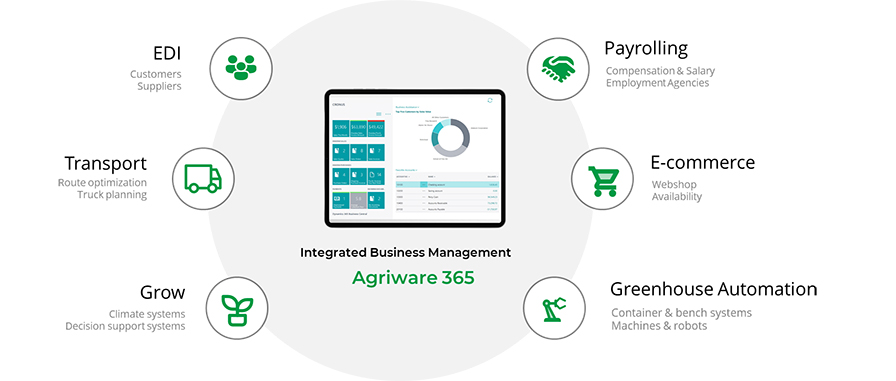
Agriware 365 connects every component of the business
2. Financial control
ERP isn’t just a finance tool—it’s a strategic asset that ensures fiscal health, compliance, and growth readiness. If you’re serious about financial control, investing in an ERP is essential. Every process ties directly to your general ledger and financial reports, delivering real-time, comprehensive insights.
Some practical examples of financial control with an ERP system:
- Real-time insight in stock value and WIP (work in progress) value as a result of your operational activities
- Manage Payables and Receivables in a timely and efficient manner.
- Report accurately against forecast, budgets and actuals
- Forecast cashflow based on expected payables, receivables and budgets
- Implement approval workflows for purchases and credit checks for sales
3. Succession Planning and Continuity
For long-term success, succession planning is non-negotiable. A modern ERP captures your business’s core strengths—strategy, processes, protocols, and expertise—in a sustainable way. This empowers faster onboarding, broadens skill accessibility, and preserves institutional knowledge.
Some practical examples that ensure success and continuity:
- Provide real-time visibility into availability across departments.
- Track actual costs and inventory value instantly.
- Optimize climate and growth protocols by crop, variety, season, or region.
- Convert sales forecasts into automated production plans.
- Trigger replenishment and sourcing based on demand.
David Hoffman, CEO Hoffman Nurseries: “With the founder’s retirement, institutional knowledge needed to be preserved in a structured, robust system”.
4. Cutting costs
As a grower, just like in any industry, keeping costs under control is essential. One of the biggest cost factors is labor, making it a prime area for savings. ERP systems help achieve this by streamlining processes, improving efficiency, and automating repetitive tasks. Labor cost savings of over 4% are not uncommon. Plus, an ERP system helps cut waste by improving quality control and preventing overproduction.
Some practical examples that leads to cost reduction:
- Reduce waste and overproduction by executing a sophisticated planning for just-in-time production
- Save time and resources with automated processes like order handling
- Minimize overtime with better demand forecasting and resource planning
- Track labor costs, monitor productivity, and identify inefficiencies by integrating a workforce management system
- Maximize space utilization with advanced space planning for optimal efficiency
5. Boost yield with fewer workers
We have entered an era of labor scarcity. The shortage of available workers is a global challenge, significantly impacting the horticulture industry. Since this isn’t expected to change anytime soon, we must adapt to the situation. The question is: how can you keep up with market demands with fewer workers? Or even better, how can you scale your organization in these times?
Here are some practical examples of how ERP helps overcome labor shortages:
- Optimized planning to balance workloads throughout the year and across weekly schedules
- Store your business intelligence in a system, enabling less experienced workers to perform tasks effectively.
- Integrate planning with greenhouse automation to cut manual labor and boost output
- Leverage AI tools like Microsoft Copilot in Agriware ERP to streamline workflows, automate routine decisions, and guide workers with real-time insights—reducing dependency on skilled labor.

6. Supply chain integration
The world is becoming a digital town square, making it easier to connect and grow. Smooth communication with you suppliers, customers and transporters is key to integrating seamlessly into the supply chain. ERP is only about streamlining your internal processes; it also plays a big role in supply chain integration.
Some practical examples how ERP helps you integrate in the supply chain:
- Digital sales order process (EDI connections) to minimize mistakes and effort.
- Automated E-invoicing to reduce administrative handling and get paid sooner
- Integrate you E-commerce portal or web shop with you order application to reach a broader market and reduce order handling time
- Integrate with your carriers to track & trace your shipments and returnable goods
7. Data & AI
Artificial intelligence is transforming ERP into a powerhouse for greenhouse growers, turning raw data into actionable intelligence. Think of it as a smart assistant—like ChatGPT—embedded in your system, learning from patterns and driving decisions. With Microsoft Copilot in Agriware (built on Dynamics 365), AI integrates with your business data, delivering tailored insights, flagging bottlenecks, and automating tasks—all from a secure Microsoft Cloud platform with a single, reliable source of truth. This boosts productivity across departments by making data accessible and actionable in real time.
For example, a planner might ask Copilot, “What’s driving my energy costs?” The AI could pinpoint a 10% overuse in a greenhouse zone, pulling data instantly from systems and batch data. Production, finance, sales, operations, and quality control all gain sharper, faster insights.

This article is written by William Van Loenen, Chief Product Officer at Mprise Agriware.
Mprise Agriware provides ERP & CRM Business software for the greenhouse industry, helping growers manage and connect all key business processes—from finance, sales, production, inventory, shipping, and more. Built on Microsoft Dynamics infrastructure, the 130-member team has successfully completed 250+ software implementations across the green industry, serving all types of businesses in ornamentals, plugs and liners, fruits, trees, shrubs, seeds, and beyond. Visit www.mprise-agriware.com for more.