



Boosting Root Growth in Woody Nursery Plants With IBA
 December 10, 2024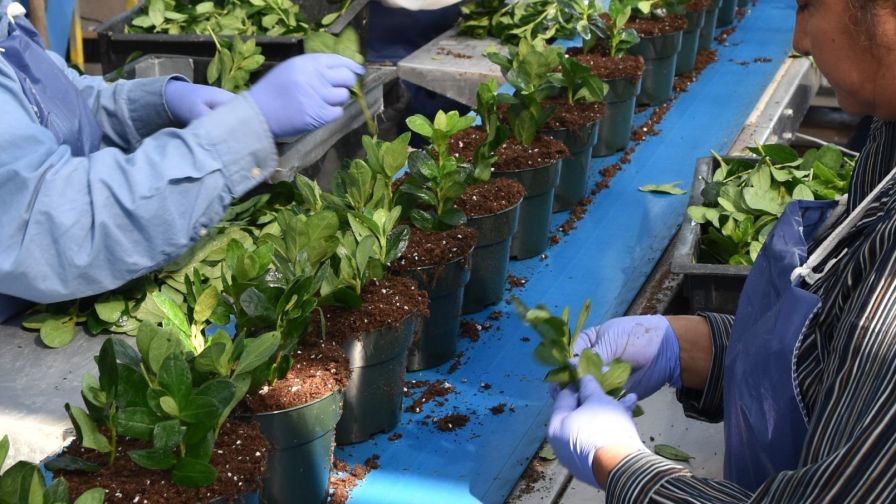
Employees demonstrating proper personal protective equipment (PPE) while propagating azalea (Rhododendron sp.) cuttings. Workers are wearing long-sleeve shirts, aprons, long pants, closed-toe shoes with socks, and waterproof gloves. The cuttings are being inserted into growing media after a quick dip in indole-3-butyric acid (IBA) rooting hormone solution. | W. Garrett Owen, OSU
Woody ornamentals and other nursery plants can be difficult to root from cuttings. According to Olivia J. Liebing and W. Garrett Owen of The Ohio State University, this is because “This leaves stem cuttings vulnerable to water stress, requiring specialized care and environments to prevent drying out. Therefore, new roots need to be encouraged quickly from non-root tissues through a process called adventitious rooting.”
However, there is the option to use rooting hormones, which stimulate the four key stages needed for cutting rooting:
- Dedifferentiation
- Root initiation
- Root formation
- Root elongation
The pair go over a particular rooting hormone, the synthetic auxin of indole-3-butyric acid (IBA), in a recent e-Gro Alert.
IBA Impacts on Plant Growth
IBA is naturally found in plants, although in tiny amounts. The synthetic form available to growers is often administered to plants at much higher amounts, helping to better “induce and promote root growth and development.” Once IBA is applied, plants convert the synthetic auxin into indole-3-acetic acid (IAA), which is used by plants to “not only influence adventitious rooting, but a suite of responses including apical dominance, cambial growth, and phototropism.”
All in all, IBA’s impacts on cuttings are “substantial and lasting,” creating much more uniform rooting compared to non-IBA treated counterparts.
IBA Applications Methods
Liebing and Owen provide three main and tested methods of IBA application to plants. The method that’s best for each grower depends on their crop selection of choice, in addition to available tools, workforce, and more.
Additionally, the pair note that IBA “is commercially available in talc, salt, and liquid formulations. Working with solutions of IBA is often preferred over talc for the application speed and uniform coverage, though talc has a longer shelf life while in a plant ready form.”
1. Quick Dips
Insert the basal end of a cutting into an IBA solution for 3 to 5 seconds. Cuttings can be dipped in bundles to increase efficiency. After dipping is complete, “growers should insert the cuttings into propagation substrate and place in the propagation environment.”
2. Long Soak
Let an unrooted cutting soak in a diluted IBA solution for up to 24 hours. The concentration of the solution should “range between 20 to 200 ppm IBA.” During this process, the solution, and cuttings, should be kept out of direct sunlight.
Additionally, while longer soaks usually promote better and additional rooting, staying submerged in the solution for too long can “reduce bud break.”
Lastly, while the practice of long soaking isn’t popular among growers due to its time-consuming nature, it is useful to try for plant cuttings that are particularly resistant to rooting.
3. Foliar Sprays
Foliar sprays helped reduce both needed labor and potential exposure to IBA, through the handling of dipped cuttings. This streamlining of the propagation process, if done correctly and safely, can help to reduce the costs of the operation.
According to Liebing and Owen, “Sprays are often applied after sticking and can be reapplied to hasten root development and uniformity.” Compared to long soak solution concentration, the levels of foliar sprays range between “200 and 2,000 ppm IBA.”
Lastly, due to stress caused by sunlight, the optimal time to apply foliar sprays is when light levels are low. Additionally, conditions should be dry at the time of spraying, not affected by outside weather or irrigation methods, “allowing the IBA solution to slowly dry on the plant surface.”
For more information on best practices for IBA applications, please read the full e-Gro (Electronic Grower Resources Online) alert “Boost Your Roots: Enhance Rooting in Woody Nursery Plants with IBA.” Additional and current e-Gro alert pieces from Volume 13 (2024) can be found online.
Subscribe to eNewsletter