



A New Generation of Horticulturalists at North Carolina State University
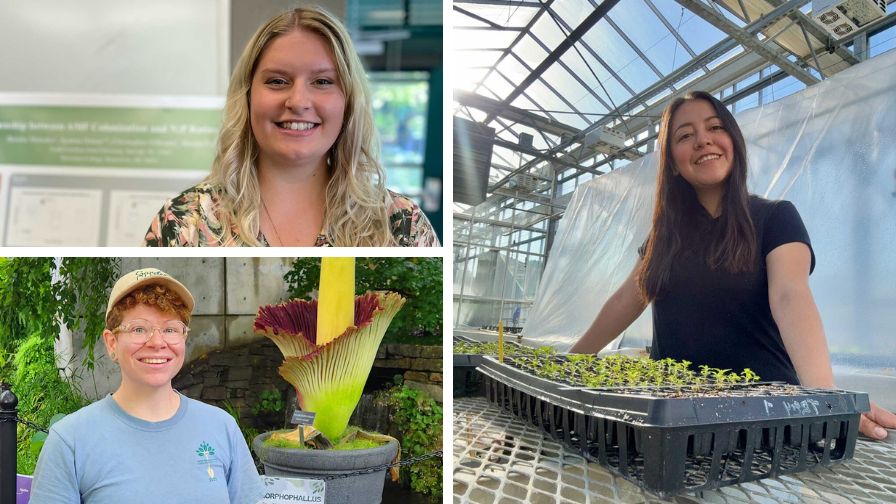
(Clockwise from top left) Brooke Matsuko, Ingrid Tuyuc, and Alisha Ray. | NC State University
In the dynamic world of horticulture, it’s essential that young professionals entering the workforce are equipped with the right skills and cutting-edge tools to prepare them for a variety of exciting careers in plant science.
From microscopic soil allies to high-tech plant propagation, the newest cohort of horticulture graduates from North Carolina State University is prepared to face some of the most urgent challenges to global food systems. Their work, focusing on resilience, cost-saving farm management, and advanced crop technology, demonstrates a hands-on approach to fortifying agriculture for the future.
Among them, Brooke Matusko, Alisha Ray, and Ingrid Tuyuc have each carved distinct paths, overcoming obstacles and envisioning impactful solutions for the horticultural landscape.
Fungi as a Failsafe Against Drought
Brooke Matusko, who earned her Master of Science degree this fall, focused her thesis on integrating a natural soil defense system into vegetable production, advised by Emmanuel Torres, Assistant Professor in the Department of Horticultural Science. Matusko studied arbuscular mycorrhizal fungi, or AMF, a beneficial microorganism that acts as an extension of a plant’s root system.
“These fungi have been shown to assist plants with water and nutrient acquisition and stress tolerance. Specifically, we examined the effects of AMF on both water and nutrient stress mitigation in bell peppers under greenhouse conditions,” says Matusko.
As climate events increase with the frequency of droughts and heatwaves, Matusko sees AMF as a powerful tool when combined with other sustainable initiatives.
“Integrating these fungi into agricultural production systems could provide a natural solution to fortify plants against common stressors such as droughts, heatwaves, pest and disease pressure, and nutrient-poor soils,” she says.
Matusko plans to promote sustainable agriculture and food system initiatives and looks forward to collaborating with growers and researchers to implement these biological solutions.
Clearing the Water for Commercial Nurseries
For commercial nurseries, fighting weeds is a costly and labor-intensive battle. Alisha Ray, a recent graduate of the Horticultural Science Master’s Program and Department Research Operations Manager, tackled this economic challenge by investigating an unexpected source of infestation, irrigation ponds.
“The purpose of my research was to determine if nursery irrigation ponds were a source of weed seed infestation and, if so, ways to manage this source to ultimately lower control costs,” says Ray.
With the guidance of Joe Neal, Professor of Weed Science, her findings confirmed that weed seeds are indeed present in irrigation pond water. More critically, Ray found that some weed seeds are buoyant and can remain viable in the water for up to one year. The solution is straightforward: prevention.
Ray determined that the best management practice is ensuring that the irrigation pond surroundings and runoff paths are kept free of weeds. This simple step prevents seeds from being deposited into the ponds, particularly those species whose seeds maintain viability while submerged.
As a nontraditional student, Ray says her experience prepared her to be a better teacher and liaison for the industry. “I learned to take what I was learning from my research and translate it into steps growers could directly apply.”
Ray plans to continue guiding the next generation of horticulturists and hopes to transition into outreach, equipping the industry with the practical knowledge and tools it needs.

For additional information on this group of new horticulturists, including Ingrid Tuyuc’s research on the micropropagation of Stevia rebaudiana, please read the original article written by Brandon Hopper and found on the Horticultural Science section of the North Carolina State University website.
Subscribe to eNewsletter