



Planning for 2027? Focus on the Economic Drivers You Can Control
 September 27, 2026
 Dr. Charlie Hall, Chief Economist at AmericanHort and professor and Ellison Chair in International Floriculture at Texas A&M University, has spent years tracking the costs that affect greenhouse and nursery businesses and helping growers understand what those changes mean for their operations. In the face of disruptive events like BFG Supply’s bankruptcy, changing tariffs, and other supply chain issues, his Index of Prices Paid by Growers is an important tool for focusing on the things you can control.
The index provides an economic benchmark for changes in the real-world inputs growers purchase every day, from labor and fuel to containers, freight, and packaging. Hall releases the first report in early March and follows it with a summer update ahead of Cultivate, when many growers are beginning to make critical production and pricing decisions for the coming year. “I know there are going to be price expectation changes between spring and summer, so I want to give growers the latest information they need when it comes time to negotiate prices,” Hall says.
We spoke with Hall in mid-August, following the BFG announcement. Hall provided an updated look at the index’s findings and his recommendations for growers.
What the Index Currently Shows
As of mid-July 2026, Hall estimated that input prices paid by growers for 2026 would increase 3.6% from the previous year. That’s already a significant jump from the typical annual increases of 2% or less; the only significant outliers in the past 10 years were the major post-pandemic supply chain disruptions that led prices to jump by 9% or more.
Hall’s 2026 estimate is driven largely by tariffs and the current issues surrounding the Strait of Hormuz. His 2027 forecast has two scenarios, starting with a more favorable one that predicts a 2.5% price increase. This figure assumes an Iranian ceasefire, an open Strait of Hormuz, and the Section 122 tariffs lapsing.
“The problem is that none of that looks like it will happen,” Hall says, which is why he has a second scenario where prices increase 4.4%.
Labor remains the top cost for growers. The good news is that, for the most part, the costs for labor, peat (assuming current exemptions hold), freight, and fuel are largely tariff-insensitive. The bad news is that, according to Hall, there’s about a 70% correlation between fertilizer prices and oil prices. Volatility in oil prices, coupled with rising lumber costs that are pushing up home-building costs, is making both internal and external price forecasting difficult for growers.
So how can you respond? “You have to look at either price increases or absorbing the margins. It’s as simple as that,” Hall says.
Or perhaps it’s not so simple. Coming out of the COVID-19 pandemic, some growers responded to price pressures by stockpiling inventory to hedge against shortages and future price increases. This trend repeated itself in 2025 when tariffs came into play.
Stockpiling can reduce supply risk, but it also ties up cash and production or storage space in inventory that may not ultimately be needed. Rather than relying on inventory alone, Hall says growers should also look for efficiencies within their operations. For the most part, that means maximizing labor efficiency and minimizing shrink. A great place to start is through lean flow implementation, which is especially beneficial in the order pulling and truck loading stages of production (Hall says it’s typical for 50% of labor costs to be tied up here).
Of course, the BFG Supply bankruptcy has added a new wrinkle to the planning process for 2027.
“One of the things we learned during the pandemic was to be agile with the supply chain,” Hall says. “We saw the importance of having backup suppliers, as well as creating warehouse space to hold more inventory so we could move away from just-in-time delivery.”
Hall’s presentation at Cultivate ended with a brief list of recommendations for how growers can respond to economic uncertainty. Here’s an update on those recommendations with more detail.
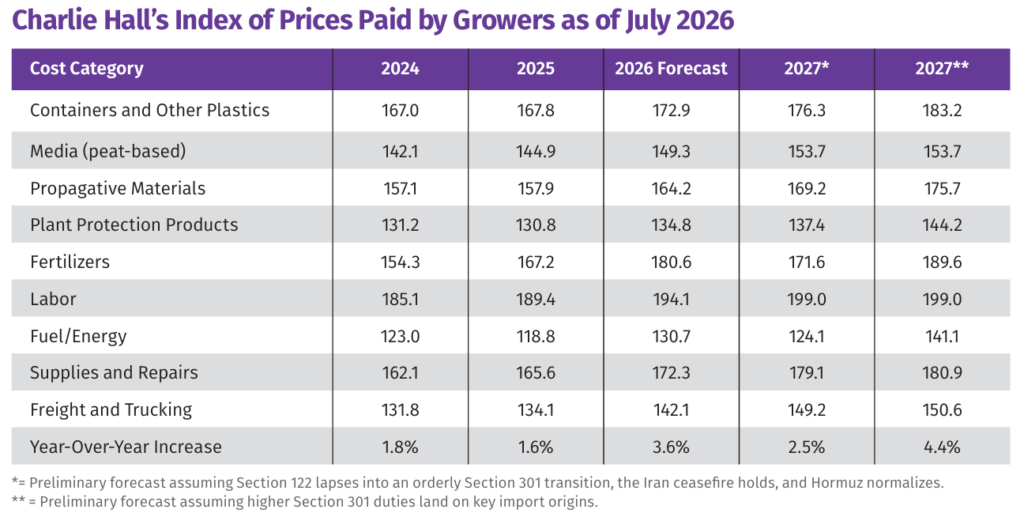
Charlie Hall’s Index of Prices Paid by Growers as of July 2026
Step 1: Track Your Trade-Area Analytics
This is the key to the demand side of your business, especially in your region. It starts with shrink and SKU rationalization.
“If your shrink numbers are higher than the average in your area, you need to take a hard look at which of your SKUs are making money and which aren’t,” Hall says.
“It’s easy to do with a few spreadsheets, and even easier with an ERP system.”
However, sales data alone does not show whether an individual product is profitable. Hall says growers also need to look at gross margins for each product.
“How can I get my bottom third of products to hit the same margin as my top third of products? The answer is usually either charging higher prices or deciding to buy my product from elsewhere instead of growing it myself,” Hall says.
You also have to look at the margin for each customer (or customer rationalization), which Hall says is not a common practice in this industry. “You may have a million-dollar customer, but you could be losing much of the profit margin for that customer in the costs you absorb to maintain that relationship, or in the discounts you’re giving them.”
Side note: Hall is a big believer in back-end versus up-front discounts. “Our traditional approach in this industry gives away too much risk; it’s too easy for your customer to buy a million units at an up-front discount and then reduce their order by a third after three rainy spring weekends,” he says.
Step 2: Close the Margin Gap
Pricing discipline and product mix are the biggest levers you control as a grower. But you have to know the gap between your current pricing and your profit objective, Hall says.
One way to do this is with a P25/P75 analysis. P25 represents the lower quartile and P75 the upper quartile for gross and operating margins. If your operation falls between those benchmarks, you may only have to make a few minor adjustments to how you operate to move toward that P75 benchmark. For example, you can save money and time simply by minimizing touches.
“Every grower should try to benchmark to that P75 mark,” Hall says. “That gap is your profit improvement roadmap.”
Step 3: Price to Your Value, Not Your Cost
Too often, Hall says, we look at our pricing relative to the competition’s pricing. “But our cost structure is not the same as our competitors’, and our value proposition is not the same, either.”
In floriculture, there are always points of parity between companies, and quality has become one of them. Years ago, you might have seen major differences in quality between operations. Today, with all the knowledge resources available, Hall says this quality differential is not what it used to be.
But there are points of differentiation you can target, such as customer service.
“It’s important to know what your customers are buying from you and how they’re buying it, but it’s even more important to know why they choose to buy from you,” Hall says. “The only way to know that is to get to know your customer, whether that’s through market research or by deepening the conversations you have with them.”
Step 4: Manage Your Working Capital
Following the three previous steps can help you free up the cash you need to take advantage of opportunities when they emerge. Growers may choose to pay down long-term debt, build up inventory, or invest in capital expenditures.
“You have to have the cash to be able to take advantage of opportunities, and that means looking at your current assets versus your current liabilities,” Hall says. “One of the biggest returns you can gain is when you properly calculate return on invested capital.”
Step 5: Defend Your Value Proposition
Even as consumers trade down in the unit sizes and prices of plants they’re buying, you can still lean into anything that offers an experience or a personal value connection.
This ties back to the functional benefits of what we produce. “The most inelastic portion of consumer demand is the stuff that augments or enhances their health and well-being,” Hall says. “We’ll pay for memories from a Disney vacation, but we’ll also buy health products to try to stay young forever or enhance our vitality. Sometimes that can simply mean surrounding yourself with chlorophyll.”
Click here to download Dr. Charlie Hall’s Economist Forecast presentation from Cultivate’26.
Subscribe to eNewsletter