


Washed, Low-EC, or Buffered? How to Specify Coco Substrate for Your Crop
 October 7, 2026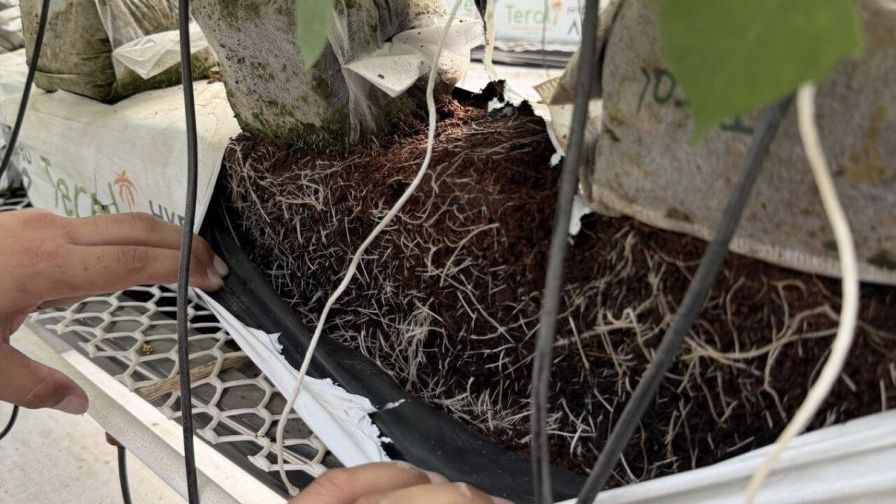
Photo: Teral
Coco coir has become one of the most widely used soilless substrates in protected cultivation, from tomato and cucumber slabs to strawberry troughs and nursery propagation. Yet many purchasing conversations still start, and end, with two words: “low EC”. That is a useful starting point, but it is not a specification. Two bags labeled “washed” or “buffered” can behave very differently once they are irrigated with your water and your nutrient recipe.
It’s important to what washing and buffering actually do, why the EC number on a data sheet can mislead you, and what to write into a substrate specification so the product that arrives matches the product you trialed.
Why Coir Needs Treatment
Coir pith is the spongy material left after the long fibers are extracted from coconut husk. Fresh pith typically carries soluble salts, mainly potassium and sodium, from the husk and from processing. It also has a meaningful cation exchange capacity: the particle surfaces hold positively charged ions and swap them with the solution around them.
That gives growers two separate problems to manage:
- Free salts in the pore water, which raise EC and can stress young roots.
- Ions held on the exchange sites, which do not show up fully in a quick EC reading but can be released later, while the coir takes up calcium and magnesium from your feed in exchange.
Washing and buffering address these two problems differently. Washing means rinsing the pith with fresh water to flush out soluble salts. A well-washed material will show a low EC in an extract test. This is what most suppliers mean by “low EC” or “washed” coir.
What washing does not do reliably is change what is sitting on the exchange sites. Potassium and sodium bound to the coir can remain after a thorough rinse. In a crop, that can show up as the substrate holding back calcium and magnesium from the nutrient solution in the first weeks, while releasing potassium and sodium into the root zone.
Washing quality also depends heavily on the water used. If the rinse water itself is high in sodium or bicarbonate, the washed product may not be as clean as the label suggests. Asking a supplier about their washing water source and how they monitor it is a reasonable question.
Buffering is a chemical pre-treatment, usually soaking the coir in a calcium-based solution (calcium nitrate is common, sometimes with magnesium), so that calcium occupies the exchange sites and displaces potassium and sodium. The displaced ions are then washed out.
The practical result is a substrate that is less likely to “steal” calcium and magnesium from your feed at the start of the crop. For many fertigated greenhouse crops in slabs and bags, buffered coir is the default choice for exactly this reason.
Buffering is not automatically better for every use, though. Some substrate blenders prefer to buy washed, unbuffered coir and condition it themselves to their own recipe. Some growers who mix coir with other components or use it as a minor fraction in a peat-reduced blend may be fine with a low-EC washed grade. The point is to choose deliberately, not by habit.
Ask How EC Was Measured
This is where many specifications fall apart. An EC value means little without the method behind it. Common approaches include the 1:1.5 volume extract widely used in Dutch horticulture, the 1:5 extract described in European standard EN 13038, a 1:2 dilution, the saturated media extract (SME), and the pour-through method. They use different water-to-substrate ratios, so the same material will give different numbers. A reading of 0.5 mS/cm by one method and 0.5 mS/cm by another do not describe the same product.
When you compare suppliers, ask for:
- The extraction method and ratio, and whether the sample was tested at delivered moisture or after a defined pre-treatment.
- Whether the figure is a single batch result or a production average.
- Sodium and potassium in the extract, not just total EC, if buffering matters to you.
You can learn more about how to read a cocopeat EC and pH test report here, but the core rule is simple: compare like with like, and put the method in the contract.
Check pH Alongside Water and Feed
Coir is generally slightly acidic to near-neutral, and pH tends to be less of a headline problem than salts. It still belongs in the specification, measured with a stated method (EN 13037 is the European reference). More importantly, interpret it alongside your irrigation water alkalinity and your feed. A substrate pH that looks ideal on paper can drift quickly with high-bicarbonate water.
Matching Treatment to Crop and System
Here are a few practical starting points to be confirmed with your own agronomist and trials:
- Fertigated slabs and growbags for tomato, cucumber, and capsicum. Buffered coir is the common choice, because the first weeks after planting are when calcium availability matters and when growers want predictable EC in the slab.
- Strawberry troughs and bags. Strawberries are generally regarded as salt-sensitive, so both low EC and a clear buffering status are worth specifying. Pay equal attention to structure and drainage.
- Propagation and seedling media. Fine, screened, low-EC material with long fiber removed helps even tray filling. Whether you also need buffering depends on how long plants stay in the medium and how they are fed.
- Blending stock for substrate manufacturers. Many blenders want washed, unbuffered or lightly treated coir so they control the final chemistry. Specify the treatment you want, not the one that is easiest to supply.
What to Put in the Specification
A useful coco specification should read more like a short technical document than a product name. At minimum:
- Treatment: washed only, or buffered, and with what (calcium nitrate, calcium plus magnesium, other).
- EC limit and method: for example, “EC below X mS/cm, 1:1.5 volume extract” or “1:5 extract per EN 13038”.
- pH range and method.
- Na and K in extract, if buffering is critical.
- Physical grade: pith-to-chip ratio, particle size fractions, fibre content.
- Moisture basis and compressed/expanded volume, so you know what you are buying per litre.
- Sampling and acceptance: how many samples per lot, who tests, and what happens if a batch is out of specification.
The Bottom Line
“Low EC” describes one measurement on one day. “Buffered” describes a treatment that may or may not have been done thoroughly. Neither, on its own, tells you how the substrate will perform under your water, your feed and your irrigation strategy.
The most reliable approach is to agree on a written specification with stated methods, trial a sample in your own system, and then hold every subsequent batch to the same numbers. The coir itself is only half of the product. The other half is the information that comes with it.
Subscribe to eNewsletter
