


Rethinking Garden Center Layouts to Better Guide Consumers
 February 11, 2026
 I think many garden centers are laid out in a fairly predictable way. Most organize plants into familiar groups such as annuals, perennials, trees and shrubs, and vegetables and herbs. These categories are often further divided by light requirements, including full sun, full shade, and everything in between. Beyond that, plants are also frequently arranged alphabetically.
Alphabetical ordering may be helpful for customers who arrive knowing exactly what they want, but it can also be limiting and confusing. Shoppers may struggle to decide whether to look for plants by Latin name or common name, and inevitably, some will be more familiar with one than the other. Latin names require a certain level of horticulture knowledge, while common names can be unclear, especially when the same name refers to multiple species. I’ve suggested before that garden center layouts could be improved, and it feels like the right time to take a deeper look at how rethinking organization could lead to a better shopping experience.
Organizing Plants by Purpose

Summer blooming perennial collection — Allium lusitanicum ‘Summer Beauty’ and Liatris spicata ‘Blazing Star’ . | Chalet Home + Garden
Just about all horticulturists have heard the phrase “right plant, right place, right purpose.” It’s a guiding principle in garden design, so why not use it to help customers build better gardens in retail settings as well?
If plants were organized by a particular characteristic or function, customers could more easily understand the roles different plants can play in their landscapes. These roles could be as broad or as specific as a garden center chooses, whether that means grouping plants that attract pollinators or those with extensive root systems that help prevent soil erosion on slopes.




Organizing plants this way also creates opportunities for cleaner marketing and more meaningful signage built around shared traits or usage. It would be interesting to see plants grouped by role in the same way the Myers-Briggs personality test categorizes people into types like protectors or inventors.
From Purpose to Presentation
Many gardeners already know why they want a plant or what they want it to do, especially when they have a specific site in mind. Reorganizing plants on garden center benches by the roles they can fulfill would help shoppers more easily find plants based on purpose, but that alone is only a first step.
If those plants are still arranged in uniform rows, the layout remains visually dull. Small vignettes that group different cultivars into a sample garden setting could help address this while also inspiring additional sales by showing customers practical design possibilities. At the very least, these vignettes would create more engaging and attractive displays.
Operational Considerations for Garden Centers
From the garden center’s perspective, this updated layout comes with clear pros and cons. Ideally, plants grouped together would share similar care requirements, which is relatively straightforward when it comes to light exposure. For other variables, such as water needs, this approach could be preferable to alphabetical layouts in some cases.
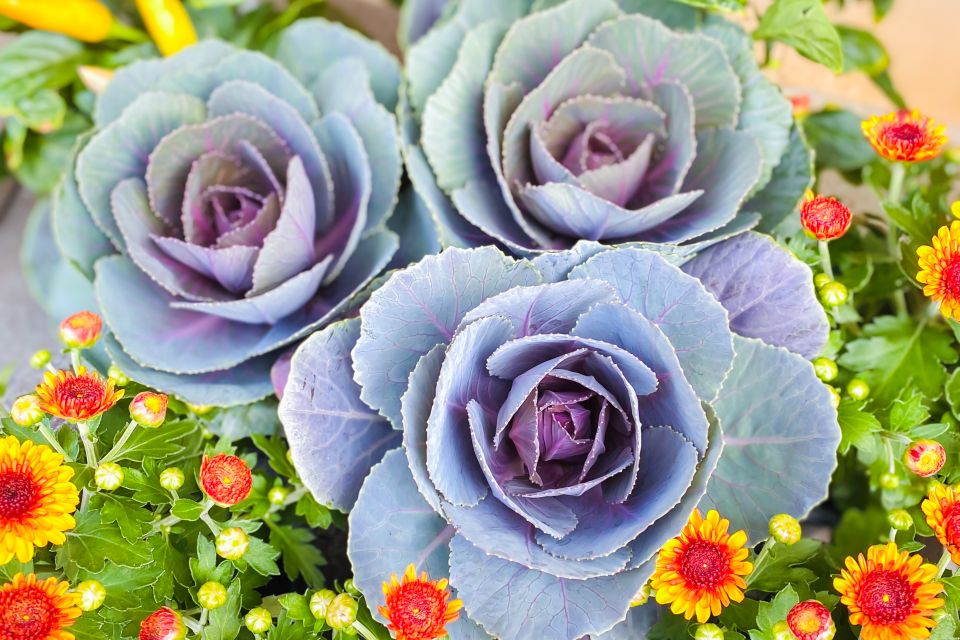
Fall annuals — mums, peppers, and cabbage. | Chalet Home + Garden
If a group includes plants that prefer moist conditions, such as queen of the prairie (Filipendula rubra), cardinal flower (Lobelia cardinalis), and mountain fleece (Persicaria amplexicaulis), the entire section could be watered once or twice a day more efficiently. Separating these moisture-loving plants from others would likely reduce unnecessary watering elsewhere, saving both water and labor in the process.
Managing Inventory Across Multiple Locations
Another consideration with this format is how inventory is distributed across the garden center. Contrary to current practice, a given cultivar does not necessarily need to have its entire stock in a single location. For example, the speedwell (Veronica prostrata) cultivar ‘Moon River’ could appear in a group focused on evergreen plants with winter interest and in a group highlighting groundcovers that form short, dense mats. In this scenario, inventory management becomes more complex, as a cultivar may appear to be sold out in one area while still available in another.
Despite this added complexity, placing cultivars in multiple groups can help illustrate just how versatile many plants are and encourage customers to see them in new ways.
Since I’ve never run a garden center, I don’t know how burdensome this type of reorganization might be to maintain. In some situations, however, it could prove easier to manage while also creating a more attractive and purposeful shopping environment.
Regardless, garden center owners who prefer traditional, alphabetized rows of benches can take comfort in knowing that persistent plant people like me are still likely to browse every offering, no matter how the plants are arranged.
Subscribe to eNewsletter
