


A Guide to Wood Substrates: The Viability of Hardwood Trees
 February 24, 2026
 Commercial wood fiber substrates have been produced primarily from conifer, or softwood, tree species since their introduction several decades ago. Globally, the most common softwoods used include pine (Pinus), spruce (Abies), and larch (Larix), which are widely grown for lumber, paper, and other forest products. In addition to their broad availability, conifers have proven well-suited for wood fiber production due to the chemical composition of their wood, including cellulose, hemicellulose, and lignin, which differ from that of hardwood or deciduous species.
While both conifers and hardwoods produce extractive compounds that can be phytotoxic to plants, conifer wood generally resists decomposition over time more effectively than wood derived from hardwood species.
Early Research on Hardwood Species
Past research in the U.S., dating back to the 1950s, evaluated numerous hardwood species for their potential use as substrate components. Many of these studies concluded that hardwoods either degraded too rapidly during crop production or contained phytotoxic compounds that negatively affected plant growth.
Interest in hardwood substrates remained limited until 2005, when researchers at Virginia Tech conducted trials to assess the suitability of several hardwood species commonly found in the eastern U.S. Species evaluated included black walnut (Juglans nigra), ash (Fraxinus americana), tulip poplar (Liriodendron tulipifera), black locust (Robinia pseudoacacia), red oak (Quercus rubra), red maple (Acer rubrum), white oak (Quercus alba), and sycamore (Platanus occidentalis).
Phytotoxicity and Rapid Decomposition
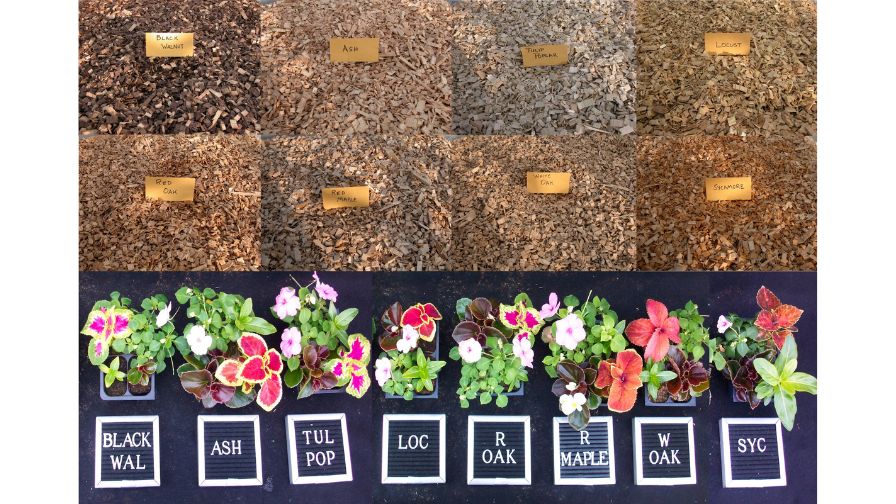
Figure 1: Eight hardwood tree species evaluated for use as wood substrate components. | Brian E. Jackson





Trees were harvested, chipped, and processed through a hammermill to produce wood substrates for plant growth trials using several annual bedding plant species (Figure 1).
Several hardwood species, particularly black walnut, black locust, and the two oak species, cause severe growth reductions due to phytotoxicity.
Across the short trial period of four to six weeks, substrates produced from all hardwood species showed accelerated decomposition, resulting in noticeable container shrinkage.
Performance of 100% Hardwood Substrates
These trials were conducted using 100% wood as the substrate. Additional experiments incorporating hardwood materials at 25% to 50% with peat improved overall performance, although plant growth reductions were still observed.
Research on these hardwood species was discontinued as parallel studies demonstrated that wood substrates produced from loblolly pine (Pinus taeda) showed greater promise as a viable substrate option.
Why Revisit Hardwoods Now?
Since 2005, interest in, commercialization of, and adoption of engineered wood substrates produced from conifer species have increased steadily. With an improved understanding of processing methods, preconditioning techniques, and crop management practices for conifer-based wood substrates, researchers have been able to revisit early assumptions about alternative wood sources.
In 2024 members of the Horticultural Substrates Laboratory at North Carolina State University (NCSU) initiated a series of projects to reexamine the potential of hardwood tree species as substrate components. These species represent a widely available and often underutilized forest resource.
Rather than evaluating individual hardwood species independently, the research team elected to test multiple species together to better reflect commercial realities. Unlike pine, hardwood trees are not typically harvested by species for substrate use.
In practical applications, hardwood materials are more likely to be sourced as mixed species, whether from forest thinning operations, storm debris, or land-clearing activities. Evaluating mixed hardwood substrates. therefore. provided a more realistic assessment of how these materials might be used in commercial production systems.
Stratified Container Trials Using Mixed Hardwoods
Four common native hardwood species, including sweet gum (Liquidambar styraciflua), red oak, white oak, and water oak (Quercus nigra), were harvested during winter dormancy, chipped as whole trees, and processed together in equal ratios through a hammermill to produce the wood substrate.
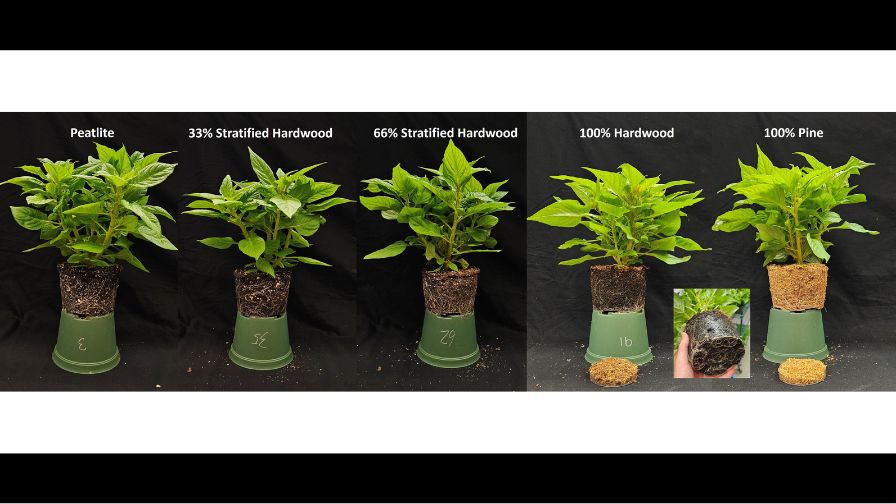
Figure 2: Celosia grown in containers, stratified with 33% or 66% processed hardwood in the lower portion, compared with 100% hardwood and pine substrates. | Andre Truter
The first project, led by NCSU graduate student Andre Truter, evaluated the hardwood material using a stratified container approach. Containers were layered with either one-third (33%) or two-thirds (66%) hardwood substrate in the bottom portion, with the upper portions filled with a peatlite mix consisting of 80% peat and 20% perlite.
Additional treatments included 100% hardwood and 100% loblolly pine substrates. Annual bedding plant species were grown for six to eight weeks under uniform fertility and irrigation conditions.
Crop Performance and Substrate Stability
Results from these trials showed promising growth responses in some species (Figure 2). Celosia, for example, exhibited no growth differences among the hardwood treatments when compared with the control substrate.
However, degradation of the hardwood material was clearly observed during the trial period. Root-ball evaluations showed that the hardwood substrate darkened from yellow to black within six weeks, while the pine substrate showed little visible change or decomposition.
Crop Response to Increasing Hardwood Content
Other species evaluated in these experiments showed reduced growth as the percentage of hardwood increased at the bottom of the containers. This response may reflect the effects of hardwood aging during storage between experiments, a species-specific sensitivity, or other physical or chemical limitations associated with the hardwood material. Despite these responses, the overall results were encouraging and suggest that hardwood components may be viable under certain production conditions.
Hardwood Dilution Within Pine-Based Substrates
A second series of experiments, conducted by Bret Timmons (Ph.D. student), evaluated the hardwood substrate at varying inclusion rates as a dilution within a pine-based substrate.
This approach was intended to simulate a commercial pine harvesting operation in which hardwood species present within the stand could also be harvested and processed together.
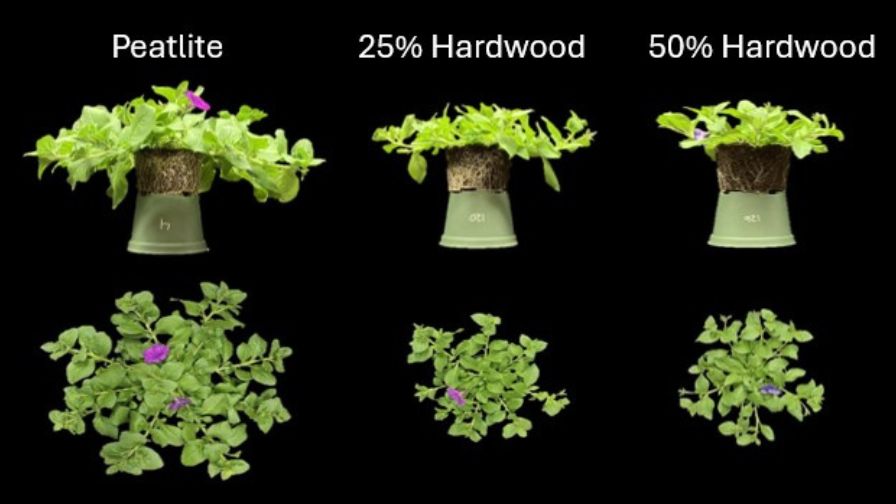
Figure 3: Petunia grown in peat-based substrate compared with substrates containing 25% and 50% hardwood incorporation. | Bret Timmons
Hardwood-pine blends were incorporated into a peatlite substrate at 25% and 50% incorporation rates and used in growth trials with several annual bedding plant species. Like the stratified container study, plant responses varied by species across the wood blends.
Figure 3 illustrates reduced growth of petunia at both incorporation rates of pure hardwood, indicating a high sensitivity to the hardwood material. Aside from reduced growth, no nutrient deficiencies or visual growth abnormalities were observed. Not shown are plants grown in pine-hardwood blends, which in several cases produced growth comparable to the control substrate, even at the 50% incorporation rate.
Implications for Commercial Substrate Use
These studies provide evidence that incorporating a portion of wood substrate derived from hardwood trees is feasible in container crop production. Ongoing research is focused on better defining threshold inclusion rates for hardwood components, either alone or blended with pine, that support acceptable crop performance. These thresholds will likely vary based on plant species, incorporation rate, production cycle length, and other management factors.
Scale and Industry Potential
Even if only 15% to 20% hardwood material can be successfully utilized, the potential impact is substantial. At a national or global scale, this would represent millions of cubic yards of widely available, low-cost substrate material. Parallel research efforts in Europe are also investigating the use of hardwood trees as substrate components. In addition, researchers in the U.S. and abroad are evaluating hardwoods processed through extrusion systems (screw processors) and defibrators (disc refiners), with promising early results. Currently, some growers in the U.S. are already sourcing and successfully incorporating hardwood-based materials into their production systems.

Make sure to check out Parts 1, 2, and 3 in this series covering wood substrates, and stay tuned for Parts 5 and 6!
Subscribe to eNewsletter