



Operations Focus on Sustainability With MPS Certification
 May 19, 2024
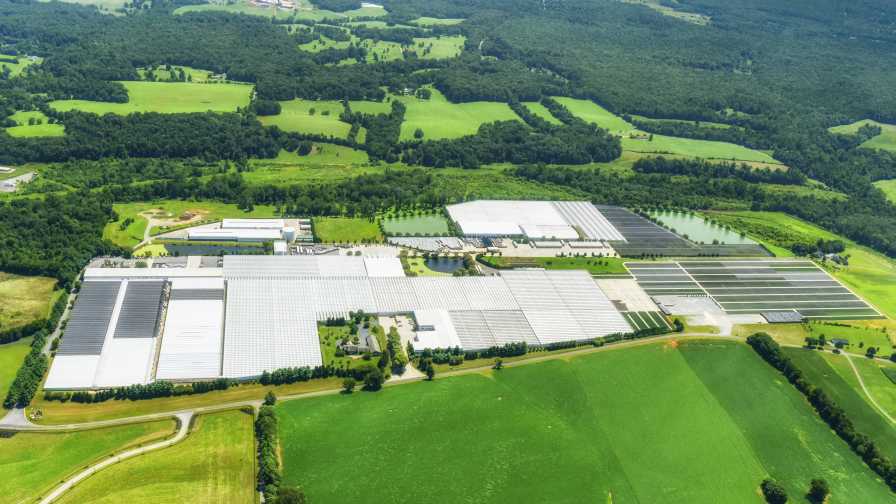
Annuals production at Costa Farms (L) and ebb and flow irrigation system at D.S. Cole Growers (R) | Costa Farms, and D.S. Cole Growers
Editor’s note: This is the first installment of a four-part series on MPS certification and sustainability.
Sustainability is more important now than ever. Some may view it as a buzzword — a marketing trend that people are interested in for now, but it will fade away eventually without any significant changes in the market.
Sustainability is hard to define. What exactly makes a business sustainable? A business could make enough revenue to sustain itself, or it could engage in practices that are sustainable for the environment. What about the employees and the community surrounding a business? Should the business operate to sustain them, too?
MPS says yes. MPS was founded 30 years ago with the cornerstone of being an organization for growers by growers, according to Area Manager Maik Mandemaker. MPS assists growers in measuring their inputs, such as fertilizer, crop protection, energy, and water use, and waste reduction.


“That’s the essence of what we do at MPS,” says Mandemaker. “We help growers see where they stand and how they could improve themselves to become more sustainable.”
By using an anonymous benchmarking system, growers can compare their data with other growers in their region who are growing similar crops. Growers can see if they are on the high end of the spectrum when it comes to pesticide use, for example, and make a plan for how to reduce their stats.
Of the growers that are MPS certified, most have the basic MPS-ABC certification, meaning they are reducing their environmental impact. Some also receive the MPS-GAP certification, which focuses on responsible cultivation practices, such as protective measures and storage of substances.
The European market is structured differently than the U.S. market, so growers in Europe may be a little more familiar with this program. The EU sets rules that apply to everyone, while the U.S. market is more fragmented. Initiatives on sustainability are driven primarily by the grower, not the government, says Frank Lammers, MPS Regional Coordinator for North America.
There is potential for growth in the North American market for improving sustainability practices. Mandemaker says that in the Netherlands, many growers are geographically close to each other and know what their competitors are working on. In the U.S., growers are spread far apart, which makes it more difficult to exchange information.
“That is different from the Netherlands, where you can see into the glasshouse of your neighbor,” says Mandemaker. “The advantage of what we do is that we give, in a digital way, the same type of information. As a grower, you can see what your theoretical neighbor is working on to reduce their energy use, crop protection use, and environmental footprint.”
It is difficult to make significant changes to the operation without first acknowledging where you’re at. For example, how could a head grower reduce her pesticide use by 25% without knowing exactly how much she uses now? This is where MPS comes in. By offering an anonymized benchmark platform that helps growers measure their inputs, the grower can take the next step of making informed decisions about how to be a more sustainable operation. The growers’ data and personal information are always secure. Lammers says MPS is not here to punish growers.
“That is not the case. There are ground rules and there is governance in place, but we do not hand out fines or transcend local legislation,” he says. “We just make things very transparent and provide aid so growers can see what the way forward is in terms of sustainability.”
Greenhouse Grower recently posted our 2024 Top 100 Growers list. Many of the growers on the list are MPS-certified, including Costa Farms.
‘Love Where You Work’ at Costa Farms
Costa Farms, No. 1 on Greenhouse Grower’s Top 100 Growers list, has been MPS-ABC certified on all of its sites since 2020. Its newest acquisition, Battlefield Farms, had been MPS-ABC and MPS-GAP certified prior to the acquisition.
While Costa Farms has invested in sustainability efforts for many years, Cesar Martinez, Senior Director of Environment, Health, and Safety for Costa Farms, says the certification conversation came up around 2015. His team knew that the business should better track sustainability, but were unsure of specific steps to take. After an MPS representative came to visit the farm, it was clear that joining the program was the right way to go.
“We knew it would get us pointed in the right direction so we could get a grasp of one of our biggest inputs and costs which is pesticides. We are also looking for alternatives for those,” says Martinez. “At that point, neonicotinoids were becoming a hot topic, so we had to manage those. Some of our big customers were asking, ‘What are you going to do?’ We floated this idea, and they supported it.”
Collecting data for an MPS certification is a team effort, so getting buy-in from your staff is critical. Some people may be on board simply with the idea of being sustainable and minimizing the operation’s environmental footprint. Others may see the value of an MPS certification with the potential savings on input costs. Martinez says consumer insights have driven the sustainability initiative, as well. For example, he has noticed many comments from consumers on Costa Farms’ social media posts that mention being “green” or “organic.”
“The customers say this is the way of the future, so get on the train and let’s go,” he says.
Costa Farms Environmental and Sustainability Manager Maria Giudici says the sustainability initiative has three components — natural resources, social responsibility, and financial stability. All three factors influence each other, and the team strives to improve each of these simultaneously.
Associate General Counsel Jorge Zamora says Costa Farms’ mantra is “Love where you work.” According to him, Costa Farms does not just want to be the best agricultural employer in Miami, it wants to be the best agricultural employer in the country.
“That’s an important part of what our human resources department focuses on and their contribution to being sustainable,” says Zamora. “We focus on the social impact on our people at work and outside of work, such as impacting their lives through education.”
In addition to Costa Farms’ MPS certification, the operation has initiated various other programs to offer education, healthcare, and personal and professional development to its team members (stay tuned for more information in a future installment of this series).
D.S. Cole Growers Paves the Way
D.S. Cole Growers in Loudon, NH, was the first greenhouse operation to be MPS certified in the U.S. President Doug Cole joined MPS in 2009. He learned about MPS from his trips to Europe, where MPS originated. While Cole was president of the Ohio Floricultural Association (OFA), MPS approached the board to see if OFA would be interested in working with MPS. Cole decided to be a guinea pig and take on the program at his own operation.
Cole says he joined the program because MPS would be helpful in interactions with his retail customers. An MPS certificate proves that the grower is engaging in sustainable production practices, which would interest his buyers.
“What starts in Europe often ends up coming this way when it comes to these types of programs, so I figured we might as well get on board,” says Cole. “I knew it would help us be a better grower and we’ll be ready when this type of program is more in demand. It has made us more cognizant of our practices.”
D.S. Cole Growers has always had sustainable practices in mind, such as recycling cardboard and plastic and reducing pesticide use. As a member of the MPS program, the operation can track exactly how much energy and fertilizer is used each month. MPS is focused on not just the amount of pesticide used, but more importantly, the type used. Cole says the goal is to be rated as an “A” level grower. MPS has ranked all pesticides based on their environmental impact. The grower is given a score based on the type of pesticide used as well as the volume.
“That’s what MPS is so good at,” Cole says. “They have the ability to measure these issues and benchmark us against others in our industry.”
With the MPS program, growers can compare and set realistic goals. For example, Cole says a grower may want to reduce chemical pesticide use by 5% every year. If you’re starting with many chemicals, that may be possible. If a grower is already using minimal chemicals, that goal is not always attainable.
“We benchmark against our peers and ourselves to see if we’re improving and how to compare,” says Cole. “Who else is better to compare to than companies doing the same thing?”
Once growers have collected data and measured various inputs, such as crop protection, fertilizer, water, energy use, and waste reduction, they can compare to other MPS-certified growers and learn from each other. The process of collecting data and benchmarking will be further discussed in the next installment of this series, which will be posted on GreenhouseGrower.com on May 25.
Subscribe to eNewsletter
