



Tips for Successful Poinsettia Production in 2025
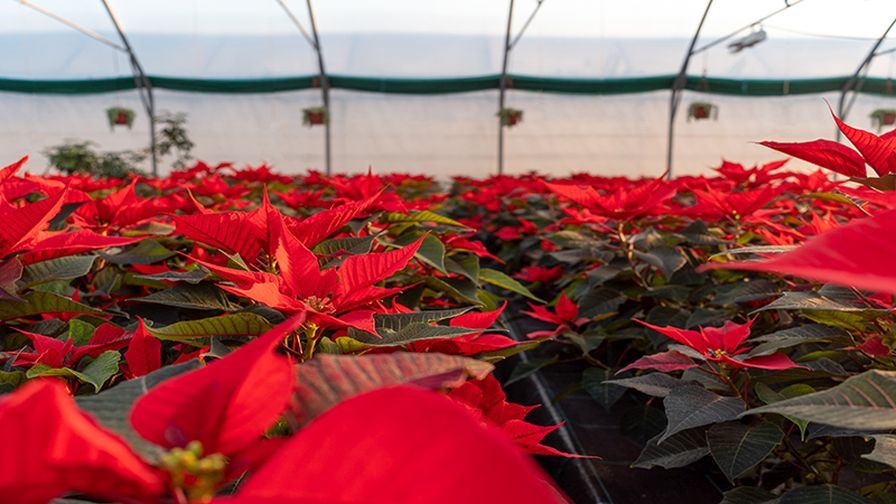
Closeup of red poinsettia flowers (Euphorbia pulcherrima) in greenhouse sunlight. | Corteva Agriscience
Even this early in the year, poinsettias are making their way into greenhouses across North America, and they always arrive at the hottest time of the year. Nutritional issues, environmental stress, and plant growth regulator (PGR) mistakes can all be costly in this high-value crop. Read on for production tips and how to manage this seasonal favorite in the greenhouse.
Only looking for certain information? Choose from the list below:
1. Nutrition
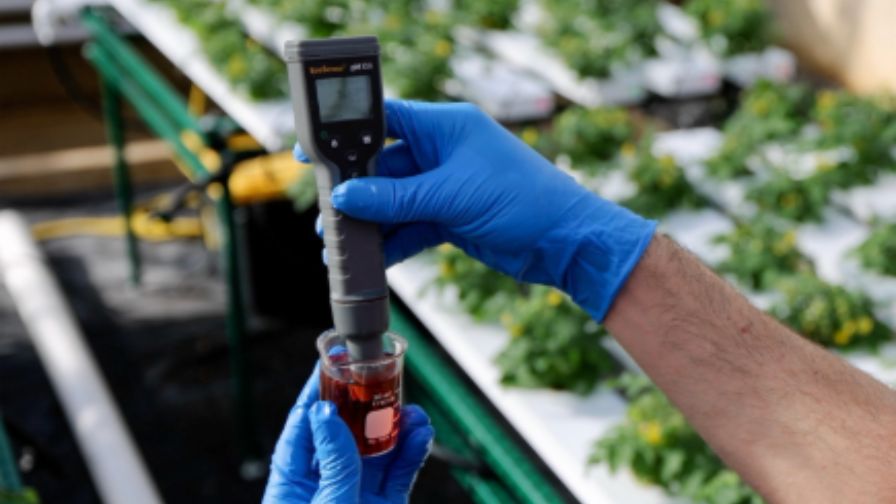
Poinsettia are picky eaters – the conditions need to be right for them to uptake fertilizer and avoid deficiencies. Maintaining a pH of 5.5 – 6.5 in the media and using fertilizer with a nitrogen concentration of 150 – 300 ppm will help you avoid most nutritional disorders.
It’s essential to start feeding early, about 10 days after sticking, to prevent lower leaf yellowing (nutrient deficiency) and to produce larger leaves at the bottom of the plant. Remember, the goal is to have a pyramid-shaped plant with large leaves on the bottom to create the appearance of fullness.


Control your leaf size by adjusting the amount of ammonia and phosphorus in your fertilizer mix. More will create a larger leaf, and less will create a smaller leaf. Ammonia is a type of nitrogen, but not all NPK mixes will have enough of the ammoniacal form of nitrogen. Ask your fertilizer sales rep for a detailed breakdown of your mix and consider choosing a mix where about 30% of the nitrogen is listed as “ammoniacal nitrogen”.
For phosphorus, 10% and above is considered a lot (so use less if you want smaller leaves), but you can go up to 20% if you are trying to significantly increase leaf size early in the crop. The flip side of using higher Phosphorus is that, besides larger leaves, your plants are also going to shoot up in size and risk becoming stretchy. It is imperative to increase your PGR applications accordingly when utilizing this strategy.
2. Managing the Greenhouse Environment
Heat Stress
Managing heat stress in the greenhouse in July and August is a difficult task, especially when dealing with young plants. However, with new genetics and recommendations, it has become easier to manage over the years. The key is recognizing how heat stress presents itself in the crop and having a few key tools in your back pocket to manage it when it inevitably happens.
Spacing
Pots that are too close together will have weak, elongated stems as the plant competes for light and resources with its neighbors.
Tight spacing can lead to uneven canopy expansion and contribute to disease and pest pressure in humid microclimates (including Botrytis, especially in 4-inch pots where spacing is usually tighter).
3. PGR Applications
Most newer poinsettia varieties and hybrids have been bred to have a compact, upright shape, so pinching and PGR application are perhaps not as critical as they were in the past (although every grower has their preference). PGR mistakes can be costly, so the more information a grower can gather before deciding to spray, the better.
Graphical tracking of plant development against your sales specs for height and diameter can assist in making height management decisions, whether they are PGR applications or DIF adjustments. To graphically track your crop over the season, measure and record the height of at least 10 plants of each variety that you grow weekly (different varieties may have different growth curves). Make sure to be consistent in measuring height from either the pot lip or the floor/benchtop. Indicate dates for any production changes or product applications and ensure the amounts and application methods of PGRs are noted as well.
4. Resources & New Recommendations
Remember how much of a pain poinsettias were to grow 10 years ago? 20 years ago? Too young to remember? Ask a seasoned poinsettia grower for their battle stories. Here’s the good news – over time, it has become a (slightly) easier crop to grow as researchers, breeders, and growers work together year after year to improve growing recommendations, genetics, and pest control. Capitalize on the hard work of our community by always keeping up to date with the newest recommendations.
Here are some for you to check out:
- 2025 Production Guide – Selecta North America
- Nutritional Monitoring – e-Gro
- Poinsettia Pests – ONfloriculture
For more information on each section listed above, including additional resource guides on poinsettia production and trials, please read the original article found on the ONfloriculture website.
Subscribe to eNewsletter
