




Need a Plan to Finish Thrips?
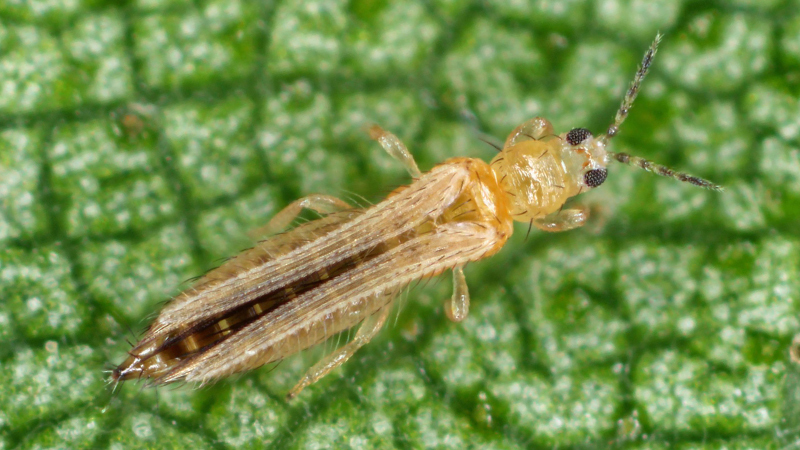
Thrips can be a huge problem in ornamentals grown under glass. Thrips field-grown pressure can vary by crop, management, and environmental conditions. There are more than 6,000 thrips species feeding on plants all over the world. More than one dozen species of thrips feed on greenhouse-grown crops in the US and Canada.
Knowing the life cycle of this pest and having a good rotational program is important for effective control. Adults and pupae typically overwinter in the soil. With rising temperatures,
newly emerged females insert eggs into the tissues of flowers, leaves or stems. Each female can produce up to 80 eggs, which hatch within days in warm weather or weeks to months in colder weather. They become wingless larvae (nymphs), which feed on plant sap. After two or more nymphal stages, many thrips drop to the soil to pupate then repeat the cycle. There may be 12-15 generations per year with the entire cycle from egg to adult requiring less than 16 days in warm weather. Thrips damage is related to their piercing and sucking feeding, which results in stippling, discolored flecking, bronzing, silvering, or curling of the petal or leaf surface.
Chemical management of thrips can be difficult to achieve because of species mobility, feeding behavior and the protected egg and pupal stages, as well as species-related efficacy. Product choices, improper timing of application, failure to treat the proper plant parts, and inadequate spray coverage are common mistakes that can prevent a life cycle break and effective control. When using chemical options, a multiple-application program targeting both foliar and soil life cycle management should be considered. For resistance management, it is important to rotate among different mode-of-action (MOA) groups. Application retreatment timing is dependent on temperature-related developmental time.
Luckily, Nufarm offers powerful insecticides with proven effectiveness on the even the most threatening pests. Nufarm recommends the following example of a rotational treatment program when thrips are present and active.
- Week 1 – TriStar® tank mixed with IGR such as Pedestal® or Azadirachtin as a spray
- Week 2 – Overture® as a spray
- Week 3 – Tame® [or bifenthrin] as a sprench for soil stage
- Week 4 – Minx™ 2 or Conserve® or Pylon® as a spray can be added to this rotation where multiple pest pressures exist
For additional information about Nufarm and their insect and mite solutions, visit Nufarm.com/usturf/insect-solutions. Attending Cultivate? Stop by the Cultivate Live stage Sunday, July 16 at 10am to hear Nufarm Technical Development Manager Rick Fletcher discuss thrips: the old and the new.