




Why plants prefer coir, and growers as well
To understand why coconut fiber is a special growing medium from an agronomic point of view, it is important to analyze the differences between a soil crop and a coir crop and compare the main factors that generate stress at the root level.
The behavior of a plant is generally influenced by the micro-climate in the greenhouse and the rhizosphere where it develops explains Juan Manuel García, Product Manager at Projar, “therefore, using the highest quality coir fiber as a base will allow the maximum vegetative and productive response of the crops”. Micro-climate conditions will always be common in any productive system, whether soil or hydroponic, therefore, we must look for differences at the root level.
We consulted Projar, one of the greatest proponents of this type of crop, and they the five types of stress that a root system can suffer:

Water stress
The absorption of water by the root is affected by two forces. On the one hand, the matrix potential is the force with which water is retained by the root system. On the other hand, the osmotic potential is generated due to the ions dissolved in the medium (salinity).
In a soil crop, once the water balance is reached after irrigation and field capacity, a water retention force is produced higher than that found in coconut fiber. These values are 5-30 KPa for soil and 1-5 KPa for coconut fiber.
According to these values, we can affirm that a plant grown in coir will need to make a lower energy expenditure compared to a plant in soil to absorb the same unit of volume.
Salinity stress
This type of stress negatively affects water absorption. In soil, ion mobility is strongly affected by two reasons: CEC (Cation Exchange Capacity) and the chemical complexity of the soil itself. In an organic substrate such as coconut fiber, the cation-type ions are more mobile, and the CEC is occupied by Calcium cations. In this case, the salts accumulated on the substrate can be easily washed away. Therefore, it is possible to maintain a stable level of salinity, which does not happen in a soil.
Stress due to oxygen deficiency
The root needs oxygen to breathe, absorb water and nutrients, and perform other metabolic activities. The pore space is the proportion of the total volume that a substrate has when it has been saturated with water and has drained. The porosity in coir is high and coarse enough to allow air to occupy a minimum of 30-35% of the total volume immediately after irrigation. With this we assure the root the oxygen it needs without having to endure periods of waterlogging as occurs in a soil.
Temperature stress
The root is highly dependent on temperatures both in its biological activity, development, and growth, as well as in its functional activity. The thermal inertia of coir, being of organic origin, is quite high and guarantees greater temperature stability in the root environment.
Stress due to pathologies
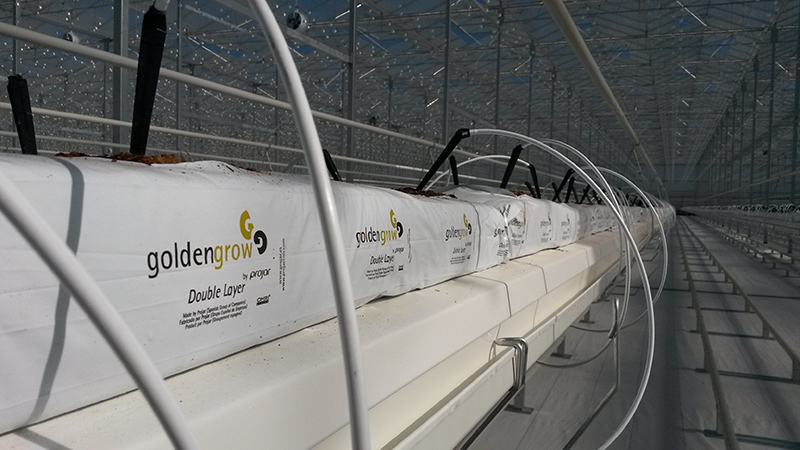
The risk of root diseases is enhanced in soil crops. The soil is a continuous medium as there are no insulating barriers between a diseased plant and its neighbors. The cultivation in coir with isolated units is much better arranged to avoid infections due to the difficulty of the spread of the disease.
Projar, with more than 35 years of experience in the market, has created an advisory manual on the basics of growing with coir, which are the crops that are best adapted to hydroponic cultivation and the rapid return on investment in this system cultivation.
You can download the manual for free from this link: