




Biologist Organizes Public Gardens to Protect against New Invasive Species
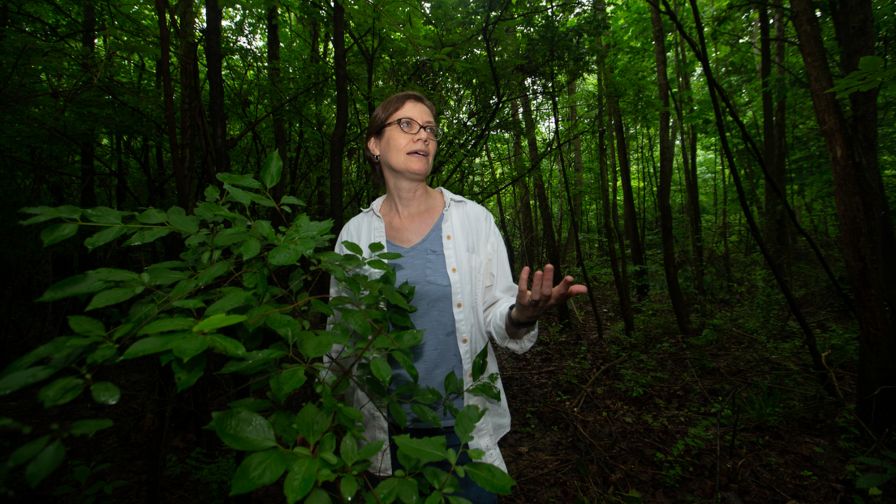
University of Cincinnati Professor Theresa Culley at the Harris Benedict Nature Preserve | Joseph Fuqua II
A botanist at the University of Cincinnati is helping to organize public gardens across North America to develop an early warning system about non-native plants that could threaten agriculture or wild spaces.
UC College of Arts and Sciences Professor Theresa Culley is an expert on invasive species who advises federal agencies and states such as Ohio about the economic threats posed by non-native plants.
She has assembled a network so far of 54 public gardens in Canada and the U.S. to share information about non-native, potentially invasive species they are finding in and around their properties. To date, the public gardens have reported nearly 1,000 examples that gardens are monitoring.
“The purpose is to get gardens talking to each other about plants they deem to be problematic,” says Culley.
“If you look at effective invasives, by the time they spread, it’s too late. People are spending a lot of money today to get rid of honeysuckle, for example. The idea is to use public gardens as sentinels for plant invasion so we can avoid having to spend so much money and time getting rid of these plant invaders.”
Invasive species are a leading cause of biodiversity loss around the world. The Invasive Plant Atlas of the United States identifies more than 1,400 trees, shrubs, grasses, and other foreign plants growing in natural areas. Invasive plants and animals cause an estimated $120 billion in damage and economic losses each year, according to the U.S. Department of the Interior. The agency spends more than $140 million per year addressing invasive species to try to mitigate or prevent these losses.
The agency says that preventing new invasive species from taking hold is a far more cost-effective strategy than trying to remove species once they’ve been established.
You don’t have to look far to find examples of problem plants.
Callery pear trees were introduced to the United States as fast-growing ornamental trees with pretty spring blooms. The first cloned variety was sterile, but once other varieties were created with sturdier trunks that were less likely to split, they began to cross-pollinate and produce fruit. Soon, these trees escaped cultivation and began showing up in forests and highway edges across the Midwest.
Amur honeysuckle was a favorite landscaping bush for yards across the U.S. and to prevent erosion along roadsides. But this bush from China leafs out earlier in the spring than other plants and stays green through the early winter. As a result, its leaves often shade out other ground covers. And birds spread its red berries far and wide.
The new UC collaboration is already sharing useful information.
Some public gardens are reporting that the Amur cork tree, an import from East Asia, is starting to show up in more wild places. Its roots have allelopathic properties that can suppress the growth of other plants to wage chemical warfare, which gives it a competitive advantage.
As a result of the public garden collaboration, some last year shared an alert with landscapers and nurseries urging them to sell only non-fruit-bearing Amur cork trees in a bid to stem the wild expansion.
Kurt Dreisilker, Head of Natural Resources and Collections Horticulture at the Morton Arboretum in Lisle, IL, has helped to organize the gardens network. He says it’s useful for public gardens to know what other gardens are seeing across the country.
“Sometimes those species may not be known as invasive so the network can get the word out ahead of time before plants become invasive,” says Dreisilker.
Gardens might be especially vigilant when they see potential problem species pop up nearby or at multiple gardens. “I absolutely do think this network holds promise to help prevent plants from becoming invasive,” he says.
Culley says what makes public gardens good sentinels is the botanical expertise they offer along with typically extensive recordkeeping. “The gardens are called living collections. They know where each plant is from and whether it is producing fruit,” she says.
Public gardens also can be a bellwether for the gradual creep of some species that are taking advantage of a warming climate to move north into states where winters historically have been too cold for them. Culley says she is optimistic that public gardens will be a useful source of information for park and refuge managers nationwide.
“There is a lot of hope, but it requires everyone working together,” she says.
Subscribe to eNewsletter