



Two Longtime America in Bloom Supporters Reflect on 25 Years
 June 23, 2026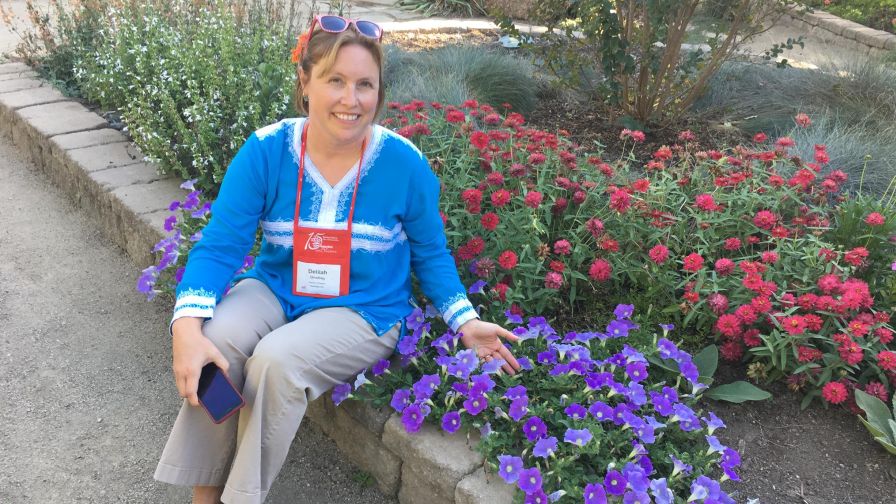
Delilah Onofrey at the 2016 AIB symposium; photo: Delilah Onofrey
Greenhouse Grower’s June 2026 cover story features a closer look at the past, present, and future of America in Bloom. Two of the earliest champions of America in Bloom were Delilah Onofrey, the former Editor of Greenhouse Grower and current Marketing Director at Suntory Flowers, and Dr. Marvin Miller, Market Research Manager for Ball Horticultural Company, who has been engaged with America in Bloom from the beginning and has served on the AIB Board of Directors for 25 years. Keep reading for insights and reflections from Delilah and Marvin on the legacy that America in Bloom built and is continuing to build.
Starting Local, Growing Nationally
“Greenhouse Grower magazine was an early advocate and champion for launching America in Bloom (AIB). As editor, I proposed a Bloom City USA modeled after the Arbor Day Foundation’s Tree City USA. At the same time, Raymond Carriere of Canada’s Communities In Bloom approached Bedding Plants International, an industry organization that was looking for a new mission.
I volunteered to help lead the charge. Before coming to Greenhouse Grower, I was a newspaper reporter for a small daily paper and could see the potential for a grassroots initiative. I wrote about the city of Ravenna, OH’s streetscape program and its efforts to become a Tree City, and I could see hundreds of towns doing it.
With a national magazine, we had the perfect platform to rally the industry to raise funds and recruit towns to be in the program. We published “Planting Pride” supplements that growers and retailers could take to City Hall. I met with the mayors of Willoughby, OH, where I worked, and Westlake, OH, where I lived, and those towns were among the first 38 entrants. Ohio was so well represented that we hosted the 2005 AIB symposium in Cleveland.
For 25 years, I’ve felt like a proud mother watching more than 400 towns bloom, from Echo, OR, with a few hundred people to big cities, like Chicago. The beauty of America in Bloom is how actionable it is. You can start with a dozen planters on a few blocks in a commercial district. It’s the opposite of blight, contagious in a good way. Never underestimate the power of petunias! You want to get to the point where residents would be upset if their beautiful hanging baskets went away.
The AIB model also brings people together who care about the town but are acting in different silos, whether that be the chamber of commerce, historical society, parks and recreation department, or environmental groups. When they compare notes, they realize they are doing a lot and can achieve even more. So many towns have used reports from AIB advisors to pursue grants. It becomes a real catalyst for positive change. It’s an opportunity for communities to take charge of their destinies and create better places to live, work and play. You might not be able to change what’s going on in the world, but you can make a difference at home. AIB is a cost-effective way to do that.
Bringing the Benefits of Plants to All Communities
When industry folks first came together to talk about a program that became America in Bloom, it was spawned by the awareness of similar beautification programs in Europe that went back decades, and a newer program that had recently started in Canada. Indeed, in France, there were competitive programs aimed at beautifying train stations and hotels that began in the early 20th century, and more organized national beautification efforts that pre-dated World War II. It was President Charles de Gaulle, who wanted cities and towns to brighten their surroundings, that led to the establishment of Villes et Villages Fleuri in 1959. Tidy Towns of Ireland, aimed at recognizing the tidiest cities, towns, and villages in Ireland, began in 1958, and does incorporate horticultural beautification in its mission. Britain in Bloom dates from 1964. And Ententes Florale, which began in 1975 as a competition between British and French cities, now includes cities from about a dozen European countries. Finally, Canada’s Communities in Bloom, which began in 1995, had created a more recent awareness of the beautification programs around the world.
From the beginning, AIB has included embracing the “Power of Plants” into its mission. We knew about many scientific studies that had proven the environmental, economic, and health and well-being benefits of plants and about both the active and passive relationships people can have with plants. People who take a walk in the woods or even in a park or garden feel rejuvenated, but even those who don’t embrace this kind of activity still benefit from the oxygen that plants make. We wanted to share those messages with America, one community at a time!
When we look at environmental benefits, we often begin with the oxygen plants make. But we soon turn to pollution and talk about the remediation plants can assist with when soils are contaminated, or the filtering plants can provide when waters need improving, the screening plants can provide for light pollution, and the job that trees, shrub and lawns can do to ameliorate air pollution by screening contaminants from the environment. Plants can provide sound barriers along busy city streets or highways. Positioned correctly, plants can help reduce energy needs for homeowners, while providing shade in the summer and/or windbreaks in winter. And the list of environmental benefits goes on and on.
The discussion of economic benefits begins with attracting tourists and businesses to cities and towns, shoppers to shopping districts, and people to neighborhoods. We know that people will pay a premium for housing that faces parks, and property values increase when homes are beautifully landscaped. People like to visit well-landscaped areas, and businesses like to locate where people are circulating. Historically, plants were used to acclimate consumers to shopping indoors when malls were first built in the 1970s and 1980s. And plants are now being used to woo consumers to return to downtown shopping districts, reviving blocks of once-abandoned storefronts into thriving economic centers.
During the pandemic, the health and well-being benefits of plants came to the forefront for a lot of people. The industry welcomed millions of new gardeners. National parks saw an initial drop due to closures, but beginning in late 2021, many parks have experienced several years of record attendance, sometimes leading to overcrowding concerns. But the health and well-being benefits are also very local and very individual. People do better cognitively when plants are around them. Children perform better in school when the classroom includes plants. Attitudes are brighter when people take a break in nature. Plants help reduce crime. And as author Rachel Carson pointed out in her last book, The Sense of Wonder, children exposed to nature will create a curiosity that can propel them for the rest of their lives.
We have shared these Power of Plants stories, one way or another, at every AIB Symposium, in almost every AIB newsletter, and in each visit to the cities in the program for our 25-year history. They are included in the books we’ve published where cities in the program have told of their successes over the years. And they serve as points of pride for all that have been engaged with America in Bloom for the last quarter-century. We thank those in the industry who have helped to sponsor our efforts and welcome all to help us grow the program for the next 25 years!
Subscribe to eNewsletter
