



H-2A Program Sees Massive Growth in First Half of 2026
A MarketIntel report on H-2A Program growth in fiscal years 2025 and 2026. | American Farm Bureau Federation
As growers across the country struggle with a domestic labor shortage, use of the H-2A temporary agricultural worker program continues to grow. With more than a quarter million positions certified through the first half of fiscal year 2026 (October 2025–March 2026), the program is already tracking well ahead of every prior first half on record and on pace to surpass 2025’s full-year total.
Huge Q2 for H-2A Certifications Results in Record First Half
Annual H-2A certifications have climbed in every fiscal year since 2012, with the first half of fiscal year 2026 already outpacing the entire first half of every prior year. Growth in H-2A job certifications was slower in fiscal years 2023 and 2024, which can be partially attributed to a costly 2023 disaggregation rule that required farmers to break job duties into separate applications and pay employees for jobs they might not always perform. The rule was vacated by a federal court in August 2025, leading to a sharp acceleration in demand for authorized workers via the H-2A guest worker program.
The second quarter of fiscal year 2026 had 192,000 positions certified, a 20.5% jump over the second quarter of fiscal year 2025 (159,554) and the highest single-quarter jump on record. Quarter one of fiscal year 2026 also posted a gain, reaching 62,367 — up 7.1% from the first quarter of fiscal year 2025. Together, the first half of fiscal year 2026 totals 254,688 certified positions, a 16.9% increase over the same period last year and 19.2% above fiscal year 2024’s first half. The certification rate has held steady throughout, with 97.6% of requested positions receiving approval in the second quarter of 2026, consistent with the 97%+ rate seen in every year since 2021.
Broad H-2A Usage Gains Across the Country
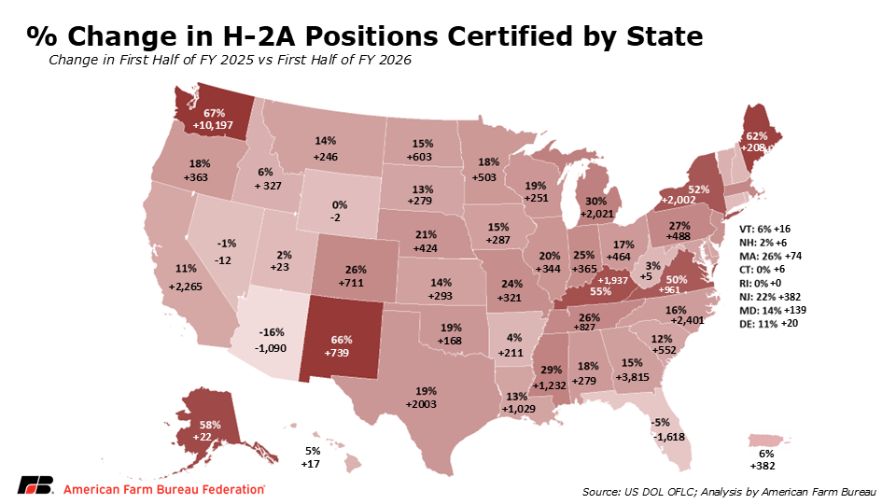
Photo: American Farm Bureau Federation
The growth story is not confined to any one region. As the state-level map illustrates, the vast majority of states posted positive first-half changes from fiscal year 2025 to fiscal year 2026, with an overall average national increase of 5.7%. While a handful of states in the Southeast and along the West Coast saw modest declines, 43 of 50 states expanded their H-2A use during the first half of fiscal year 2026.
Among the states with the highest totals of certified H-2A positions, Washington posted one of the most striking gains, with first-half certifications rising 67.2% year-over-year, from 15,171 in the first half of fiscal year 2025 to 25,368 in the first half of fiscal year 2026. Georgia also had strong growth (+15.3%), while Florida, despite remaining the top state in overall certifications, posted a modest first-half-of-the-year decline of 5.1%. Florida’s pattern, however, is consistent with prior years: its certifications are heavily weighted toward the third and fourth quarters, when peak harvest labor is concentrated, making first-half-of-the-year comparisons less representative of its full-year trajectory. Through the first half of fiscal year 2026, Florida had certified 30,044 positions, already 52.8% of its full fiscal year 2025 total of 56,934.

For more information on the current state of the H-2A Program, including a look at the five states with the most H-2A activity, please read the original article from Cameron Castino on the American Farm Bureau Federation website.
Subscribe to eNewsletter